Hi, what do you want to do?






Curated OER
Stop Pulling My Bot Around!
Students investigate the relationship between work and mechanical advantage. In this physics lesson plan, students calculate the work and efficiency of pulleys. They identify the different types of pulleys.

Curated OER
Galvanometers
Students construct their own galvanometer. In this physics lesson, students explain how it is used to detect electric current. They conduct an experiment to measure how much electricity flows through the circuit.

Curated OER
Our Desert Backyard
Students make observations of their own backyard. In this environment instructional activity, students keep records of the plants and animals they see in their home or school yard. Students make notes of how the weather and environment...

Curated OER
The Lost Newton's Laws Lesson
Students explore momentum. In this physics lesson, students perform an experiment in which two balls are released on slanted boards while students observe which ball will go the farthest and the fastest. Students define and explain...

Curated OER
Mass: Applying and Interpreting
Students rotate through six studying stations solving problems that involve applying and interpreting aspects of mass. They solve various word problems, and measure the contents of cans and calculate the mass of two cans.

Curated OER
Toting the Log and Lifting the Babe
Students use simple machines that demonstrate force, friction, work and power. They investigate and explain simple machines.

Curated OER
School Neighborhood Walking Tour
Students list specific boundaries in their school neighborhood and explain their possible purpose. They examine a neighborhood and see what connects us and what divides us. They, in groups, make maps of various neighborhoods and present...

Curated OER
The Sun as the Driving Force of the Water Cycle
Students study the water cycle and how the sun is an important factor. In this water cycle lesson students investigate how to desalinate water and explore the different densities of fresh versus saltwater.

Curated OER
Density
Students determine the density of different substances. In this physical science lesson, students rank them according to their density. They discover the relationship between volume and density.

Curated OER
Newton's Third Law
Learners use inquiry and observation to explore Newton's third law of motion: for every action there is a reaction. In this physics activity, students rotate through six stations set up with materials and picture directions illustrating...

Curated OER
Inclined Plane
Students using clay and a toothpick, shape the clay into a "mountain" upon which they make a road that is the shortest in distance. They measure the length of their road and then make a road that is the longest in distance without...

Curated OER
Making Sense of Density
Young scholars identify the concepts of density, mass, and volume that define the property of a substance. They also determine that the properties of materials, such as, density and volume, can be compared and measured by using rulers,...

Curated OER
Buoyant Force
Students illustrate Archimedes' Principle of Buoyant Force. In this graphing activity, students will observe that the buoyant force on an object is equal to the weight of the fluid it displaces. Students will then create a graph showing...

Curated OER
CD Slide
High schoolers identify the different types of friction. In this physics lesson, students explain how weight affects friction. They calculate normal force and coefficient of friction using a mathematical formula.

Curated OER
Butterfly Round-Up
Learners classify the characteristics of butterflies and moths moths. In this life cycle lesson, students identify butterflies and moths common in the state of Iowa as well as their characteristics. Learners then learn the proper...

Curated OER
Necessary Nitrogen
Students view a video that presents the biogeochemical cycle of nitrogen. They compare types of soils and consider how different fertilizers affect soil composition.

Curated OER
How Much Does a Bear Weigh?
Students estimate how many children in their class it would take to equal the mass of one adult bear. They then weigh and record their measurement on a chart to check their estimate.

Curated OER
Biodiversity in Our Watershed
Eighth graders create a database of animals and birds in the area in which they live. They use molded prints to make a cast of an imprint from a specific animal. They identify and research animals and prepare an outline for an oral...

University of Colorado
University of Colorado: Ph Et Interactive Simulations: Masses & Springs
Hang various mass weights on spring scales while you adjust the spring stiffness and damping in this online activity. Slow down the action, take it to another planet, or watch the amount of potential, thermal, and kinetic energy.
TeachEngineering
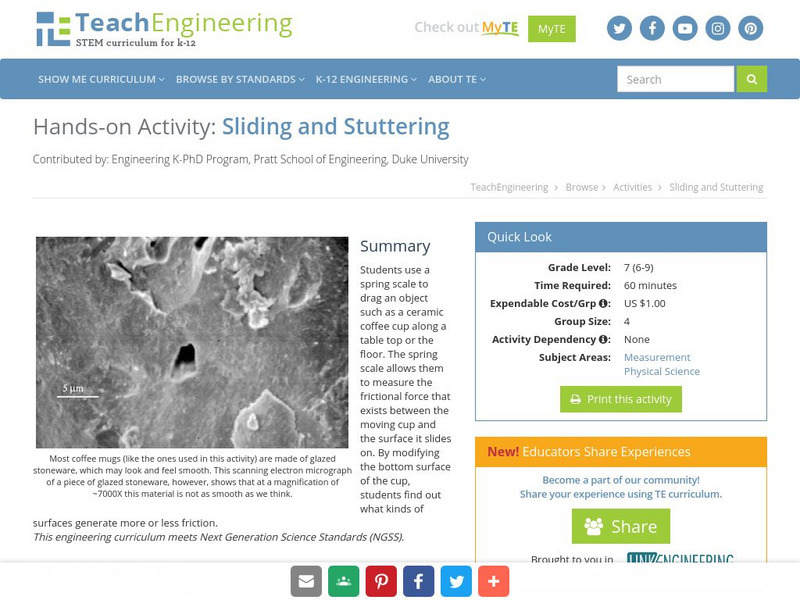
Teach Engineering: Sliding and Stuttering
Students use a spring scale to drag an object such as a ceramic coffee cup along a table top or the floor. The spring scale allows them to measure the frictional force that exists between the moving cup and the surface it slides on. By...
TeachEngineering
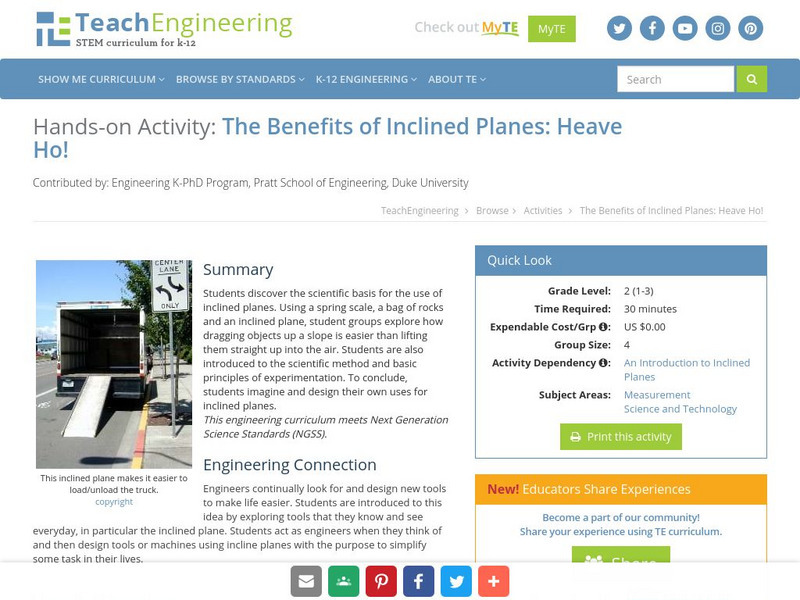
Teach Engineering: Heave Ho!
Students will discover the scientific basis for the use of inclined planes. They will explore, using a spring scale, a bag of rocks and an inclined plane, how dragging objects up a slope is easier than lifting them straight up into the...

TeachEngineering
Teach Engineering: Hanging Around
Students learn about weight by building a spring scale and observing how it responds to objects with different masses.
TeachEngineering
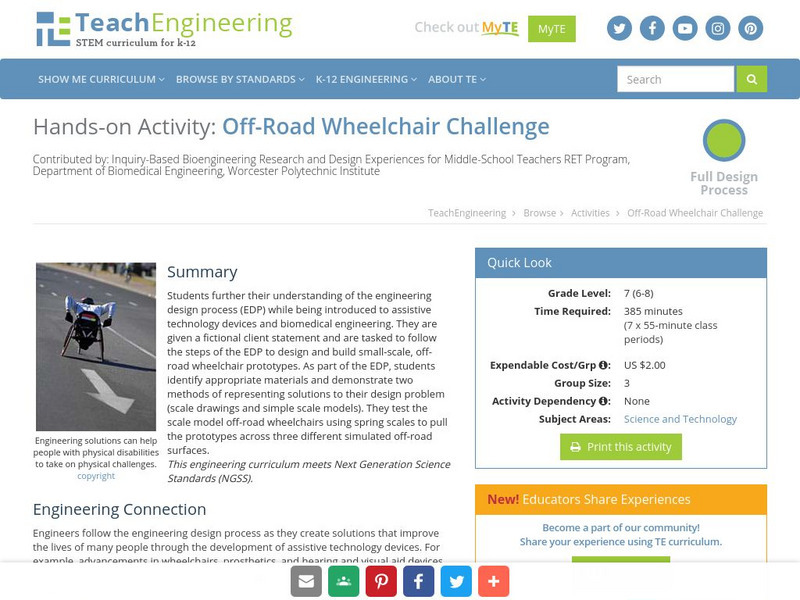
Teach Engineering: Off Road Wheelchair Challenge
Students further their understanding of the engineering design process (EDP) while being introduced to assistive technology devices and biomedical engineering. They are given a fictional client statement and are tasked to follow the...

TeachEngineering
Teach Engineering: Mechanics Mania
Through ten lessons and numerous activities, students explore the natural universal rules engineers and physicists use to understand how things move and stay still. Together, these rules are called "mechanics." The study of mechanics is...