Hi, what do you want to do?






Magic of Physics
Rotating Sky
Ever found it difficult to observe the night sky with pupils because school takes place during the day? Host a stellar lesson using a detailed night sky interactive! Scholars view the apparent rotation of the sky from the comfort of the...

American Museum of Natural History
Planetary Mysteries
A website all about planetary mysteries—it's a one-stop-shop for all things, stars, planets, and space travel. Scholars read an astronomy overview to discover the page's big ideas, then choose from the plethora of resources, including...

American Museum of Natural History
What is Astronomy?
Go study the universe. Pupils learn seven aspects about astronomy and astronomers. They begin to learn about constellations; distance and motion between objects; gravity; the electromagnetic spectrum; dark matter and energy; and teams of...

American Museum of Natural History
How Did the Universe Begin?
The Big Bang Theory is more than a television show. Pupils read how Edwin Hubble observed other galaxies and noticed that the galaxies are moving away from each other. Scholars learn about the idea of the big bang and what happened next...

Weber State University
The Sun and the Seasons
Why is there more daylight in June than in December if you live above the equator? How does the angle of sunlight shift throughout the year? Answer these questions and more with an interactive article about the sun, its path through the...

Curated OER
ESL Colors Activity
In this ESL colors worksheet, students watch a video titled "The Colors of the Earth," then choose the correct colors to describe pictures and the correct animals being described.

Curated OER
Reading and Comprehension: UFOS
In this interactive reading comprehension worksheet, learners read two short entries about UFOS. They match the text with the pictures that go with the story and write the letter in the box at the end of each. They enter their...

Curated OER
Levels of Ability
In this levels of ability activity, students fill in the blanks to sentences with the correct forms of can, could, be able to, may, or might. Students complete 13 multiple choice questions.

Curated OER
ESL: Commonly Confused Words
In this ESL commonly confused words learning exercise, learners fill in blanks in sentences, selecting the appropriate word from choices given. Students may click on an answer button for immediate feedback.
Other
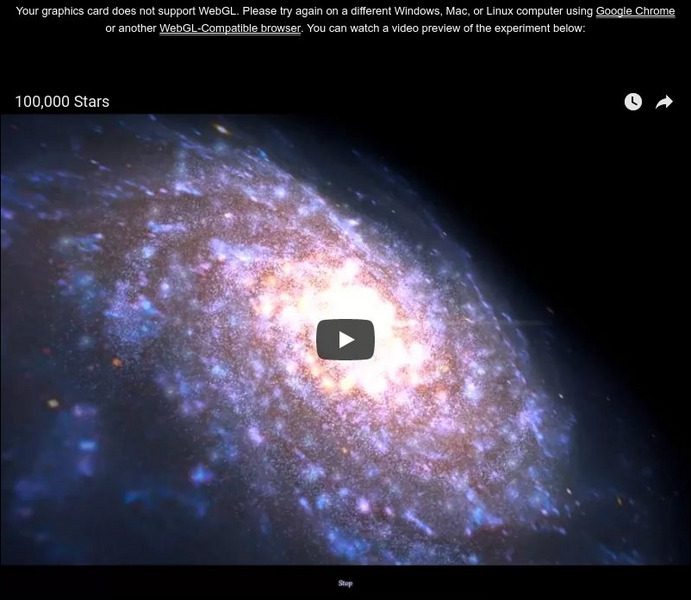
Chrome Experiments: 100,000 Stars
Zoom in and out to explore our galaxy in this interactive 3D visualization of the stellar neighborhood, including over 100,000 nearby stars.

American Museum of Natural History
American Museum of Natural History: O Logy: Stuff to Do: Stargazing
Get started on the road to becoming an expert stargazer by following these recommendations for identifying stars, planets, and constellations. Includes an example of a journal that can be used as a record of your investigations.
American Museum of Natural History
American Museum of Natural History: O Logy: A Closer Look at Mars
If you look up at the sky on a clear night, you may see a red dot among the stars. This dot is Mars, named in ancient times after the Roman god of war. Although no one has ever visited this red planet, we know a lot about it. This site...