Hi, what do you want to do?






Khan Academy
Khan Academy: Seismic Waves and How We Know Earth's Structure
This video illustrates and explains how seismic waves function. These waves are broken down into two types: surface and body. Take a look into why waves help understand the structure of Earth. [8:38]

Khan Academy
Khan Academy: Plate Tectonics: Structure of the Earth
Explains in more detail the different layers that make up the structure of the Earth. [9:33]

PBS
Pbs Learning Media: Crash Course Astronomy: The Earth
Learn all about planet Earth, from the composition of its internal structure and core, to its shifting continental plates, and placement in the solar system. We take a tour of Earth's inner and outer core, the origins of the planet's...

NASA
Nasa: Interconnection of Earth's Systems
This video clip explains what a system is and what happens when one part of a system is changed or altered (1:22).
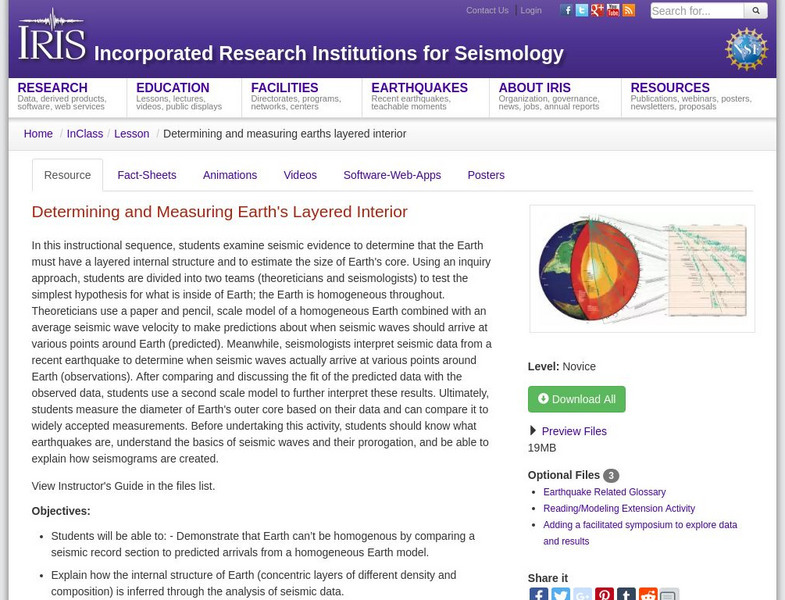
Incorporated Research Institutions for Seismology
Iris: Determining and Measuring Earth's Layered Interior
In this instructional sequence, students examine seismic evidence to determine that the Earth must have a layered internal structure and to estimate the size of Earth's core.

Khan Academy
Khan Academy: Tree of Life: Agriculture Rocks Our World
A video showing how change in the Earth's climate 14,000 years ago led to the development of agriculture. Learn how this development provided more food to feed a larger population, changed the social structure of communities, led to the...
Annenberg Foundation
Annenberg Learner: Earth and Space Science: Journey to the Earth's Interior
Material to begin an exploration of the Earth's interior. An hour-long video is accompanied by learning goals, an outline and overview, details on igneous rock, seismic waves, and the Earth's layers, and ideas for teaching this unit in...

Khan Academy
Khan Academy: Seismic Waves and Earth's Structure: Refraction of Seismic Waves
Explains how any type of wave can be refracted, and how this applies to seismic waves and to our understanding of the Earth's structure. [9:21]
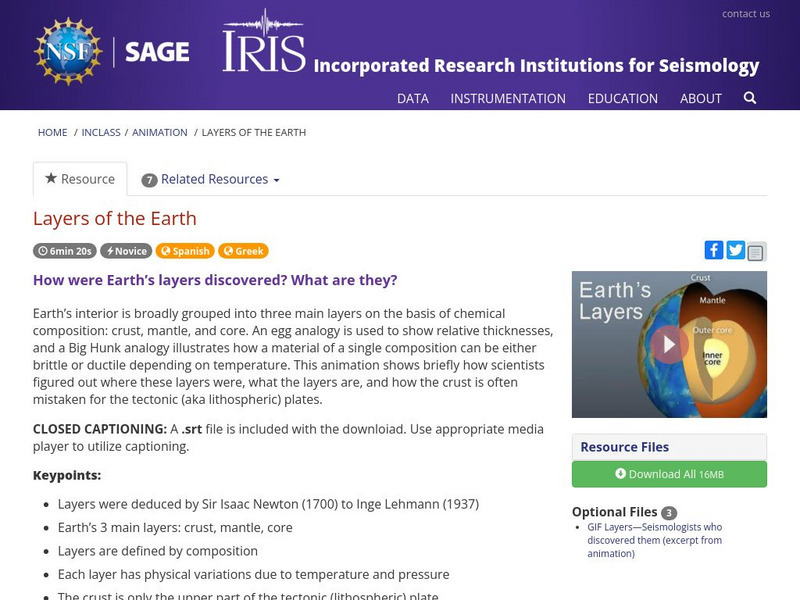
Incorporated Research Institutions for Seismology
Iris: Layers of the Earth
This animation explores the 3 main layers of the Earth and tells how they were discovered, what they are, and how the crust differs from the tectonic (lithospheric) plates. [6:20]
PBS
Pbs Learning Media: Diamonds Everywhere
This Nature video offers an introduction to the socio-economic value of diamonds. [1:45]
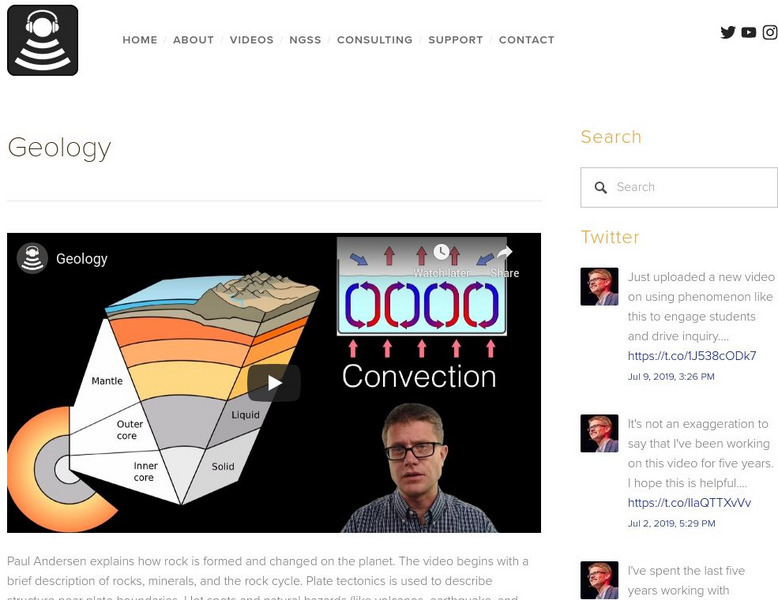
Bozeman Science
Bozeman Science: Geology
Paul Andersen explains how rock is formed and changed on the planet. The video begins with a brief description of rocks, minerals, and the rock cycle. Plate tectonics is used to describe structure near plate boundaries. Hot spots and...
PBS
Pbs Learning Media: Ingredients for Life: Carbon
This video segment adapted from NOVA illustrates why carbon is at the center of life on Earth. It also asks whether carbon-based life might exist on other planets. [1:38]

Khan Academy
Khan Academy: Protein Synthesis in the Cellular Factory
Take a tour of where protein synthesis happens in this video. Learn about RNA's history and how it has evolved since the origin of life on Earth. [3:56]
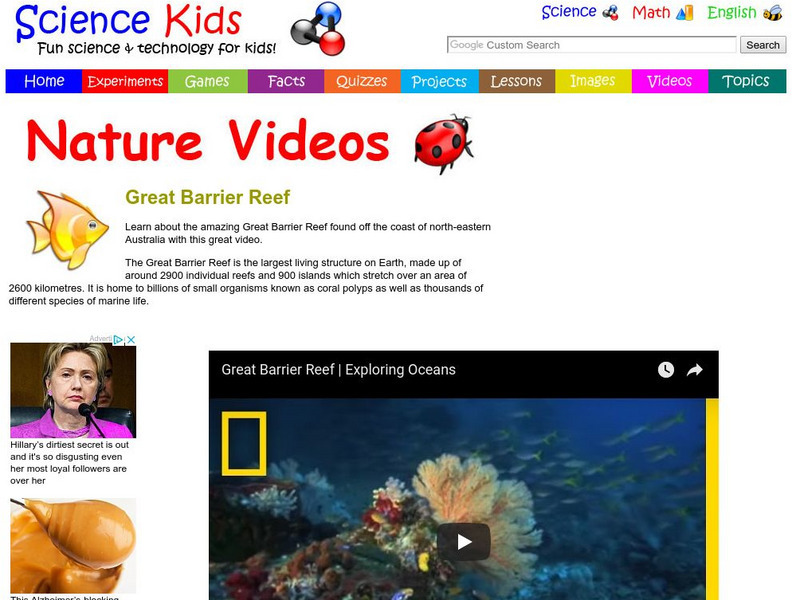
Science for Kids
Science Kids: Nature Videos: Great Barrier Reef
Did you know the Great Barrier Reef is made up of about 2900 individual reefs and home to billions of organisms? This video will explore the largest living structure on Earth known as the Great Barrier Reef. [4:06]
PBS
Pbs Learning Media: Crash Course Astronomy: The Moon
Take a tour of the moon, the closest astronomical object to Earth. Learn theories of the moon's formation, understand its surface features and how they formed, like the highlands and maria, and the moon's internal structures. [9:47]
PBS
Pbs Learning Media: Crash Course Chemistry: Polar & Non Polar Molecules
In this video, you'll learn that molecules need to have both charge asymmetry and geometric asymmetry to be polar, and that charge asymmetry is caused by a difference in electronegativities. You'll also learn how to notate a dipole...
PBS
Pbs Learning Media: Capturing Carbon
In this video segment adapted from NOVA scienceNOW, a scientist, inspired by his daughter's science fair project, develops a synthetic tree to remove excess carbon dioxide from the air. [5:23]

Khan Academy
Khan Academy: Why S Waves Only Travel in Solids
Explains why S-waves will only travel in solids.