Hi, what do you want to do?





Sophia Learning
Sophia: Structure and Function of Macromolecules: Carbohydrates
An introduction to the structure and function of the energy-rich molecules, carbohydrates.
CK-12 Foundation
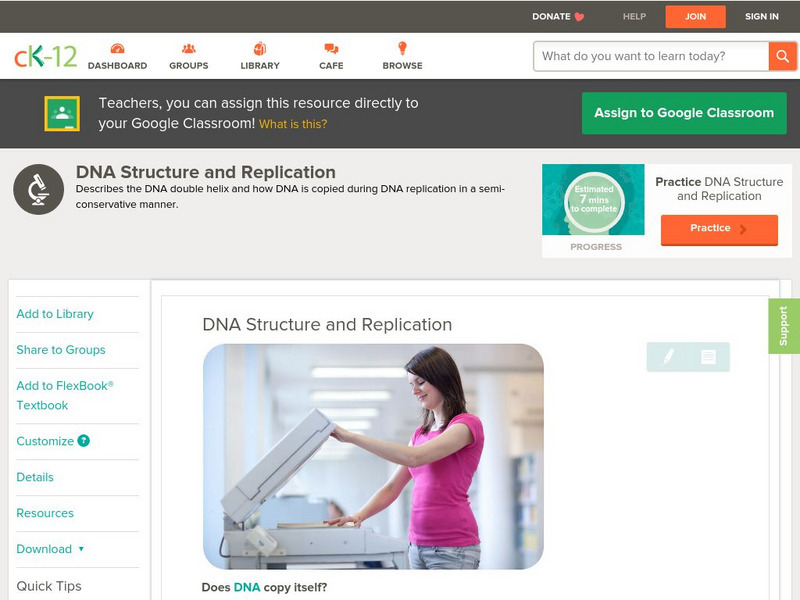
Ck 12: Life Science: Dna Structure and Replication
[Free Registration/Login may be required to access all resource tools.] DNA must replicate (copy) itself so that each resulting cell after mitosis and cell division has the same DNA as the parent cell. DNA replication occurs during the S...
Concord Consortium
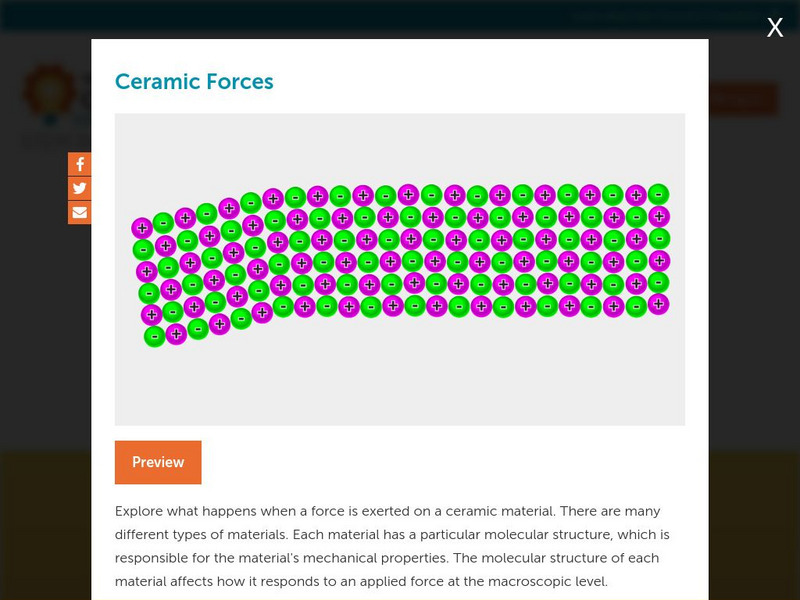
Concord Consortium: Ceramic Forces
Explore what happens when a force is exerted on a ceramic material. The molecular structure of the material affects how it responds to an applied force at the macroscopic level.
Concord Consortium
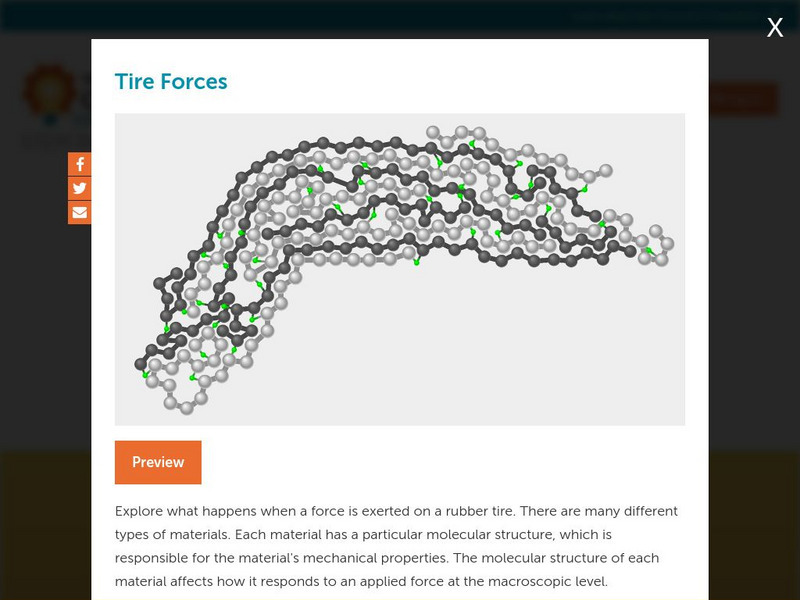
Concord Consortium: Tire Forces
Explore what happens when a force is exerted on a rubber tire. The molecular structure of each material affects how it responds to an applied force at the macroscopic level.

Other
Beautiful Chemistry: Beautiful Structures: Liquid Crystals
With this interactive activity, see how the molecules inside a liquid crystal exhibit some degree of order. Based on the nature of ordering, liquid crystals can be classified into several phases. Four are shown here.
Famous Scientists
Famous Scientists: Francis Crick
Discover Francis Crick, British molecular biologist, physicist, and neuroscientist who jointly won a Nobel Prize for his discoveries concerning the molecular structure of nucleic acids.
University of Utah
University of Utah: Learn Genetics: Build a Dna Molecule
Build a short strand of DNA using the base pairing rule. An interactive learning experience that reinforces the base pairing rule.
American Chemical Society
Middle School Chemistry: Lesson Plans: Why Does Water Dissolve Salt?
Students use their own model of a salt crystal and water molecule to show how water dissolves salt. Then, they relate their observations to the structure of salt, water, and alcohol on the molecular level.
Concord Consortium
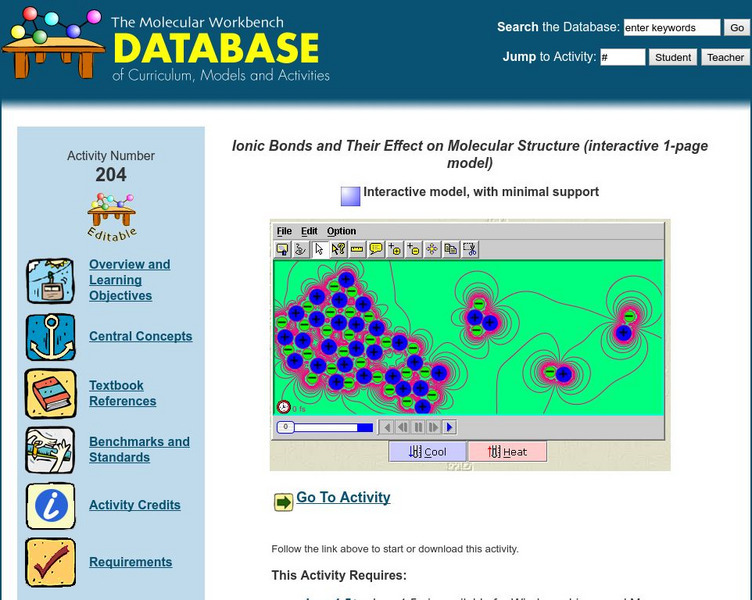
The Molecular Workbench Database: Ionic Bonds
In this simulation observe ionic bonds and how they affect the structure of the molecule.
CK-12 Foundation
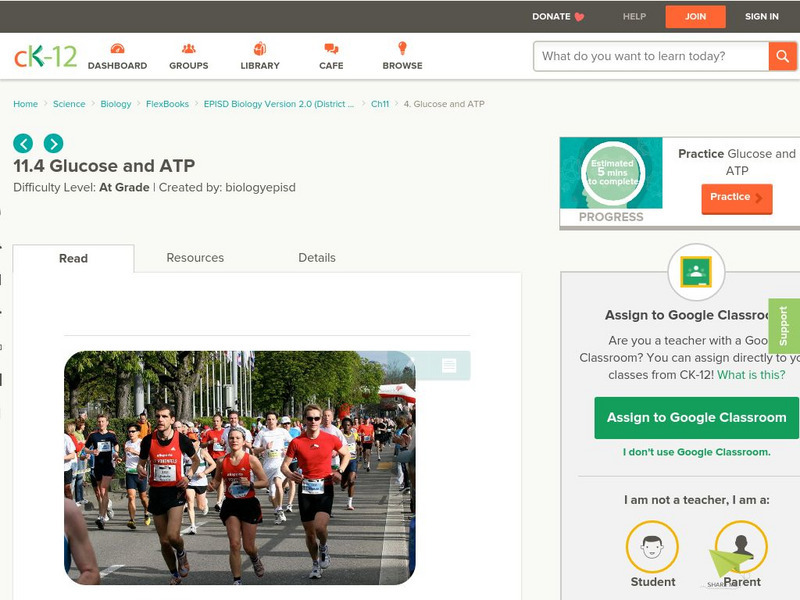
Ck 12: Glucose and Atp
[Free Registration/Login may be required to access all resource tools.] Students take a look at glucose and ATP. They will be able to explain the structure of ATP and will learn how ATP is a source of energy for a cell.

Cold Spring Harbor Laboratory
Dna Interactive: Genome
This site is provided for by DNA Interactive. The genome is the entire endowment of genetic information. It is the "Book of life," on an organism. This site demonstrates the methods used to map and sequence the human genome and to...
TeachEngineering
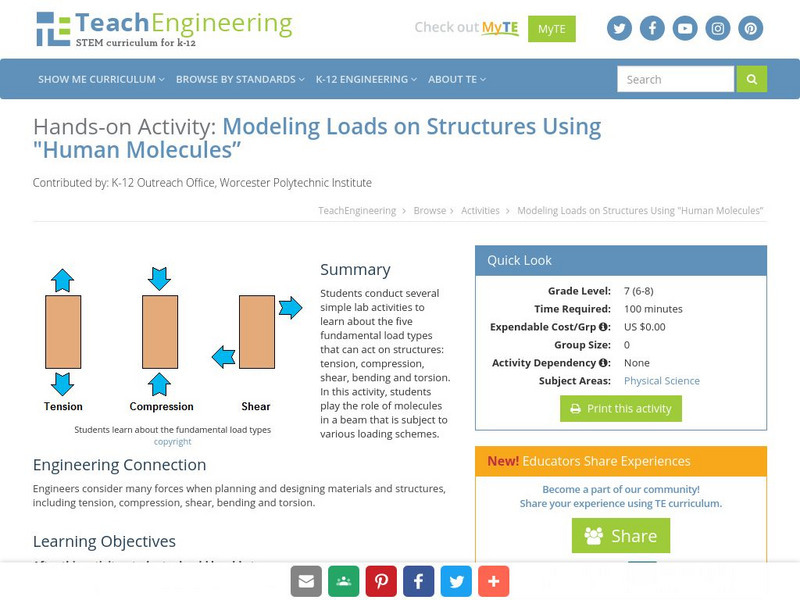
Teach Engineering: Forces on the Human Molecule
Students will conduct several simple lab activities to learn about the five fundamental load types that can act on structures: tension, compression, shear, bending, and torsion. In this activity, students will play the role of molecules...
National Health Museum
Access Excellence: Dna Sequencing (Dry Lab Activity)
This site is an advanced level hands-on activity to explain the Di-deoxy sequencing of DNA.
PBS
Nova: Journey Into Dna
Investigate the structure and function of DNA using this animated presentation.
Chiral Publishing
Chiral Publishing: An Introduction to Chemistry: Molecular Structures: Olestra
View a 3-D model of olestra, and compare it to a similar structure of a triglyceride. Also see the molecules that make up olestra. All compounds can be manipulated and studied from every angle.

Chiral Publishing
Chiral Publishing: An Introduction to Chemistry: Molecular Structures: Aldehydes
Investigate the chemical structure of aldehydes by manipulating these 3-D molecules. See two common aldehydes from every possible angle.
Chiral Publishing
Chiral Publishing: An Introduction to Chemistry: Protein Secondary Structures
Discover the alpha-helix and the beta sheet, both secondary structures of proteins. View diagrams and a 3-D model of the different parts of a protein molecule.
The Wonder of Science
The Wonder of Science: Ms Ps1 1: Atomic Composition Model
A collection of lesson plans for helping students understand atomic composition. Site uses work samples, phenomena, assessment templates, and videos to plan lessons to describe the atomic composition of simple molecules.
Chiral Publishing
Chiral Publishing: An Introduction to Chemistry: Molecular Structures: Tetrahedral Shape
Interact with molecules of methane, ammonia, and water, by manipulating colorful applets to see these molecules from all sides and observe their tetrahedral shapes.
Other
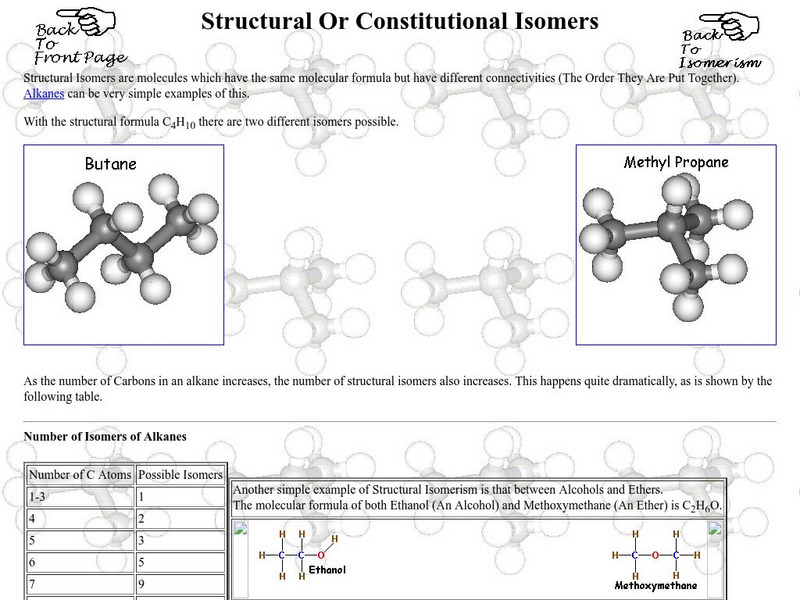
Bristol University: Structural or Constitutional Isomers
Structural Isomers are molecules which have the same molecular formula but have different connectivities (The Order They Are Put Together). Alkanes can be very simple examples of this. This pages shows a few examples.
Other
Hypertextbook: Large Molecules
This is a good, in-depth reference for the study of macromolecules in biology - lipids, proteins and carbohydrates. Includes images and links to other sources as well as a quiz for students to check understanding.
Science is Fun
University of Wisconsin Madison: Chlorophyll
This site on chlorophyll discusses what it is, its structure, molecules with similar structure, its role in photosynthesis, and its absorption spectrum.
Texas Instruments
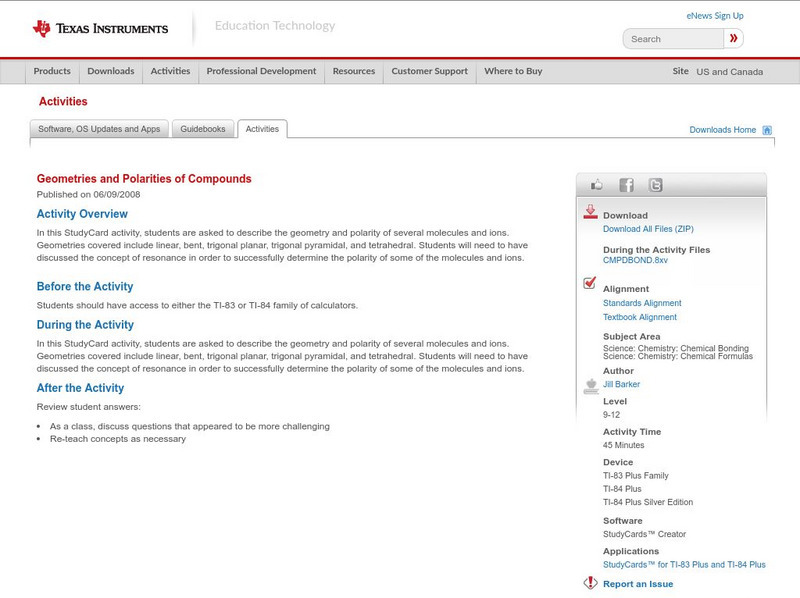
Texas Instruments: Geometries and Polarities of Compounds
In this StudyCard activity, students are asked to describe the geometry and polarity of several molecules and ions. Geometries covered include linear, bent, trigonal planar, trigonal pyramidal, and tetrahedral. Students will need to have...

TED Talks
Ted: Ted Ed: The Invisible Motion of Still Objects
Ran Tivony describes how and why molecular movement occurs and investigates if it might ever stop. [4:44]