Hi, what do you want to do?





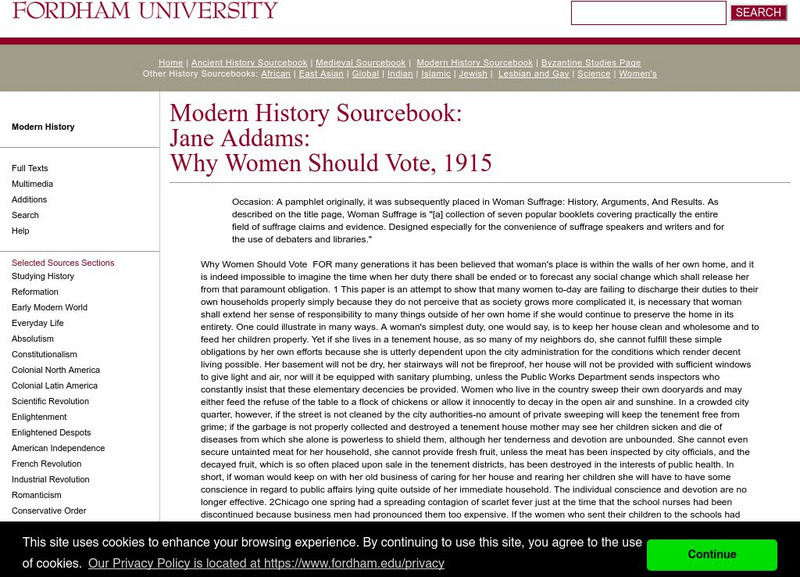
Internet History Sourcebooks Project
Fordham University: Modern History Sourcebook: Douglass Archives
Check out this primary source pamphlet written by Jane Addams, who pushed for a woman's right to vote during the Progressive Era.

National Women’s History Museum
National Women's History Museum: Seneca Falls Convention
Students will examine primary sources about the Seneca Falls Convention in 1848 to understand why a women's rights movement was necessary to gain greater rights for women.
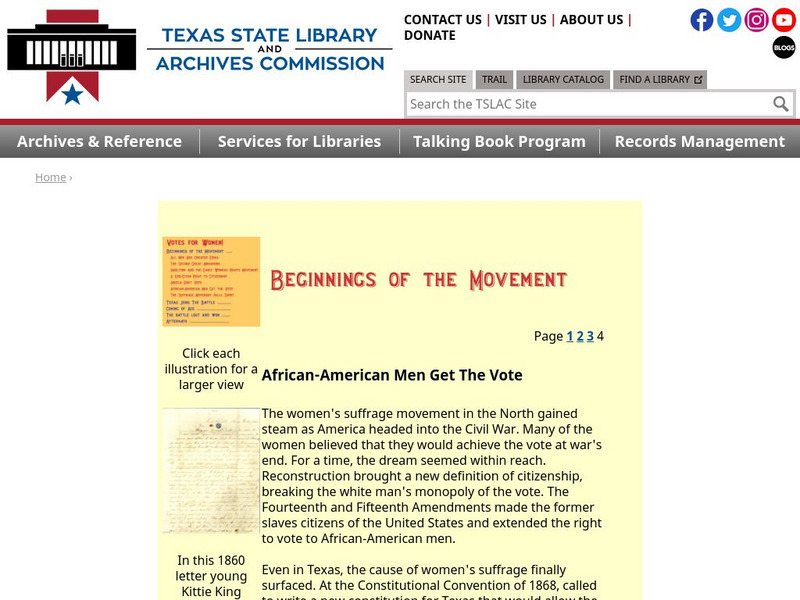
Texas State Library and Archives Commission
Texas State Library and Archives Commission: Beginnings of the Movement: African American Men Get the Vote
Explore the ways in which the women's suffrage movement, after African-American men were given the right to vote, fell short. Read texts from this period of time.

Library of Congress
Loc: Primary Source Set: Women's Suffrage
A collection of primary sources dealing with women's suffrage.
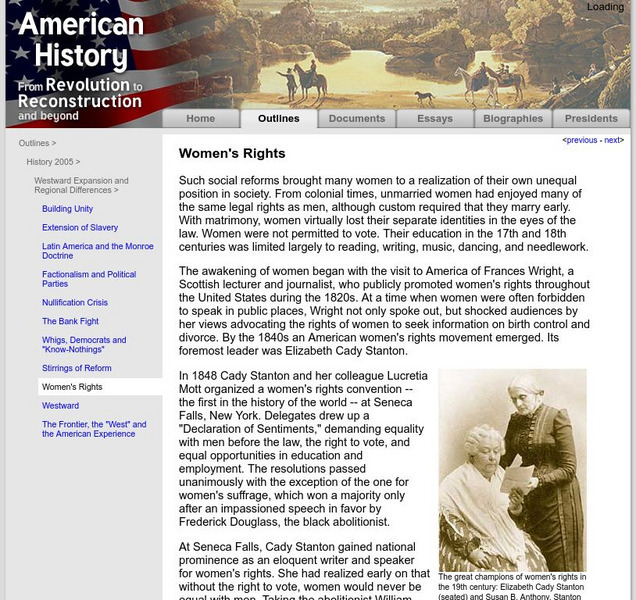
University of Groningen
American History: Outlines: Women's Rights
Such social reforms brought many women to a realization of their own unequal position in society. From colonial times, unmarried women had enjoyed many of the same legal rights as men, although custom required that they marry early. With...

National Humanities Center
National Humanities Center: Toolbox Library: The Vote, Making of African American Identity: V. 2
An appeal for black voting rights and an editorial cartoon opposing them. This resource explains that while the 15th Amendment granted black men the right to vote, southern states fought to block its implementation.

Khan Academy
Khan Academy: Ap Us History: 1890 1945: The Age of Empire: The Progressive Era
The Progressive Era from the 1890s to the 1920s evolved as a response to the negative effects of industrialization. Reforms that emerged provided protections for workers and consumers and gave women voting rights. Backlash against the...

Library of Congress
Loc: Teachers: Suffragists and Their Tactics Lesson Plan
Students work with two document collections, "Votes for Women: Suffrage Pictures: 1850-1920" and "Votes for Women: 1848-1921", to understand how the suffragists changed the requirements for voting in America.

Alabama Learning Exchange
Alex: Why Vote?
Students will complete a web quest that includes reading material on the expansion of voting rights, viewing video on historical events related to suffrage, and completing a multimedia project (public service announcement). An extension...
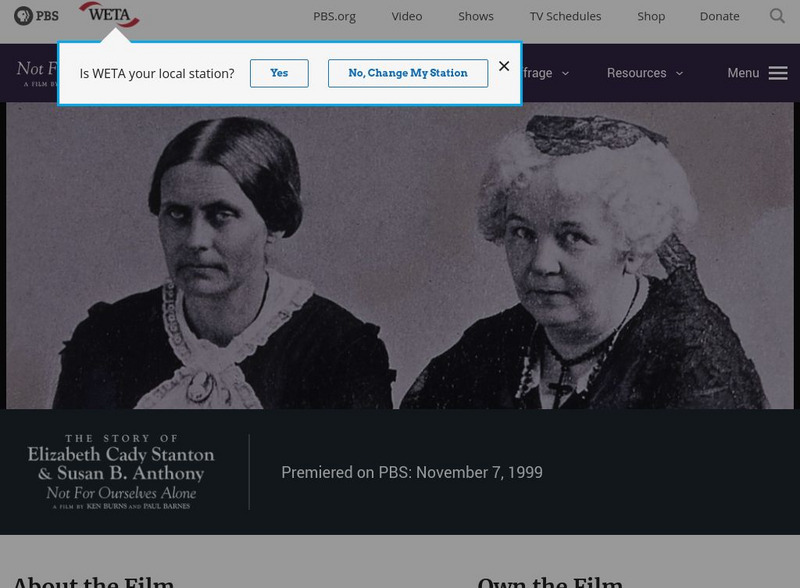
PBS
Pbs: Not for Ourselves Alone
This site, a companion to a PBS program, explores the lives of Elizabeth Cady Stanton and Susan B. Anthony. With ample use of video and audio commentary, the site chronicles their work, their friendship and thus the history of the...
Wikimedia
Wikipedia: Nineteenth Amendment to the United States Constitution
Learn about the 19th Amendment to the United States Constitution. It guarantees that a person cannot be denied the right to vote based on their gender. Includes discussion of Susan B. Anthony's and Elizabeth Cady Stanton's contributions...
Other
Susan B. Anthony House: Her Story
This detailed biography of Susan B. Anthony provides sections that focus on her work as an abolitionist, education reformer, labor activist, temperance worker, suffragist, and women's rights campaigner.
Project Gutenberg
Project Gutenberg: Women and the Republic by Helen Kendrick Johnson
Resource provides multiple formats of the entire online text of Johnson's 1913 anti-suffrage book, in which she attempts to discount the major claims made by prominent suffragists.
National Endowment for the Humanities
Neh: Edsit Ement: Cultural Change
Exciting lesson plan teaching students about the social change in women's role in society that allowed women the right to vote. Students will learn about the process women went through to gain the right to vote by exploring various...
Other
University of Michigan: Susan B. Anthony House: Susan B. Anthony
This resource divides her life into the following parts: abolitionist, educational reformer, labor activist, temperance worker, suffragist, and women's rights campaigner.
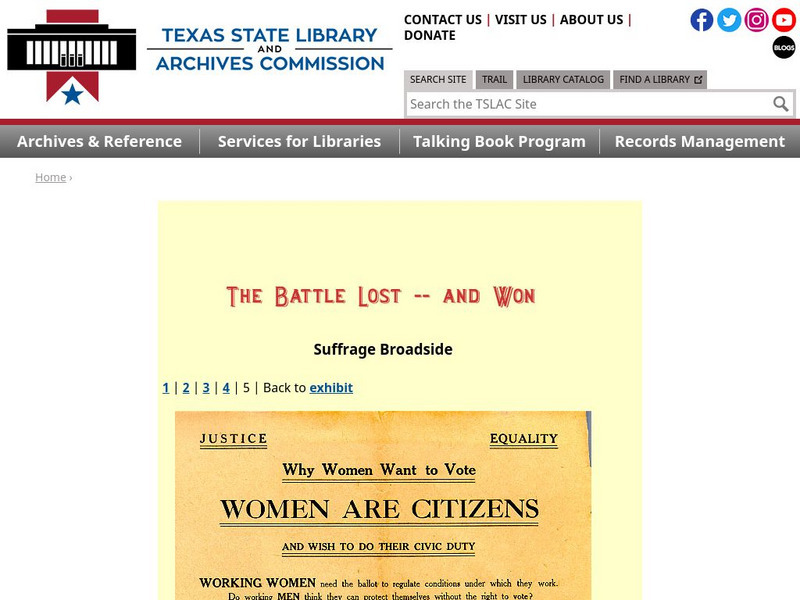
Texas State Library and Archives Commission
Texas State Library and Archives Commission: The Battle Lost and Won: Suffrage Broadside: Why Women Want to Vote
Why do working women, housekeepers, mothers, teachers and other women want the right to vote? This suffrage broadside provides answers. Published by the National American Woman Suffrage Association.
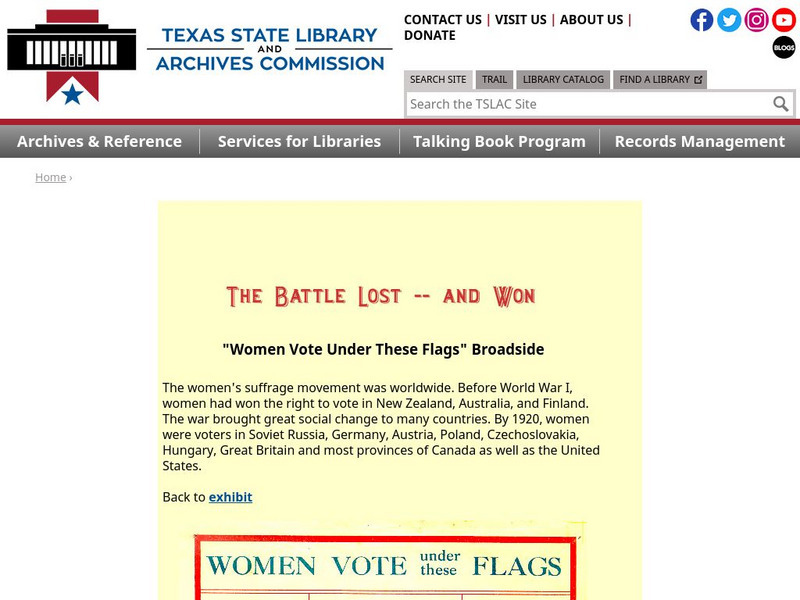
Texas State Library and Archives Commission
Texas State Library and Archives Commission: The Battle Lost and Won: "Women Vote Under These Flags" Broadside
Interesting broadside showing flags of countries that allowed women to vote, and asking under the U.S. flag, "Why do not all women vote under the flag of democracy?"
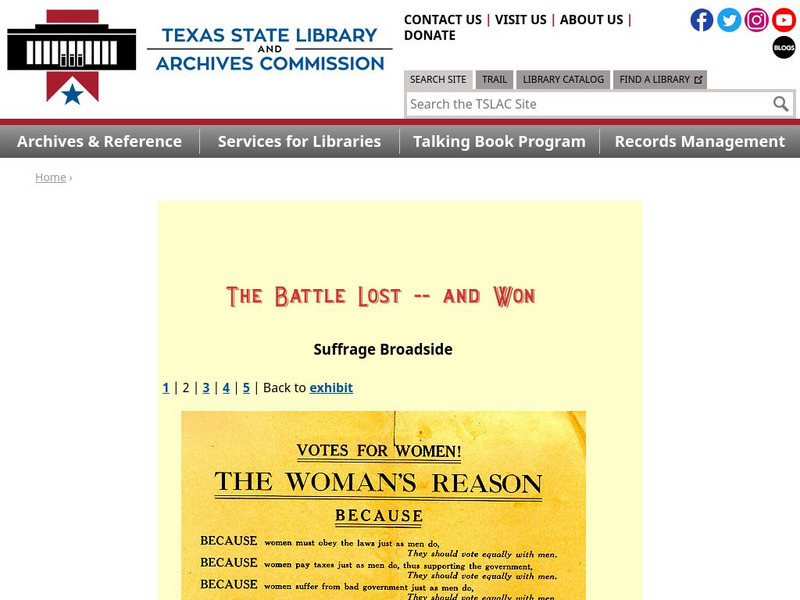
Texas State Library and Archives Commission
Texas State Library and Archives Commission: The Battle Lost and Won: Suffrage Broadside: The Woman's Reason
What were some of the reason's suffragists felt women should have the right to vote. This early 20th-century broadside has several responses. Published by the National American Woman Suffrage Association.
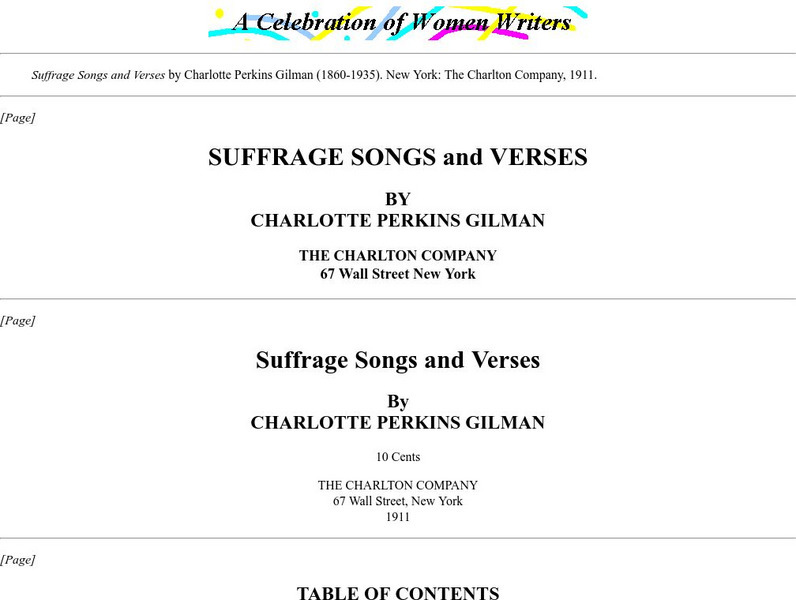
University of Pennsylvania
Suffrage Songs and Verses by Charlotte Perkins Gilman
This is the full text of Charlotte Perkins Gilman's 1911 pamphlet that served to encourage women to rally to the cause of woman suffrage.
Other
Ipu: Women's Suffrage
American women could run for election in 1788, but could not vote until 1920. This and other ironies are revealed in this timeline that shows the progression of women's political rights in countries from around the world.
Library of Congress
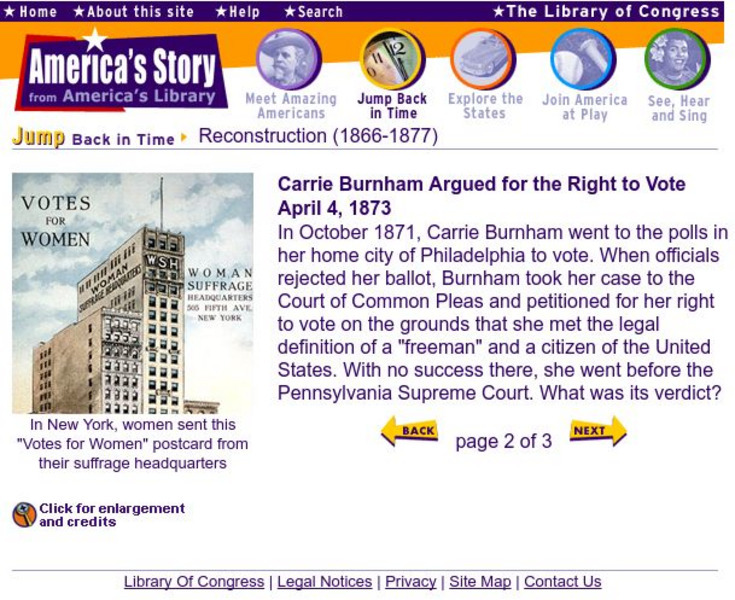
Loc: Carrie Burnham Argued for Right to Vote
A short description of one of the arguments for women's right to vote.
Other
Wiwhc: Suffrage When, Where, and Obstacles to Overcome
This online instructional activity compares aspects of women's suffrage from diverse cultures. Includes political cartoons from around the world.
Independence Hall Association
U.s. History: Women's Suffrage at Last
Trace the history of the women's suffrage movement from its organized beginnings in 1848 with the Seneca Falls Convention to the final success with the adoption of the 19th Amendment, which constitutionally granted women the right vote.
Independence Hall Association
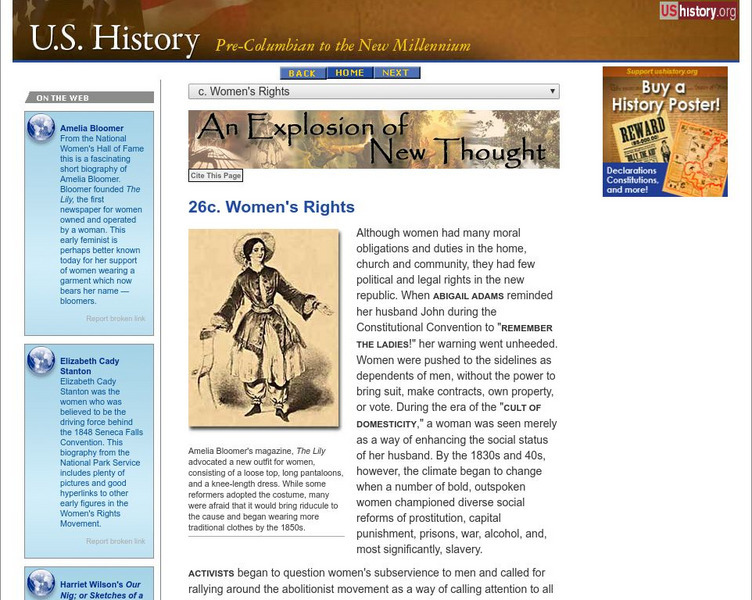
U.s. History: Women's Rights
Read about some outspoken women in the 1830s and 1840s, who began speaking out for reforms of many kinds, particularly on the issue of slavery and the rights of women to vote. The Seneca Falls Declaration pushed this idea of equality.