Hi, what do you want to do?






Curated OER
Seasonal Cloud Cover Variations
Students, in groups, access data from the NASA website Live Access Server regarding seasonal cloud coverage and the type of clouds that make up the coverage. They graph the data and make correlations between types, seasons and percentages.

Curated OER
Variables and Expressions from Around the Cosmos
In this variables and expressions learning exercise, students solve 7 problems using different mathematical formulae to find the length of Earth's day in the future, the distance to the galaxy Andromeda, the temperature of a gas cloud...

Curated OER
The Plasmasphere
For this plasmasphere worksheet, learners read about the dilute region of gases 10,000 kilometers above the Earth where atoms are ionized. Students use a photograph taken by the IMAGE EUV instrument to answer 3 questions about the...

Curated OER
Finding the Way
Students identify and research navigational tools used in deep sea explorations. They are introduced to a compass, the Global Positioning System and sonar technology and then describe their uses in underwater exploration.

Curated OER
Craters on the Moon
In this moon craters instructional activity, students use a high resolution image of the lunar surface and calculate the image scale in meters per millimeter. They use the image scale to find the largest crater in the image, the smallest...

Curated OER
Global Winds
Students extend their understanding of convection to consider global winds and the effect of the earth's rotation on the creation of patterns of prevailing wind direction.

Curated OER
Seasonal Cloud Cover Variations
Students recognize different cloud types. They determine the seaonality of various types of clouds. They graph the data and determine if a correlation exists between season, cloud cover and type of clouds most prevalent during each season.

Curated OER
Meteors
Students identify the different types of meteorite using an interactive website. For this earth science lesson, students simulate how meteors crash on a surface. They relate meteor size to crater size.

Curated OER
Bill Nye- The Atmosphere
In this science worksheet, students look for the words that fill the blanks to cover the concept of the atmosphere. The activity is meant to be a review.

Curated OER
Movement of Air II
In this movement of air instructional activity, learners determine the deflection of air masses that result from Earth's eastward rotation. Then they describe what winds provide for different trades. Students also identify and describe...

Curated OER
Wave Behavior
In this wave behavior worksheet, students will read about how sound waves are formed and how air and water temperature affects sound waves travel. Then students will complete 2 short answer questions based on the information they read.

Curated OER
The Layers of the Atmosphere
In this atmosphere worksheet, students read about the four distinct layers of the atmosphere. Then students complete 3 short answer questions.

Curated OER
Confusing Words: Rise and Raise
In this confusing words: rise and raise worksheet, students read the explanations and examples for correct usage of these two words, then interactively complete 10 sentences for practice with immediate online feedback.

Curated OER
Air Quality Issues
Students study and chart the levels of the atmosphere. They determine volume and location of the whole in the ozone layer by problem solving and drawing Antarctica.

Curated OER
Math Lesson Plan #2: Real Life Problems
Tenth graders solve problems using the tangent of angles using the flagpole and its shadow as references.

Curated OER
A Thoreau Look at Our Environment
Sixth graders write journal entries o school site at least once during each season, including sketched and written observations of present environment. They can use sample topographical maps and student's own maps. Students can use...

Curated OER
and and Ocean Views of Earth by Remote Sensing
Students explain how satellites help scientists to see more than with the unaided eye and how Landsat technology works. Students identify vegetation and fire sites in the rainforest and detect erosion along rivers. They are able to use...

NASA
Nasa: Weather
Though we live on the surface of the Earth, we actually live at the bottom of an ocean of air. Dynamic layers of air interact with the Earth's surface and the Sun's energy to produce the phenomenon of weather. The atmosphere is...
Other
Virtual Sun: Maya Environment
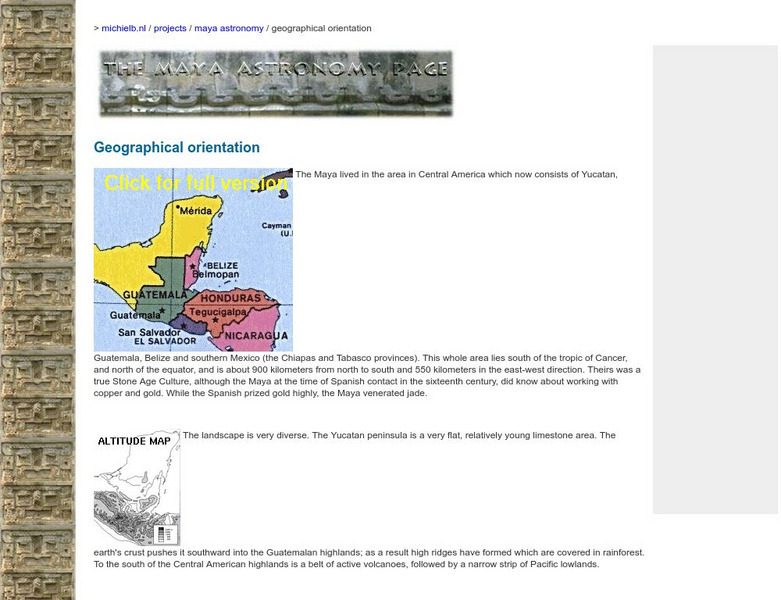
This site from the Virtual Sun gives a detailed account of the geographical region once inhabited by the Maya People. It describes the landscape, climate, and altitude.
Curated OER
Click Here to See an Altitude Map
This site from the Virtual Sun gives a detailed account of the geographical region once inhabited by the Maya People. It describes the landscape, climate, and altitude.
TeachEngineering
Teach Engineering: The North (Wall) Star
Celestial navigation is the art and science of finding one's geographic position by means of astronomical observations, particularly by measuring altitudes of celestial objects - sun, moon, planets or stars. This activity starts with a...
NASA
Nasa: Image Science Center: Ask the Space Scientist Earth
Site from NASA contains a collection of 91 questions pertaining to the Earth's atmosphere, magnetic field, ionosphere, rotation and origin of life.
Curated OER
Click Here to Get a Picture of the Maya Area in Central America
This site from the Virtual Sun gives a detailed account of the geographical region once inhabited by the Maya People. It describes the landscape, climate, and altitude.
Curated OER
Click Here to See a Rainfall Map
This site from the Virtual Sun gives a detailed account of the geographical region once inhabited by the Maya People. It describes the landscape, climate, and altitude.