Hi, what do you want to do?






Utah Education Network
Uen: How Big Are Earth, Sun, and Moon?
Understand where the sun is in the solar system and how big the earth, moon, and sun are.
University of Chicago
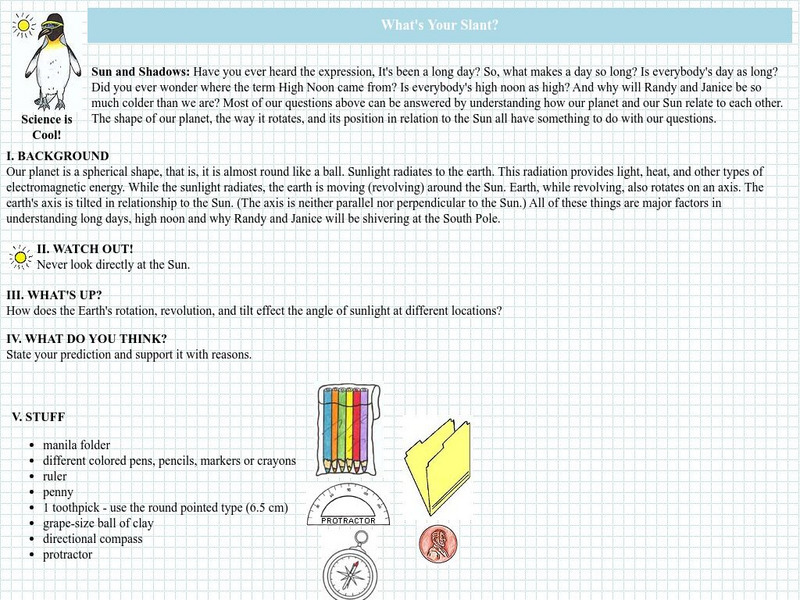
University of Chicago: What's Your Slant? Sun and Shadows
This fun activity helps you to understand the movement of the sun by studying shadows.

CK-12 Foundation
Ck 12: Earth Science: Tides
[Free Registration/Login may be required to access all resource tools.] Reveals tidal patterns and that tides are caused by the gravitational attraction of the Sun and Moon to Earth.
The Wonder of Science
The Wonder of Science: Ms Ess1 1: Earth Sun Moon System
Develop and use a model of the earth-sun-moon system to describe the cyclic patterns of lunar phases, eclipses of the sun and moon, and seasons.
Science Buddies
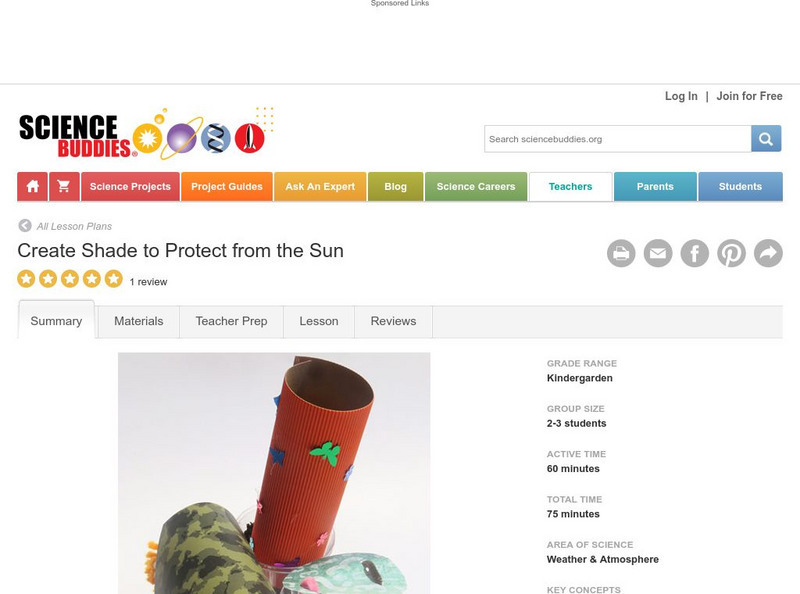
Science Buddies: Create Shade to Protect From the Sun
In this fun activity, students will get creative with craft materials. They will figure out how to protect an "animal" and its territory from getting too hot in the sun. What will they build to keep their animals cool?
Utah Education Network
Uen: Earth and Moon Observations
Earth's revolution, rotation, tilt, day and night cycle, and the sun's apparent movement across the earth are explored.
American Geosciences Institute
American Geosciences Institute: Earth Science Week: Third From the Sun
Students learn about the history of Earth imaging, the Landsat satellite program. They develop interpretation skills as they play a game that involves inferring the subjects of various Landsat images.

TED Talks
Ted: Ted Ed: The Sun's Surprising Movement Across the Sky
Suppose you placed a camera at a fixed position, took a picture of the sky at the same time every day for an entire year, and overlaid all of the photos on top of each other. What would the sun look like in that combined image? A...

Exploratorium
Exploratorium: A Guide to Astronomy Resources
A portal to resources on the sun, the Earth's neighboring planets, and the weather in space. Find out why Saturn is the "jewel of the Solar System" and explore what happens when Venus and Mercury make their rare transits across the sun.
NASA
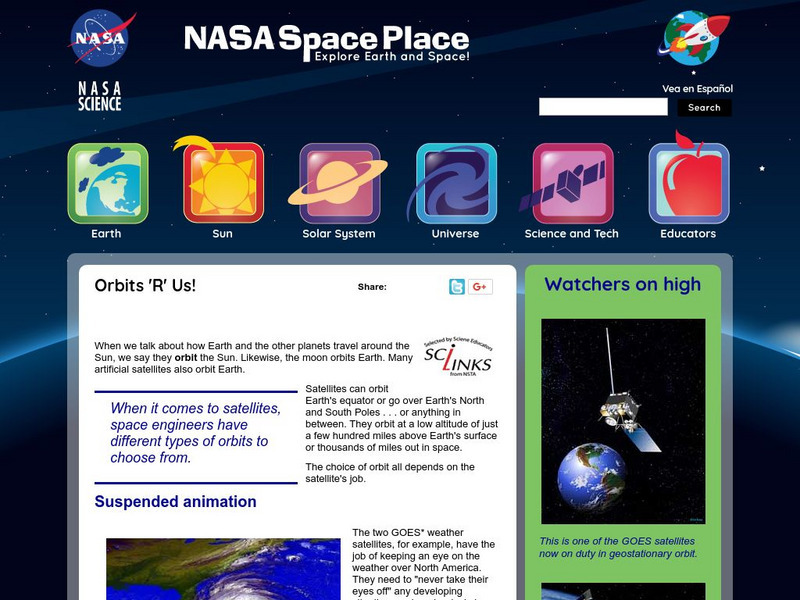
Nasa: The Space Place: Orbits 'R' Us
Learn about how Earth orbits the sun and how satellites orbit the Earth. Discover the different types of satellites such as GOES and POES and what they are used to monitor.
TeachEngineering
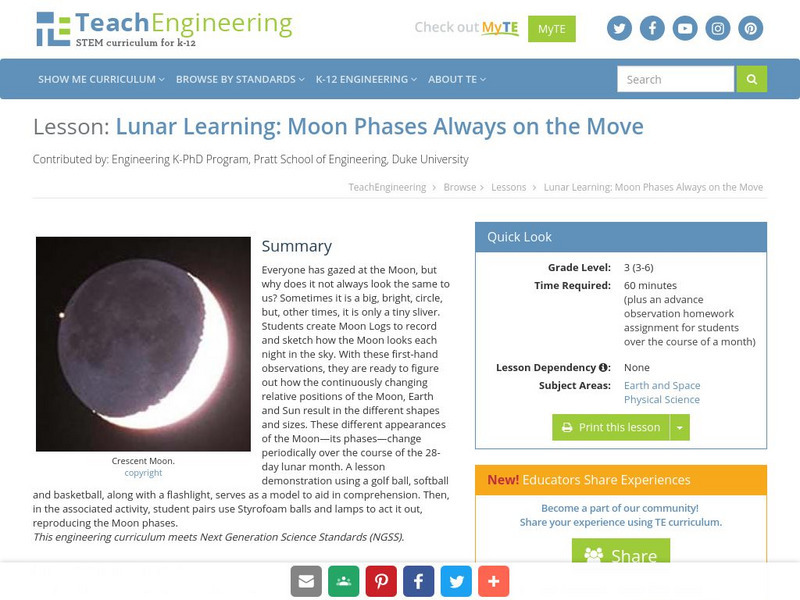
Teach Engineering: Lunar Learning
Why does the Moon not always look the same to us? Sometimes it is a big, bright, circle, but, other times, it is only a tiny sliver, if we can see it at all. The different shapes and sizes of the slivers of the Moon are referred to as...
Physics4kids
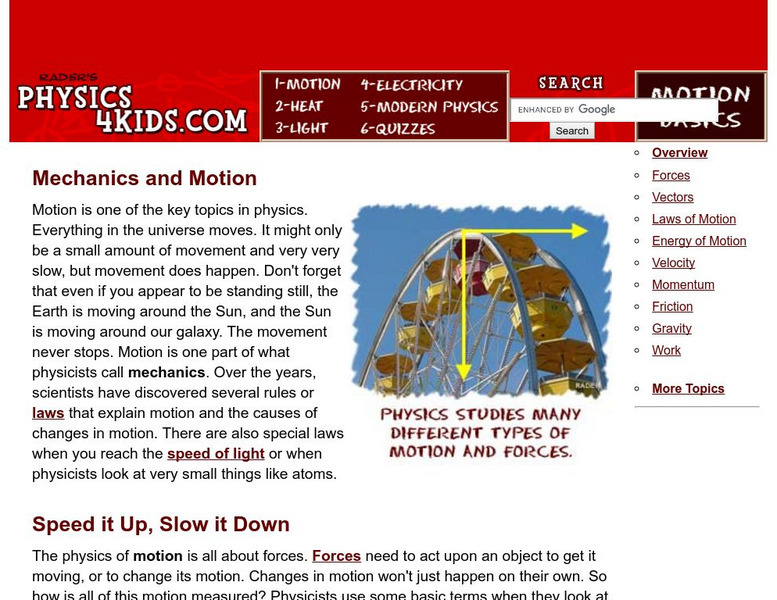
Physics 4 Kids: Mechanics and Motion
Motion is one of the key topics in physics. Everything in the universe moves. It might only be a small amount of movement and very very slow, but movement does happen. Don't forget that even if you appear to be standing still, the Earth...

Geography 4 kids
Geography4 Kids: Radiant Energy From the Sun
An introduction to radiant energy that offers a look at the different types of radiation from the sun, the radiation that actually hits Earth, and how the Sun's age will affect the radiation absorbed by Earth. Also, view NASA videos...
Thomas Jefferson National Accelerator Facility
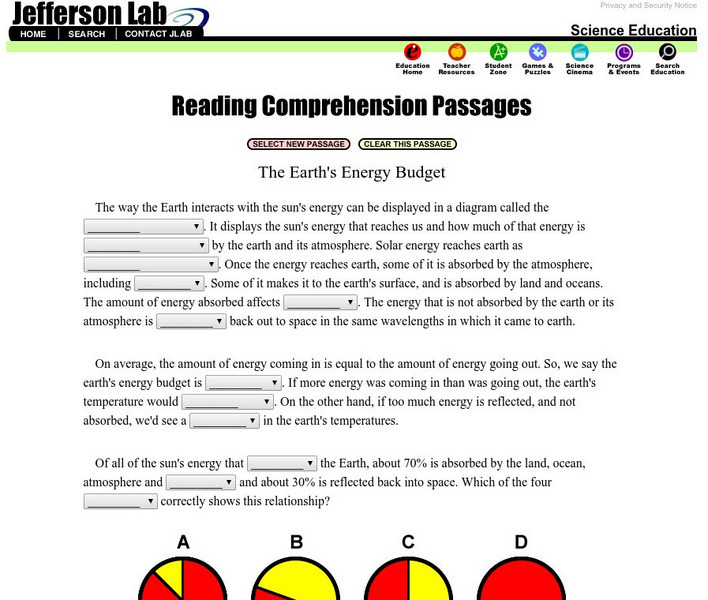
Jefferson Lab: Reading Passages: The Earth's Energy Budget
Read and fill in the blanks of this passage explaining the earth's engergy budget. Each blank has a dropdown menu with choices. When you finish, click CHECK MY ANSWERS. If you pick a wrong answer, the right answer will be displayed along...
The Wonder of Science
The Wonder of Science: 5 Ess1 1: Stellar Brightness and Distance
Learners will learn about stellar brightness and distance to be able to support their argument about the apparent brightness of our sun compared to other stars due to their distances with these lesson plans.

Alabama Learning Exchange
Alex: Sun, Earth, and Moon: Calendar of Events
During this lesson young scholars are going to take a look at moon phases and sunrise-sunset times in order to learn about daylight hours. Students discover that we do not always have the same amount of daylight each day. This lesson is...

National Geographic
National Geographic: Build a Solar Eclipse Viewer
This lesson focuses on How can you safely view a solar eclipse and solar activity? It provides step-by-step instructions for building the viewer and how to use it properly. It also provides a video and informational slides.
Other
Buzzle.com: Univer Savvy: Which Is Bigger the Earth or Sun?
Find out what the diameter and volume of the Earth and the Sun are and learn just how much bigger the Sun is. Also explains how the Sun compares to the Moon.
Enchanted Learning
Enchanted Learning: The Earth's Atmosphere
The Earth's atmosphere is a thin layer of gases that surrounds the Earth. It composed of 78% nitrogen, 21% oxygen, 0.9% argon, 0.03% carbon dioxide, and trace amounts of other gases. This thin gaseous layer insulates the Earth from...
NASA
The Earth Sun System
This resource provides some interesting video footage of the Sun. Also included is information about the effects of solar radiation on the Earth's magnetosphere and weather.

Geography 4 kids
Geography4 kids.com: Earth Around the Sun
Find out what all results from Earth revolving around the sun every 365 days as well as the rotation of the Earth every 24 hours.
Science Struck
Science Struck: A Scientific Explanation to What Causes Day and Night
Explains how the rotation and the axial tilt of the Earth are responsible for the phenomenon of day and night. Provides information about the Sun, the solar system, and the Earth, and how the circumference of the Earth was first measured...

Enchanted Learning
Enchanted Learning: Earth's Oceans Tides
This site explains what tides are and the difference between Proxigean Spring Tides, spring tides, and neap tides, and how these are formed. Graphic illustrations are provided.

Other
Center for Science Education: Eye on the Sky: What Makes Day and Night?
This activity will allow you to model day and night cycles. A rotating student holding a map (provided) models the earth. A lamp is used to model the sun. Numerous worksheets (pdf) and additional website resources are also provided.
Other popular searches
- Earth Sun and Moon
- Earth and the Sun
- Earth, Sun and Moon
- Earth and Sun
- Earth and Moon and Sun
- Sun and Earth Kindergarten
- Sun and Earth Orientation
- Sun, Earth and Moon
- Sun and Earth Facts
- Sun and Earth Sizes