Hi, what do you want to do?






Council for Economic Education
Econ Ed Link: Widget Production: Producing More Using Less
Through this economics lesson you will learn about widget production. One of the tasks is to see how productivity can help solve problems.
Texas Education Agency
Texas Gateway: Ch. 10: Buildling a Model of Aggregate Demand & Aggregate Supply
By the end of this section, you will be able to do the following: Explain the aggregate supply curve and how it relates to real GDP and potential GDP, Explain the aggregate demand curve and how it is influenced by price levels, Interpret...

Khan Academy
Khan Academy: Shifts in Aggregate Supply
If either the aggregate supply or aggregate demand curve shifts in the aggregate demand/aggregate supply-AD/A-model, the original equilibrium in the AD/AS diagram will shift to a new equilibrium. Increases and decreased in the price of...

Council for Economic Education
Econ Ed Link: The Price of Gasoline: What's Behind It?
In this lesson, students investigate the variables that contribute to the cost of gasoline. They learn that while OPEC nations do influence the price of oil and thus the price of gasoline, other factors also influence the price.
University of Nebraska Omaha
Ec Ed Web: How Can Entrepreneurs Control Costs?
This economics activity explores what influences producers to supply in regard to demand. It examines fixed and variable costs, how such costs can be reduced, and how they influence production. Includes printable worksheets.
Council for Economic Education
Econ Ed Link: Henry Ford and the Model T: A Case Study in Productivity (Part 3)
Henry Ford's use of mass production strategies to manufacture the Model T revolutionized industrial manufacturing. This 3-part learning unit provides students with the story of Henry Ford and the Model T from an economics perspective....
Other
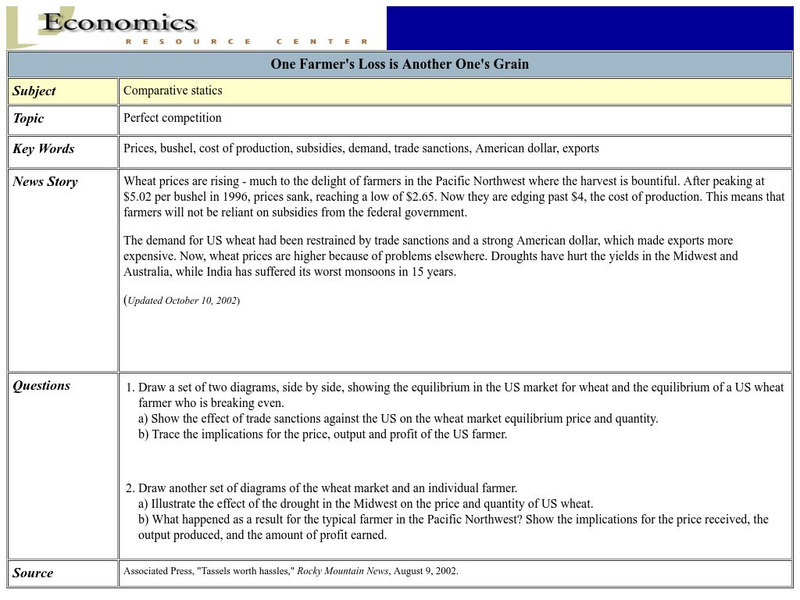
South Western Learning: Econ News: Comparative Statics: Perfect Competition
This site offers economics-based newspaper headlines and asks follow-up questions based on supply and demand in a perfectly competitive market.

Other
Federal Reserve Bank of Boston: The Economics of Pro Team Sports
Great interactive baseball game that combines your knowledge of economics and pro sports trivia. After completing the nine innings, you should have a better understanding of how economics is used in everyday life.

Khan Academy
Khan Academy: Lesson Summary: Long Run Aggregate Supply
In this lesson summary review and remind yourself of the key terms and graphs related to the long-run aggregate supply curve and its relationship to the stock of resources, technology, and the natural rate of unemployment.
Council for Economic Education
Econ Ed Link: What Do People Want to Wear?
To stay in business, fashion merchandisers must be able to anticipate what consumers want. By looking at different retail websites, students will look to anticipate what consumers are demanding. Students will then go through the market...
Council for Economic Education
Econ Ed Link: How the Crusades Led to the Finding of the New World
The instructional activity will help middle schoolers to discover the importance of the Crusades to the expansion of many European countries. Students will also be introduced to new products and find out why explorers were willing to...
Federal Reserve Bank
Federal Reserve Bank of St. Louis: The Great Depression Curriculum
From the Federal Reserve Bank of St. Louis, a curriculum guide including six lessons that help students learn about the Great Depression and the economic impact on Americans who were part of it. Features video interviews with people who...
Wikimedia
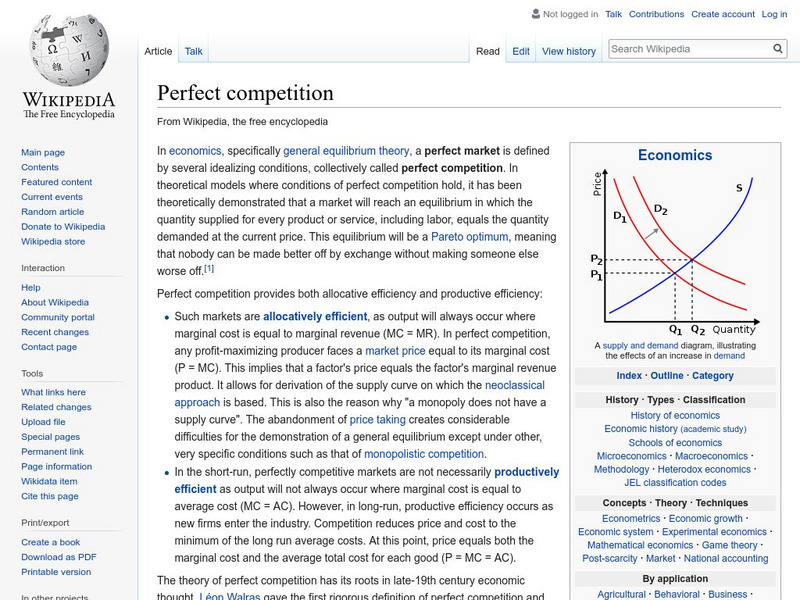
Wikipedia: Perfect Competition
This site provides a clear description of the requirements and conditions needed in a market for it to be labeled a perfectly competitive market. The topics of allocative efficiency and productive efficiency are also addressed.
Annenberg Foundation
Annenberg Learner: Graphing Lab: Moose Synthesizer Co.
In this interactive economics lab, students help Albert Moose determine how to price his product, music synthesizers, based on costs and revenue. Students create supply curves to help in the decision process.
Other
Resilience: Increasing Global Nonrenewable Natural Resource Scarcity Analysis
A detailed analysis of how nonrenewable resources will not disappear but will become increasingly scarce in the years to come. Supported by research data, graphs, and tables on the scope of nonrenewable resources, and how much we have of...

Khan Academy
Khan Academy: The Expenditure Output, or Keynesian Cross, Model
Use a diagram to analyze the relationship between aggregate expenditure and economic output in the Keynesian model.
Council for Economic Education
Econ Ed Link: Chevy Volt It's Electric!
The costs and benefits of owning an electric or hybrid car will be evaluated in this lesson. By reading and researching the history of the production of electric cars, the lesson allows students to understand how this market has developed.

Khan Academy
Khan Academy: Introduction to Factor Markets
Practice what you have learned about the supply of labor, the demand for labor, and the marginal revenue product of labor in this exercise.