Hi, what do you want to do?





Cornell University
Cornell University: Isometries and Patterns
Shows the different kinds of isometries and patterns, and gives examples of each kind. Includes definitions, terminology, examples, and problems.
CK-12 Foundation
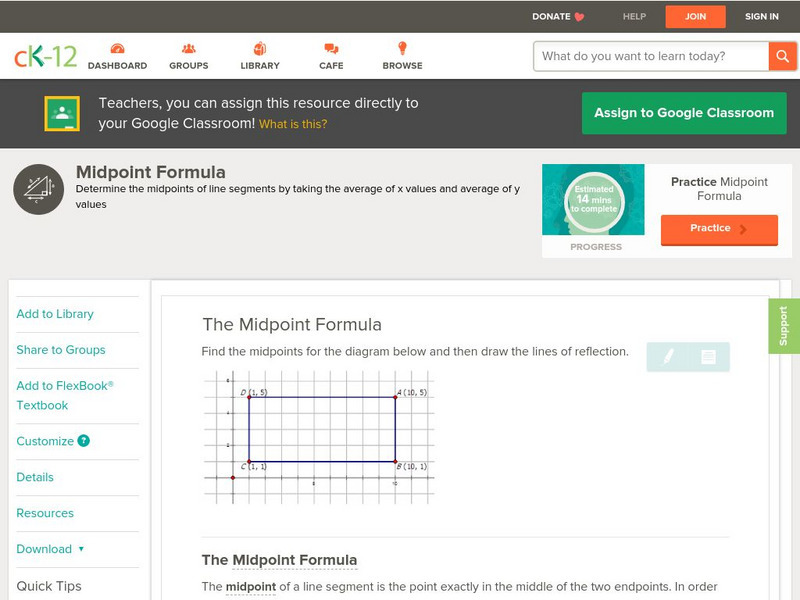
Ck 12: Algebra: Midpoint Formula
[Free Registration/Login may be required to access all resource tools.] This concept introduces midpoints of line segments.
National Council of Teachers of Mathematics
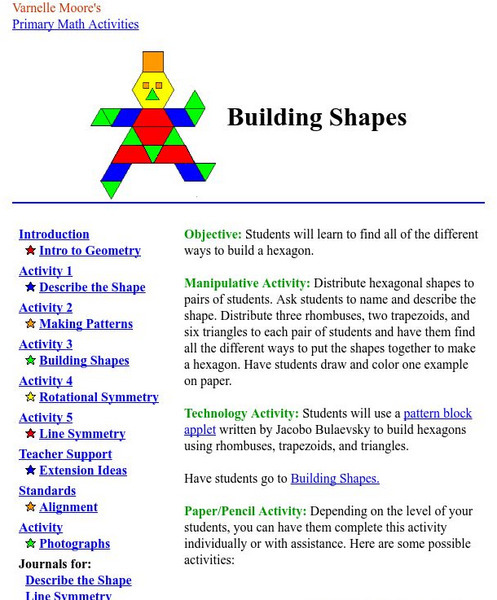
The Math Forum: Building Shapes
Based on building a hexagon, this activity from the Math Forum collection focuses on using different combinations of pattern blocks to create a hexagon. An online activity, pencil and paper method, literature connections, and a...
National Council of Teachers of Mathematics
The Math Forum: Putt Putt Golf in the Math Classroom
Putt-Putt golf can be a great tool in helping students understand angles and their reflections. Here a teacher demonstrates the "Course," set up in his classroom to assist in explaining to students how to use geometry and angles in...

TED Talks
Ted: Ted Ed: Why Are Fish Fish Shaped?
Lauren Sallan explains why certain fish features are so common, and what it reveals about fish.

Symmetry Magazine
Symmetry Magazine: Explain It in 60 Seconds: Neutralinos
Neutralinos, described here, are hypothesized particles of dark matter. Scientists hope to confirm their existence through their research with the Large Hadron Collider. "Explain It In 60 Seconds" is an article series that aims to...
Symmetry Magazine
Symmetry Magazine: Explain It in 60 Seconds: The International Linear Collider
The International Linear Collider, when built, will be larger than the Large Hadron Collider near Geneva. A short description is given here. "Explain It In 60 Seconds" is an article series that aims to summarize in a few paragraphs the...
Symmetry Magazine
Symmetry Magazine: Explain It in 60 Seconds: Superconductors
Superconductors are materials that offer no resistance to electricity passing through them. They have many applications in science, such as in the Large Hadron Collider. "Explain It In 60 Seconds" is an article series that aims to...
Symmetry Magazine
Symmetry Magazine: Explain It in 60 Seconds: Luminosity
Luminosity, described here, is a scale for measuring how efficiently a collider works. "Explain It In 60 Seconds" is an article series that aims to summarize in a few paragraphs the meaning of different concepts in particle physics.
Symmetry Magazine
Symmetry Magazine: Explain It in 60 Seconds: Quarks
Quarks, described here, are particles of matter that cannot be further broken down. Thus they are called fundamental particles. "Explain It In 60 Seconds" is an article series that aims to summarize in a few paragraphs the meaning of...
Symmetry Magazine
Symmetry Magazine: Explain It in 60 Seconds: Light Sources
Light sources are usually synchrotrons, accelerators that are used to produce intense light beams for research purposes. "Explain It In 60 Seconds" is an article series that aims to summarize in a few paragraphs the meaning of different...
Symmetry Magazine
Symmetry Magazine: Explain It in 60 Seconds: The Standard Model
The Standard Model is the theory scientists use to understand how the universe is constructed. They recognize that it has deficiencies as not everything they observe can be explained with it. "Explain It In 60 Seconds" is an article...
Symmetry Magazine
Symmetry Magazine: Explain It in 60 Seconds: The Higgs Boson
The Higgs boson, a particle hypothesized by Peter Higgs, is described in this article. "Explain It In 60 Seconds" is an article series that aims to summarize in a few paragraphs the meaning of different concepts in particle physics.
Symmetry Magazine
Symmetry Magazine: Explain It in 60 Seconds: X Ray Lasers
X-ray lasers are produced by electron beams and are extremely intense,. They have important applications in particle physics. "Explain It In 60 Seconds" is an article series that aims to summarize in a few paragraphs the meaning of...
Symmetry Magazine
Symmetry Magazine: Explain It in 60 Seconds: Acceleration of Particles
The process of particle acceleration is described. "Explain It In 60 Seconds" is an article series that aims to summarize in a few paragraphs the meaning of different concepts in particle physics.
Symmetry Magazine
Symmetry Magazine: Explain It in 60 Seconds: Simulations
Simulations are useful research tools for scientists and save a lot of time and money. Some of the ways they are used are described in this article. "Explain It In 60 Seconds" is an article series that aims to summarize in a few...
Symmetry Magazine
Symmetry Magazine: Explain It in 60 Seconds: Dark Matter
Dark matter is still quite a mystery to scientists, who hope to learn more about it through experiments with particle accelerators. "Explain It In 60 Seconds" is an article series that aims to summarize in a few paragraphs the meaning of...
Symmetry Magazine
Symmetry Magazine: Explain It in 60 Seconds: A Positron
Learn about positrons, an antiparticle and the opposite of an electron. Also available as a PDF, which requires Adobe Reader.
Symmetry Magazine
Symmetry Magazine: Explain It in 60 Seconds: String Theory
String Theory, a theory about how the universe works, is explained briefly here. "Explain It In 60 Seconds" is an article series that aims to summarize in a few paragraphs the meaning of different concepts in particle physics.
Symmetry Magazine
Symmetry Magazine: Explain It in 60 Seconds: Particle Event
Particle events, described in this article, are events that can be observed with a particle detector. "Explain It In 60 Seconds" is an article series that aims to summarize in a few paragraphs the meaning of different concepts in...
Symmetry Magazine
Symmetry Magazine: Explain It in 60 Seconds: Dark Energy
Dark energy, described here, is the ultimate mystery for scientists. It is the force that is causing the expansion of the universe they believe. "Explain It In 60 Seconds" is an article series that aims to summarize in a few paragraphs...
Symmetry Magazine
Symmetry Magazine: Explain It in 60 Seconds: A Theory
The definition of a theory as it applied to science is explained in this brief article. "Explain It In 60 Seconds" is an article series that aims to summarize in a few paragraphs the meaning of different concepts in particle physics.
Symmetry Magazine
Symmetry Magazine: Explain It in 60 Seconds: Jets
Jets, described in this article, are particle sprays resulting from other particles colliding at high speeds, such as can happen in particle accelerators. "Explain It In 60 Seconds" is an article series that aims to summarize in a few...
Symmetry Magazine
Symmetry Magazine: Explain It in 60 Seconds: The Terascale
The terascale, described in this article, is a subatomic region that requires enormous amounts of energy in order to reach it. Scientists hope to be able to study it with the Large Hadron Collider. "Explain It In 60 Seconds" is an...
Other popular searches
- Line Symmetry
- Lines of Symmetry
- Rotational Symmetry
- Geometry Lines of Symmetry
- Visual Art Lessons Symmetry
- Bilateral Symmetry
- Mathematics Line Symmetry
- Geometry Shape Symmetry
- Line of Symmetry
- Rotation Symmetry
- Geometry Shape and Symmetry
- Reflectional Symmetry