Hi, what do you want to do?





Georgia Department of Education
Ga Virtual Learning: Biology: Taxonomy
In this multi-media module students derive the relationship between single-celled and multi-celled organisms and the increasing complexity of systems.

Smithsonian Institution
Smithsonian National Zoo: Classification Systems
A great overview of the science of classification. Topics addressed include summaries of the five kingdoms, the seven taxa, the definition of a species and the classification of the panda.
Other
It's All About What's Inside. Classification and the Tree of Life [Pdf]
In this science lesson plan, students look at how animals have traditionally been classified in a tree of life diagram by examining the characteristics of plastic eggs. They then analyze the genetic code assigned for each egg and look...
My Science Site
Middle School Science: Shoe Classification Lab [Pdf]
This concise worksheet site will enable students to learn how to create a classification system and to understand the reasons for classification in science. Requires Adobe Reader.
Scholastic
Scholastic: Study Jams! Science: Plants: The Kingdoms of Life
A video, a karaoke song to sing along to, and a 7-question multiple-choice quiz on the topic of Kingdoms in the life classification system.
SRI International
Performance Assessment Links in Science: Classifying Candy 2 (Lesson)
For this fourth grade performance assessment task, students sort candies according to their properties and demonstrate their understanding of binary classification principles.
CK-12 Foundation
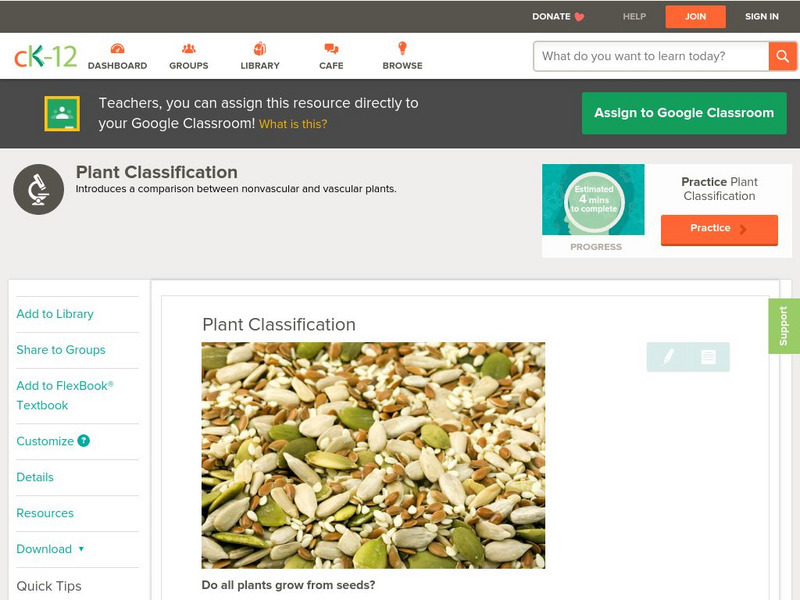
Ck 12: Life Science: Plant Classification
[Free Registration/Login may be required to access all resource tools.] Do all plants grow from seeds? No, there are actually a few plants that do not make seeds. Whether or not a plant makes seeds is one criteria used to classify...
Other
Secondary Science Program: The Six Kingdoms
A short overview of the six kingdoms in our scientific classification system: Plants, Animals, Protists, Fungi, Archaebacteria, and Eubacteria.

BBC
Bbc Schools: Ks2 Bitesize: Science: The Living World
This landing page includes learning modules on the following topics of: animals, plants, microorganisms, life cycles and reproductions, food chains, habits, humans and the environment, adaptation, inheritance, and evolution.
Science Education Resource Center at Carleton College
Serc: Ecology/geography Classification
This outdoor lesson helps students better understand ecological and geographical classifications by teaching it simultaneously in science and geography class. Presenting the two classifications together will help reinforce the idea of...
SMART Technologies
Smart: Science Choice Board Newton's Laws of Motion
Students level up learning by completing Newton's Laws of Motion task cards including all levels of Bloom's taxonomy.

CK-12 Foundation
Ck 12: Life Science: Organization of Living Things
[Free Registration/Login may be required to access all resource tools.] When you see an organism that you have never seen before, you probably put it into a group without even thinking. If it is green and leafy, you probably call it a...
Other
Math and Science Activity Center: Classification of Living Things
Kingdom is the highest rank used in the biological taxonomy of all organisms. There are 6 kingdoms in taxonomy. Every living thing comes under one of these 6 kingdoms. The six kingdoms are Eubacteria, Archae, Protista, Fungi, Plantae,...

Alabama Learning Exchange
Alex: Botany Scavenger Hunt Where's the Ginkgo?
Young scholars use a science nature journal to log in plants native to Alabama. They sketch pictures of leaves, identify the special characteristics of the plant, and describe the environment where it was found. They also research...
Scholastic
Scholastic: Study Jams! Science: Animals: Kingdoms of Life
A playful interactive introducing biology's five animal kingdoms. Watch the video, take a quiz, and review vocabulary.
Georgia Department of Education
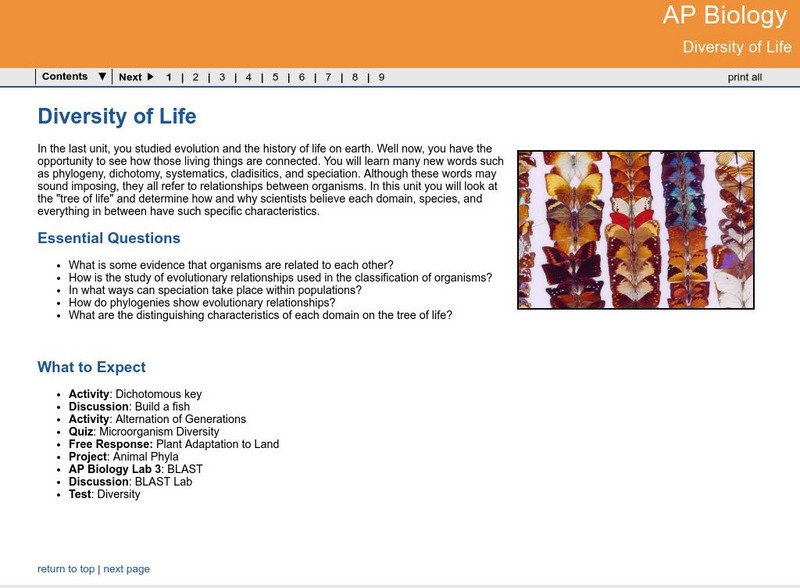
Ga Virtual Learning: Ap Biology: Diversity
An online course with interactive activities and learning exercises give students the opportunity to look at the tree of life and to determine how and why scientists believe each domain, species, and everything in between have such...
Rice University
Rice University: Web Adventures: Reconstructors: A Plaguing Problem
Online adventure game consisting of five consecutive episodes where you become a member of a team of scientists who investigate pain relieving drugs to see if they are safe. Episodes should be played in order; however, they can be...
Curated OER
Secondary Science Program: The Six Kingdoms
A short overview of the six kingdoms in our scientific classification system: Plants, Animals, Protists, Fungi, Archaebacteria, and Eubacteria. A good explanation of how organisms are placed in their particular kingdom.
Curated OER
Secondary Science Program: The Six Kingdoms
A short overview of the six kingdoms in our scientific classification system: Plants, Animals, Protists, Fungi, Archaebacteria, and Eubacteria. A good explanation of how organisms are placed in their particular kingdom.
Curated OER
Secondary Science Program: The Six Kingdoms
A short overview of the six kingdoms in our scientific classification system: Plants, Animals, Protists, Fungi, Archaebacteria, and Eubacteria. A good explanation of how organisms are placed in their particular kingdom.
Curated OER
Secondary Science Program: The Six Kingdoms
A short overview of the six kingdoms in our scientific classification system: Plants, Animals, Protists, Fungi, Archaebacteria, and Eubacteria. A good explanation of how organisms are placed in their particular kingdom.
Science Education Resource Center at Carleton College
Serc: First Grade Collecting Leaves With the Book Leaf Man
In this environmental science activity, students go on a leaf walk and collect different types of leaves, and then brainstorm characteristics of their leaves then classify them.
Science Education Resource Center at Carleton College
Serc: Interpreting the Geologic History of Canyon De Chelly
Earth Science teachers will combine field observations with the information given in the classroom to interpret the geologic history of Canyon de Chelly, Arizona.
McREL International
Mc Rel: Whelmer #64 Learning Activity: Liquid Rainbow
An easy to do activity that investigates density and solubility. The activity is presented in lesson plan format that meets NSES standards.