Hi, what do you want to do?






Curated OER
Musical Chairs Trivia
Young scholars play a fun trivia/review game that includes aspects of the childhood game, Musical Chairs.

Curated OER
Project-Based Learning Pitfalls
How to avoid the most common teacher mistakes in project-based learning.

Curated OER
The Largest Objects
In this alphabet learning exercise, students focus on the letter a. Coloring pictures that begin with the letter a sound, students choose the largest object in each box to color.

Curated OER
Magic Rope Curl-ups
Learners imagine that they are pulling themselves up from the floor using a magic rope.

Curated OER
It Might Come in Handy
Students explore the latest study on routine hand washing practices. They research some of the possible communicable diseases that can be transmitted by having lax hygiene.

Curated OER
How can deep-water corals be used to determine long-term patterns of climate change?
High schoolers explore the concept of paleoclimatological proxies. In this paleoclimatological proxies instructional activity, students explain isotope ratios in deep water coral samples. High schoolers write a paragraph...

Curated OER
Geologic Time Scale Analogy
Students examine geologic time to scale. In this geologic time lesson, students create a time-scale metaphor that shows some of the Earth's important events. Students present their metaphor to the class.

Curated OER
The Polar Express
Here are some ways to include "The Polar Express" into your holiday curriculum

Curated OER
Five Step Summary
Young scholars review the five steps to summarization. They then read the article "Whoooo-o Are You?" silently. As a class they summarize a small section of the article using the five steps included. Finally, the students summarize...

Curated OER
Teacher Erase/Color a Rhyme
In this rhyming instructional activity, students fill in 10 blanks to a rhyming poem about a teacher, then color a partially completed drawing of the teacher based on the rhymes in the poem.

Curated OER
The Periodic Table of Elements Game
Students participate in a game dealing with elements on the Periodic Table. They work together to develop their answers. They answer other discussion questions to complete the lesson.

Curated OER
National Sterotypes
Students develop their own ideas about the world around them. This lesson helps them improve their descriptive adjective vocabulary while they discuss perceived differences between nations through stereotypes.

Curated OER
Reading to Learn: Sum it Up!
Students practice summarizing texts they are reading to aid in their understanding of what they have read. After learning the steps involved in summarizing a text, students practice the five basic steps used in summarization.

Curated OER
Algebra: Linear Equations
Students explore the concept of linear equations. In this linear equations lesson plan, students examine graphic organizers on steps to solve linear equations. Students then practice solving linear equations as they play a math game.

Curated OER
Magic Money
In this math worksheet, students use the images of the money in order to translate to the actual amount for the 22 problems.

Curated OER
Exploring the Scientific Method: Separation of a Complex Mixture
Students work in teams to use the scientific method to separate complex mixtures into pure components.
ReadWriteThink
Read Write Think: When Less Is More Understanding Minimalist Fiction
Contains plans for five lessons that use Ernest Hemingway's "Cat in the Rain" and Raymond Carver's "Little Things" to teach about minimalist fiction. After studying these texts, students try to write their own minimalist fiction. In...

Better Lesson
Better Lesson: Adding and Subtracting Multiples of Ten
Students will apply the idea of adding or subtracting ten to a number by adding or subtracting multiple groups of ten from a number. Included is a detailed lesson plan, videos of the lesson in action, materials and worksheets, and center...
TeachEngineering
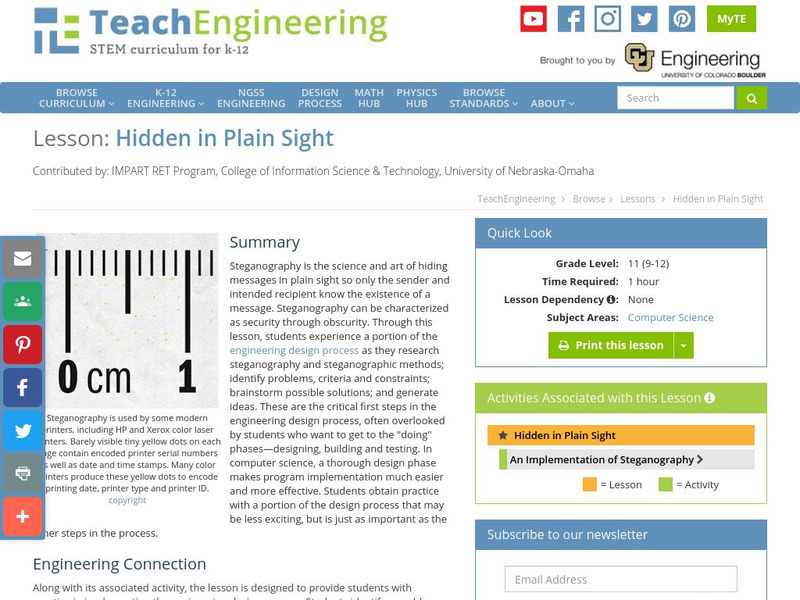
Teach Engineering: Hidden in Plain Sight
Steganography is the science and art of hiding messages in plain sight so only the sender and intended recipient know the existence of a message. Steganography can be characterized as security through obscurity. Through this lesson plan,...
Better Lesson
Better Lesson: 10 More and 10 Less
This lesson is More or Less a great lesson! Engage learners in finding 10 more and 10 less than a number using these fun activities. Includes an eSpark video on place value, detailed lesson plan, copy of a hundreds chart, and practice...
TeachEngineering
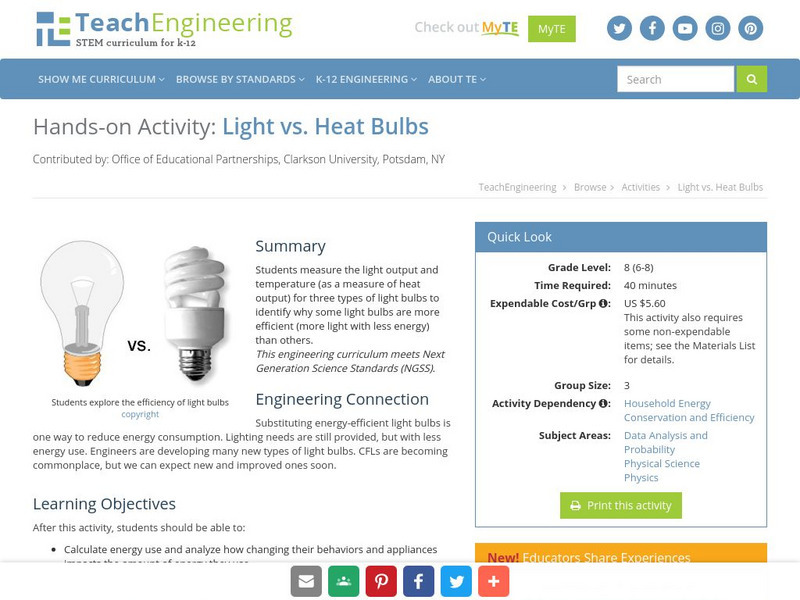
Teach Engineering: Light vs. Heat Bulbs
Students measure the light output and temperature (as a measure of heat output) for three types of light bulbs to identify why some light bulbs are more efficient (more light with less energy) than others.
TeachEngineering
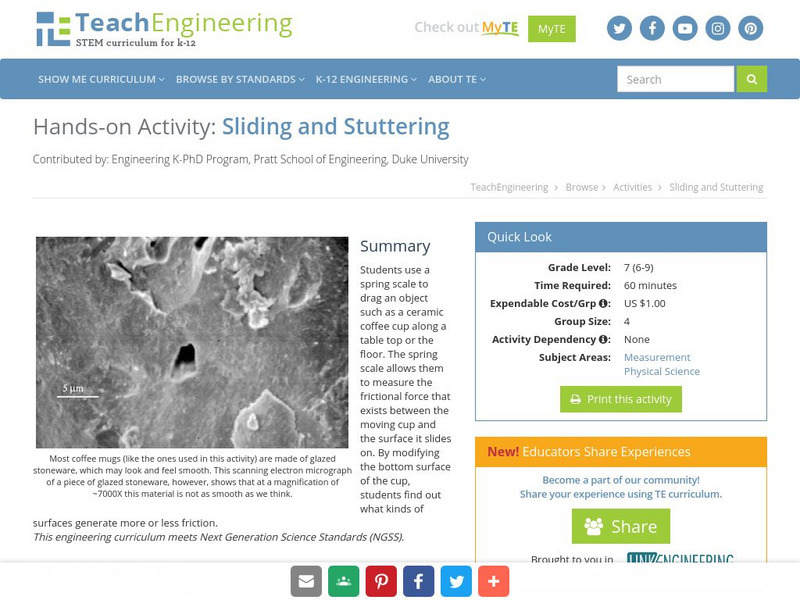
Teach Engineering: Sliding and Stuttering
Students use a spring scale to drag an object such as a ceramic coffee cup along a table top or the floor. The spring scale allows them to measure the frictional force that exists between the moving cup and the surface it slides on. By...
TeachEngineering
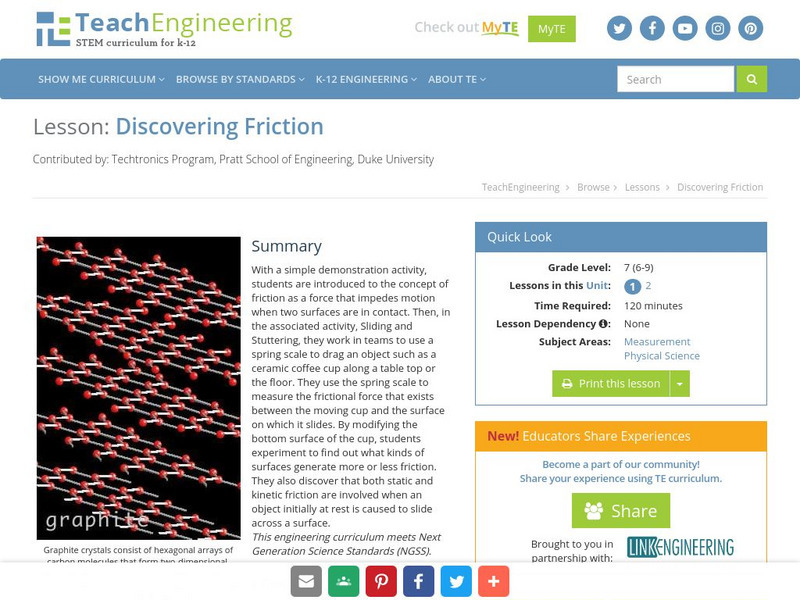
Teach Engineering: Discovering Friction
With a simple demonstration activity, young scholars are introduced to the concept of friction as a force that impedes motion when two surfaces are in contact. Then, in the Associated Activity (Sliding and Stuttering), they work in teams...
TeachEngineering
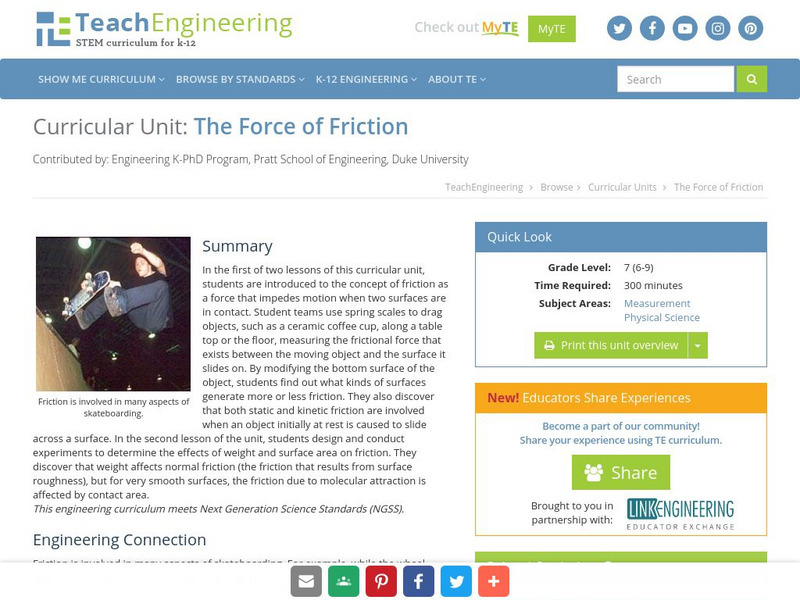
Teach Engineering: The Force of Friction
In the first of two lessons of this curricular unit, students are introduced to the concept of friction as a force that impedes motion when two surfaces are in contact. Student teams use spring scales to drag objects, such as a ceramic...