Hi, what do you want to do?






Curated OER
Honor Your Special Qualities
Learners view different sculptures from artist Ronald Baron. They discuss what the sculpture depicts. They are to create a thank you trophy for someone they know. They are to focus on that person's special qualities.

Curated OER
Introduction To Floral Morphology
Students create a model of the four basic whorls of flowers using a water bottle, construction paper and Q-tips. They then examine fresh flower specimens to see how the basic structure can vary in different species of flowering plants.

Curated OER
Family Life And Sexual Health
Students investigate the philosophy of health as outlined in the FLASH curriculum. They practice how to appreciate and respect themselves in respect to sexuality and overall wellness. There is also a section of the lesson that focuses on...

Curated OER
SkyHighScrapers
Students investigate quadratic functions. In this Algebra I/Algebra II activity, students determine the equation of a quadratic function that closely matches a set of points. Students investigate the necessary information...

Curated OER
Lightening the Load
Students explore a study of African women who are able to carry heavy loads by altering their gait; they then conduct experiments that study the relationship between exertion, weight and heart rate.

Curated OER
Advertise With Geography...it's Free And It's Easy!!
Students establish awareness of how landforms/landmarks produce a visual image of a region and demonstrate how advertisers use the "positive geographical image" to sell their product by creating their own advertisements.

Curated OER
The Sky Show
Students use lecture and research to answer the question: Why is the sky blue? students research a variety of other sky phenomena, chart their observations and participate in experiments.

Curated OER
Twisted Vision
Students explain polarization vision and why some animals have it while others do not. They examine the reasons why it would be helpful for marine organisms to have polarized light.

Curated OER
Go LEGO!
Young scholars utilize LEGO's to replace cards for a game that replicates "Go Fish".

Curated OER
Local Area - Ecosystems
Students examine ecosystems in the Connecticut River Valley. They view and discuss photos of ecosystems within their community, and create a picture web of an ecosystem.

Curated OER
Examining the African American Role in New Haven History: Pride in the Past? Hope for the Future
Fifth graders examine the role of African-Americans in New Haven, Connecticut. Using two maps, they compare and contrast the differences in the town from the past to today. In groups, they use the internet to research the contributions...

Curated OER
Fundamentalism
Eighth graders explore the historical roots of fundamentalism and determine whether fundamentalism is a religion or a political ideology. They will examine different religious fundamentalist movements around the world noting any...

Curated OER
Birds of Wisconsin
First graders explore the job done by ornithologists. They role play identifying the characteristics that make a bird a bird. They discuss what makes each bird species unique. Students are introduced to Wisconsin's most common and rare...

Curated OER
The Sine Function
Students explore the concept of the sine function. In this sine function lesson, students use a plexiglass sine wave generator to visualize the sine function. Students use a computer program/calculator to adjust aspects of the sine...

Curated OER
Anolis Lizards of the Greater Antilles
Students "take a trip" to the Greater Antilles to observethe Anolis lizards. They study the body structures and habitat of different species, then plot this data on a map to look for patterns in their distribution. From the patterns they...
Sophia Learning
Sophia: Physics: Relative Velocity Part 2
Created to teach students of the 21st century, SOPHIA is bringing relative velocity straight to your fingertips. Become the commander of your own learning experiences as you take part in this interactive lesson.
Sophia Learning
Sophia: Physics: Relative Velocity Part 3 Tutorial
Created to teach students of the 21st century, SOPHIA is bringing relative velocity straight to your fingertips. Become the commander of your own learning experiences as you take part in this interactive lesson.
TeachEngineering
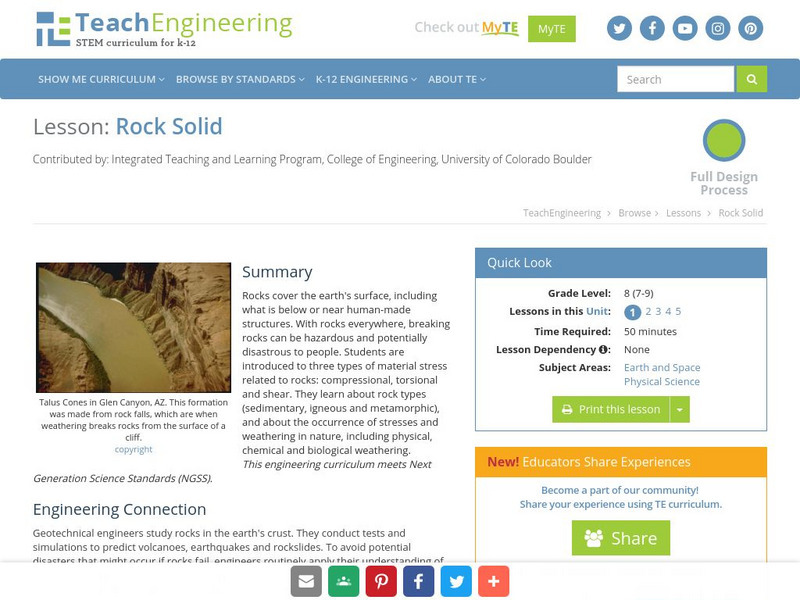
Teach Engineering: Rock Solid
Rocks cover the earth's surface, including what is below or near human-made structures. With rocks everywhere, breaking rocks can be hazardous and potentially disastrous to people. Students are introduced to three types of material...
TeachEngineering
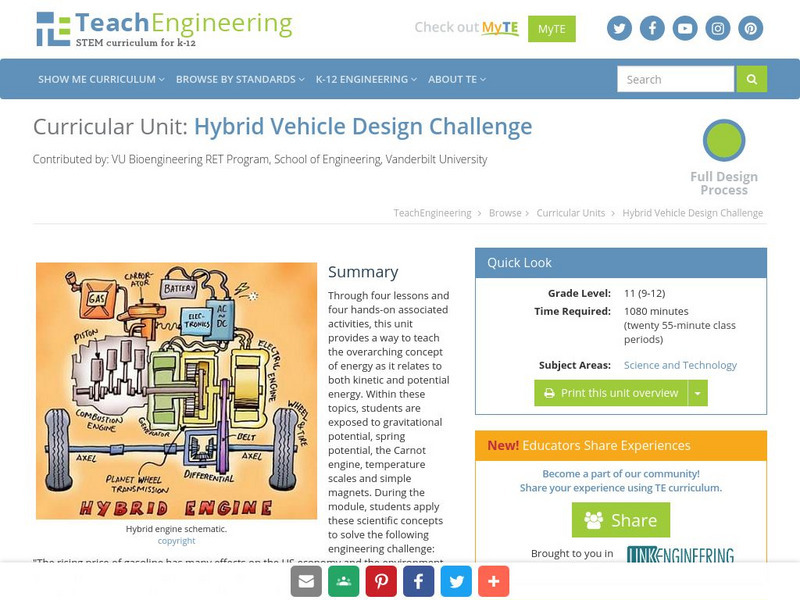
Teach Engineering: Hybrid Vehicle Design Challenge
This module is written for a first-year algebra-based physics class, though it could easily be modified for conceptual physics. It is intended to provide hands-on activities to teach the overarching concept of energy, as it relates to...
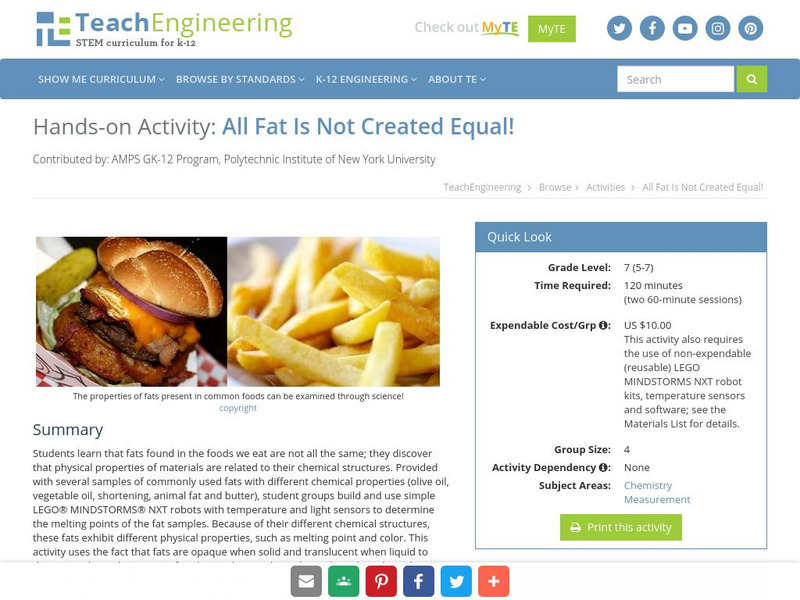
TeachEngineering
Teach Engineering: All Fat Is Not Created Equally!
Students learn that fats found in the foods we eat are not all the same; they discover that physical properties of materials are related to their chemical structures. Provided with several samples of commonly used fats with different...
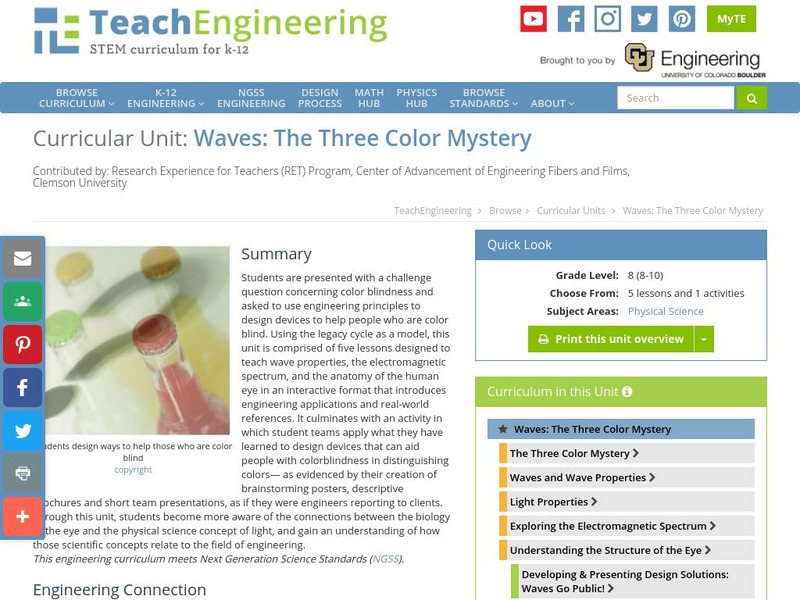
TeachEngineering
Teach Engineering: Waves: The Three Color Mystery
Students are presented with a challenge question concerning color blindness and asked to use engineering principles to design devices to help people who are color blind. Using the legacy cycle as a model, this unit is comprised of five...
PBS
Teaching Bhutan: The Water Cycle & Bhutan
Interactive science lesson plan that teaches students about the water cycle in relation to mountain ranges and monsoons common in Bhutan. Make a cloud in a bottle!
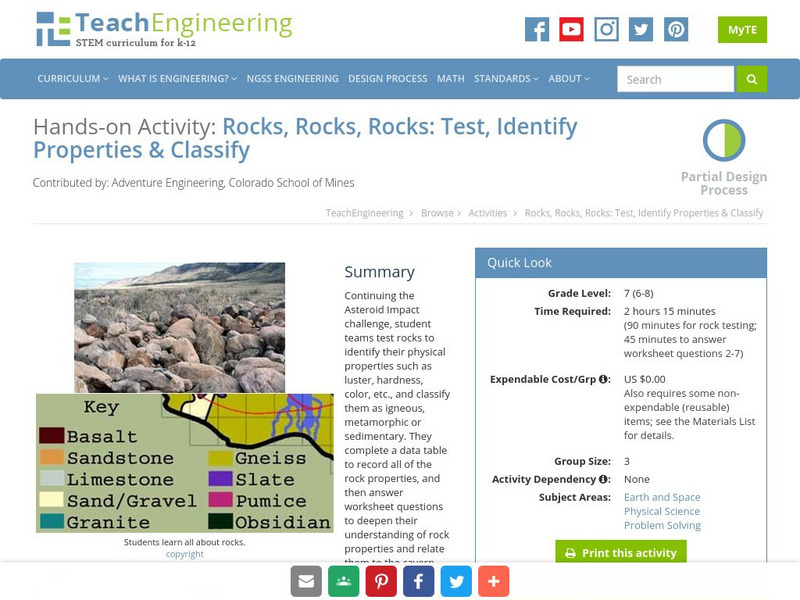
TeachEngineering
Teach Engineering: Rocks, Rocks, Rocks
Students test rocks to identify their physical properties (such as luster, hardness, color, etc.) and classify them as igneous, metamorphic or sedimentary. They complete a worksheet table to record all of the rock properties, and then...
TeachEngineering
Teach Engineering: A Shot Under Pressure
Students use their understanding of projectile physics and fluid dynamics to find the water pressure in water guns. By measuring the range of the water jets, they are able to calculate the theoretical pressure. Students create graphs to...