Hi, what do you want to do?






US National Archives
Nara: Teaching With Documents: Message From Eisenhower to Marshall
This lesson takes a close look at a primary document written by General Eisenhower to General Marshall. The document reflects a lack of information about the invasion that was underway. There are activities and worksheets included.
US National Archives
Nara: Teaching With Documents: The Amistad Case
The National Archives and Records Administration (NARA) provides background information for the Amistad case, several of the actual documents involved in the case, and teaching activities that correlate the information (at the bottom of...
US National Archives
Nara: Teaching With Documents: Political Cartoons
Offers teaching activities, four political cartoons, and a narrative about reforms proposed by three major presidential candidates in 1912: Theodore Roosevelt, William Howard Taft, and Woodrow Wilson.
US National Archives
Nara: Teaching With Documents: Little House in Census: Almanzo and Laura Wilder
Data from the 1880 and the 1900 Censuses, and how these relate to the lives of Almanzo and Laura Ingalls Wilder, are presented here. There are also ideas for teaching using primary sources.
US National Archives
Nara: Teaching With Documents: Petition of Amelia Bloomer Regarding Suffrage
Amelia Bloomer was a prominent advocate of women's rights in the 19th century. She invented bloomers to replace the skirt hoop, in an effort to free women from much of their cumbersome apparel. She later used her newspaper, The Lily, to...
US National Archives
Nara: Teaching With Documents: The United States Enters the Korean Conflict
This is a lesson plan outline which correlates the relationship between NSC-68 and U.S. policy in Korea. A National Archives and Records Administration site (NARA) with additional links to more teaching resources.
US National Archives
Nara: Teaching With Documents: 1897 Petition Against the Annexation of Hawaii
A great lesson plan using primary source materials to examine the overthrow of the Hawaiian monarchy and the subsequent annexation of Hawaii to the United States. Find the background information, documents, suggested teaching activities,...
US National Archives
Nara: Teaching With Documents: Glidden's Patent Application for Barbed Wire
The U.S. National Archives and Records Administration (NARA) provides an elaborate lesson plan on Joseph Glidden's patent for barbed wire. Content includes extensive background information about barbed wire, images of the original patent...
US National Archives
Nara: Teaching With Documents: An Act of Courage: Arrest Records of Rosa Parks
A vividly detailed account of the events that led to the arrest of Rosa Parks for "violating a city law requiring racial segregation of public buses". Provided are copies of documents relating to her arrest that were used as evidence in...
US National Archives
Nara: Teaching With Documents: Eli Whitney's Patent for the Cotton Gin
This National Archives and Records Administration site relates the history of Eli Whitney and his remarkable inventions. Links to sites with patent information on the cotton gin. Tons of teacher's resources can be found at this site.
US National Archives
Nara: Teaching With Documents: Beyond the Playing Field: Jackie Robinson
The National Archives and Records Administration (NARA) provides several primary source documents pertaining to Jackie Robinson's period of civil rights advocacy, as well as corresponding lesson plans.
US National Archives
Nara: Teaching With Documents: Glidden's Patent Application for Barbed Wire
This article from the National Archives and Records Administration (NARA), describes how barbed wire was important for ranchers in the West in the 1800s and how Joseph Glidden improved the original patent for barbed wire.
US National Archives
Nara: Teaching With Documents: Sioux Treaty of 1868
The National Archives and Records Administration highlights the Sioux Treaty of 1868. The lesson provided here relates to the power granted to the president and the Senate in Article II, Section 2, Clause 2, of the U.S. Constitution, the...
US National Archives
Nara: Teaching With Documents: Lincoln's Spot Resolutions
This "Teaching with Documents" lesson on Lincoln's spot resolutions explores the Mexican War, Lincoln's questioning of the propriety of the war, and the power of the U.S. President at that time. Content includes extensive historical...
US National Archives
Nara: Teaching With Documents:tally of the 1824 Electoral College Vote
The National Archives and Records Administration provides a lesson, with corresponding information and documents, relating to the role of the Electoral College in the election of the president and vice-president as specified in the U.S....
US National Archives
National Archives: Teaching Six Big Ideas in the Constitution
The Constitution can be broken down into 6 main themes: Limited Government, Federalism, Republicanism, Separation of Powers, Checks and Balances, and Popular Sovereignty. Learners will study background on the Founding Fathers and use...
Teaching American History
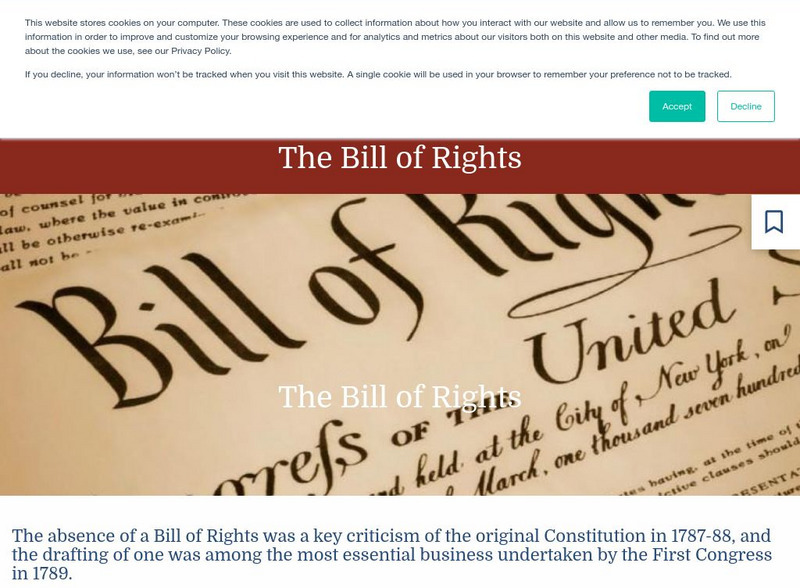
Teaching American History: Bill of Rights
Enrich learning about the U.S. Constitution's Bill of Rights with the help of this comprehensive resource. Find details about the amendments added to the new national document.
Daily Teaching Tools
Daily Teaching Tools: How to Teach Spelling
A teaching resource with free downloads of PDF documents and graphic organizers along with guidelines and practice activities to use while teaching students to become better spellers.
US National Archives
Docsteach: The School Lunch Program and the Federal Government
Young scholars will draw upon the visual and textual data presented in photographs and documents to gain an understanding of how the federal school lunch program is a direct result of the Great Depression, how it became a permanent part...

Library of Congress
Loc: Teachers: Personal Stories and Primary Sources
Young scholars will explore the value of personal stories and first-hand accounts when exploring history, in this case, the events of the early twentieth century, which included World War I and the Great Depression. Through this...

Internet History Sourcebooks Project
Fordham University: Medieval Sourcebook: History Through Primary Sources
This site from the Medieval Sourcebook answers the question: Why Study History Through Primary Sources? It provides complete information, a list of review questions, and bibliography information.
National Endowment for the Humanities
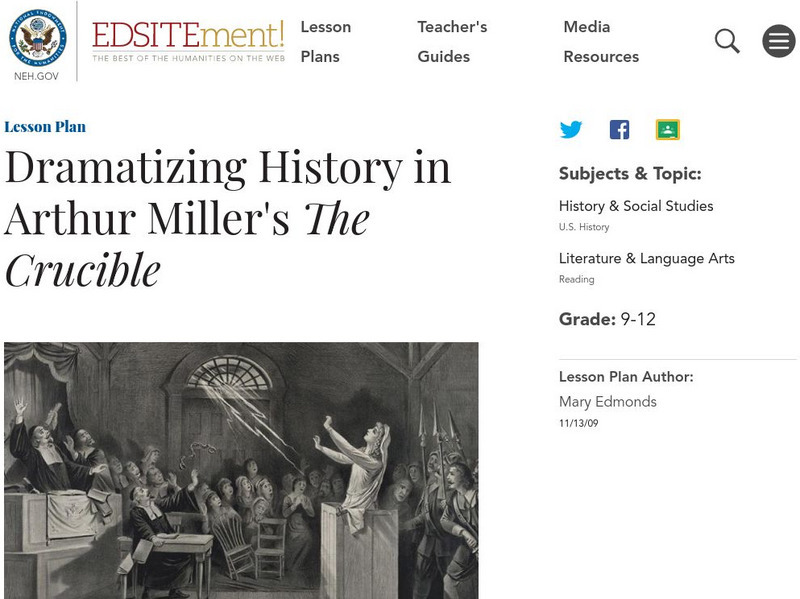
Neh: Edsit Ement: Dramatizing History in Arthur Miller's "The Crucible"
Critical analysis of both the historical documents and the literary texts connected with the Salem trials is key to this lesson, which includes a number of activities and some wonderful resources.
University of California
Regents of the University of California: Using the Cognates Strategy
This strategy guide introduces an approach for making students aware of cognates (words that have a similar spelling, pronunciation, and meaning across languages) in content-area texts. This guide includes an introductory section about...
University of California
Cal Heritage Collection: Using Primary Sources
This resource covers what primary sources are, where we can find them, and how we can assess them in the classroom.