Hi, what do you want to do?






A&E Television
History.com: Native Americans Weren't Guaranteed the Right to Vote in Every State Until 1962
Native people won citizenship in 1924, but the struggle for voting rights stretched on much longer. Native Americans couldn't be U.S. citizens when the country ratified its Constitution in 1788, and wouldn't win the right to be for 136...
Thomson Reuters
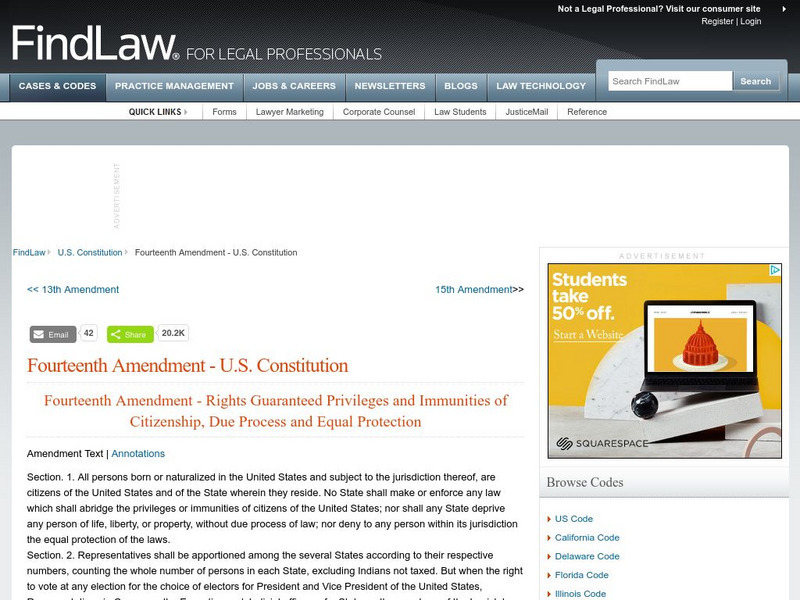
Find Law: u.s. Constitution: Fourteenth Amendment
Presents the Fourteenth Amendment - Rights Guaranteed Privileges and Immunities of Citizenship, Due Process and Equal Protection. Includes a lengthy list of annotations to the Amendment.
University of Missouri
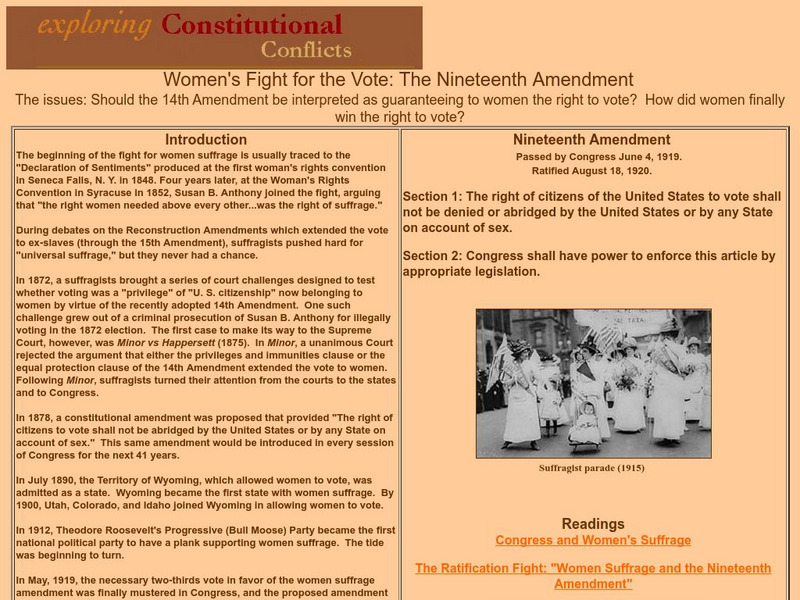
Exploring Constitutional Conflicts: Women's Fight for the Vote
Find out how women won the right to vote. Read a brief history of the women's suffrage movement and the text of the Nineteenth Amendment.
Wikimedia
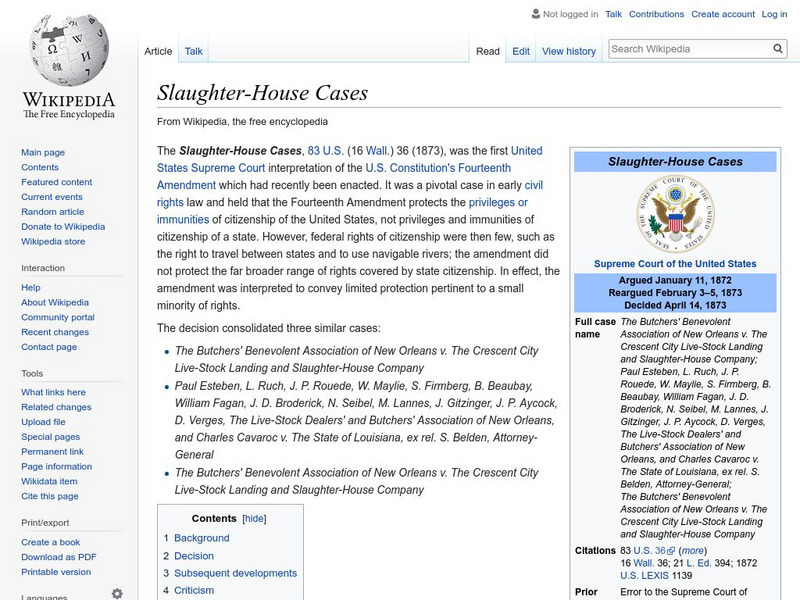
Wikipedia: The Slaughter House Cases
Learn about the historically important 1873 Slaughter-House Cases on civil rights, which became the first Supreme Court interpretation of the Fourteenth Amendment.
Other
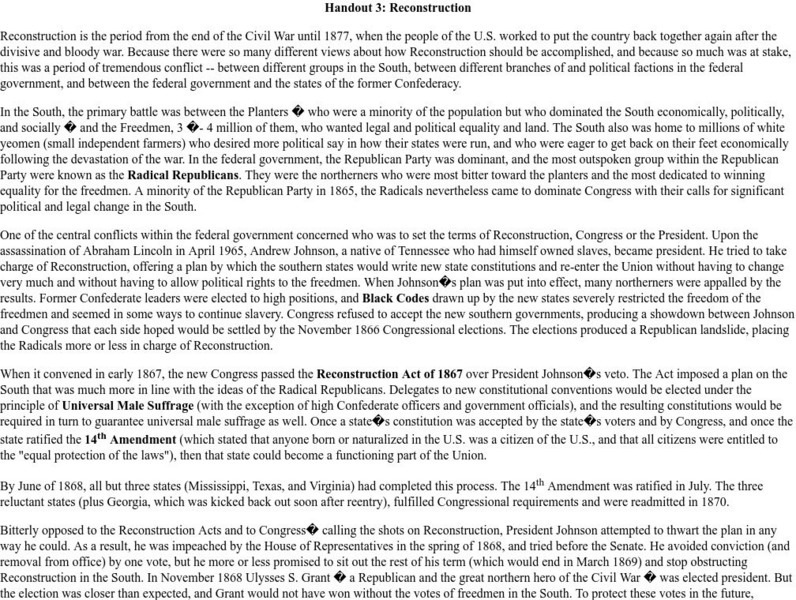
University of Western Georgia: Reconstruction in the South
An excellent distillation of the many issues addressed in the Reconstruction period in the South in the twelve years after the end of the Civil War.
Curated OER
History Matters: Separate but Equal: The Plessy v. Ferguson Case
Read the judgment of Supreme Court justice, Henry Billings Brown, who wrote for the majority in the Plessy v Ferguson decision that codified the idea of "separate but equal" in the American justice system until it was overturned by Brown...
Digital History
Digital History: Chapter 7: Affirmative Action and the Case of Alan Bakke [Pdf]
Article presents an overview of the history behind the birth of 'affirmative action'. Includes a discussion of the Supreme Court case of Alan Bakke v. the University of California and student exercises that test comprehension of the topic.
CPALMS
Florida State University Cpalms: Florida Students: The Civil War's Legacy
In this tutorial, students look at how the Civil War ended and the impact on the North and the South and on the future of the United States. The 13th, 14th, and 15th Amendments to the Constitution are also examined for how they came...
iCivics
I Civics: Obergefell v. Hodges (2015)
This mini-lesson covers the basics of the Supreme Court's decision that extended marriage rights to same-sex couples. Students learn about the 14th Amendment's Equal Protection and Due Process Clauses, and how the Court's interpretation...
Independence Hall Association
U.s. History: Separate No Longer?
An explantion of how the Supreme Court decision in Brown v Board of Education of Topeka turned the concept of separate but equal on its head. See how they determined that the 14th Amendment was being violated when schools did not fund...
Then Again
Then Again: Web Chron: Plessy v. Ferguson
A short article describing the impact of Plessy v. Ferguson on the 14th Amendment. Links to other sites.
iCivics
I Civics: Loving v. Virginia (1967)
This mini-lesson covers the basics of the Supreme Court's decision that struck down state bans on interracial marriage. Students learn about the 14th Amendment's Equal Protection Clause, and its use in court cases to challenge a range of...
iCivics
I Civics: Elk v. Wilkins (1884)
This mini-lesson examines the Supreme Court's ruling that the 14th Amendment's Citizenship Clause did not apply to American Indians born on Native reservations. Students analyze a primary document and discover how the lack of citizenship...
iCivics
I Civics: United States v. Virginia (1996)
This mini-lesson covers the basics of the Supreme Court's decision that found the Virginia Military Institute'discriminations male-only admission policy discriminated against women. Young scholars learn about the 14th Amendment's Equal...
Annenberg Foundation
Annenberg Learner: Civil Rights: Demanding Equality
Teach the history of Civil Rights using this comprehensive learning module. Trace the movement from the 14th Amendment to modern times. The focus is on African American rights but also touches on women and disabled American's rights....
Immigration and Ethnic History Society
Iehs: Kevin Kenny, "Insiders & Outsiders in 19th Century American Immigration"
This article focuses on the history of who were the insiders (with rights) and the outsiders (without rights) in the early history of the US (prior to the 14th Ammendment. It was largely based on race not citizenship.

Thomson Reuters
Find Law: u.s. Supreme Court: Mapp v. Ohio (1961)
Detailed account of the Supreme Court case of Mapp v. Ohio with the ruling that states are required to exclude evidence seized by illegal search and seizure in violation of the 4th Amendment.

Khan Academy
Khan Academy: The Montgomery Bus Boycott
Read about the action of Rosa Parks who refused to give up her seat on a bus in Montgomery, Alabama in 1955, triggering a massive bus boycott led by Martin Luther King, Jr. The boycott became the impetus for a Supreme Court ruling that...
The History Cat
The History Cat: Reconstruction Era
Describes what the South was like after the Civil War ended. Many places were in ruins and people were desperately poor with many being homeless. Social structures had collapsed now that slaves had been freed. The Reconstruction era...
Digital History
Digital History: The Supreme Court Orders Desegregation [Pdf]
This site is from a unit called 'African-Americans in the Land of Equality.' It looks at the 1954 decision by the Supreme Court in the Brown v. Board of Education case that ended school segregation.
The History Place
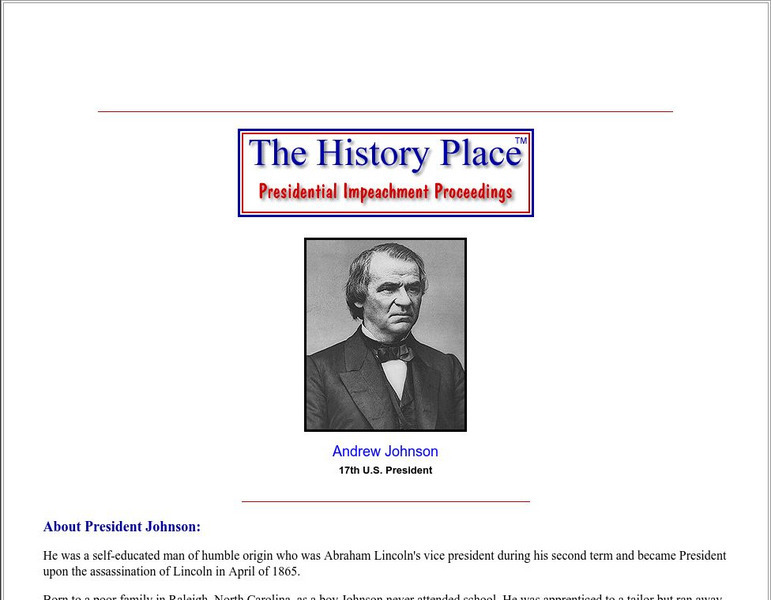
The History Place: Impeachment of Andrew Johnson
A clear explanation of the events that led to the trial and impeachment of Andrew Johnson. Included are the articles of impeachment.
Illinois Institute of Technology
The Oyez Project: Shelley v. Kraemer
Provides facts about the Supreme Court case Shelley v. Kraemer, including an abstract, links to written opinions of the Court, and how each of the nine justices ruled upon the case.
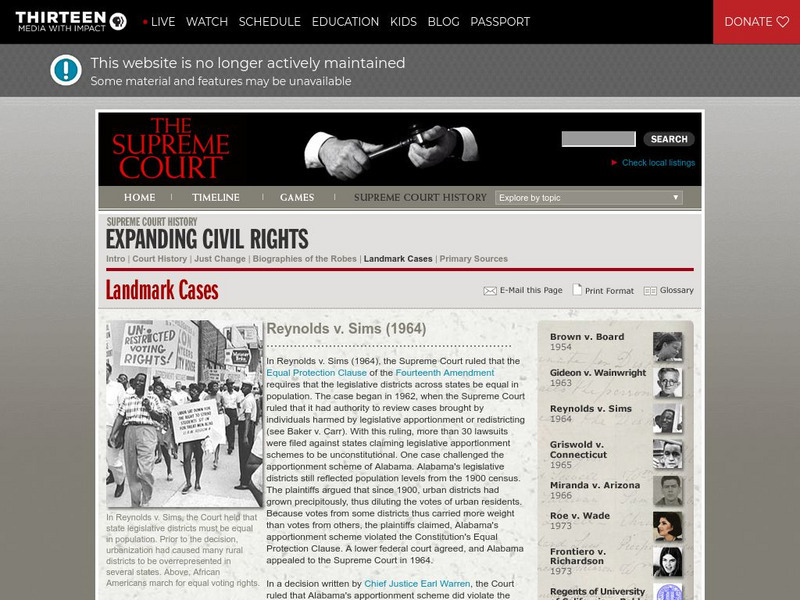
PBS
Wnet: Thirteen: The Supreme Court: Landmark Cases: Reynolds v. Sims (1964)
PBS provides a synopsis of the landmark Supreme Court case of Reynolds v. Sims, the Alabama reapportionment case in which the Court reaffirmed the principle of one person, one vote. Decision was written by Chief Justice Earl Warren.
Digital History
Digital History: Affirmative Action and the Case of Allan Bakke [Pdf]
The history of affirmative action was interwoven with the Civil Rights Act of 1964 and the Voting Rights Act of 1965. Read about how the federal government under both President Kennedy and President Nixon attempted to open up jobs to...