Hi, what do you want to do?






Library of Congress
Loc: Continental Congress and the Constitutional Convention
This site provides a collection of material regarding the work of the Continental Congress and the Constitutional Convention. Content includes a focus on how the Revolutionary War was organized, fanning the flames of patriotism,...

Library of Congress
Loc: The New Nation 1783 1815
The creation and growth of the new nation of the United States is the focus of this article. Being divided into time periods makes this site easy to understand.
Tom Richey
Tom Richey: The u.s. Constitution (1783 1789)
A comprehensive unit of the colonies gaining their independence from and trying to create an effective constitution establishing a new government. Find lessons, videos, and primary sources.
National Endowment for the Humanities
Neh: Edsit Ement: Declare the Causes
Offers lesson plans that guide students to understanding the structure of the Declaration of Independence. Throughout the course of the lesson, students will be working on writing their own declaration of grievances relative to issues in...
Digital History
Digital History: Was the Constitutional Convention Legal?
A look at the convening of a Constitutional Convention to address the problems inherent in the Articles of Confederation. Read a quote from George Washington, who addressed the legality of such a convention.
University of Chicago
The Founders' Constitution: Deficiencies of the Confederation
The original text of a letter from Alexander Hamilton to Governor George Clinton of New York in 1778 complaining of inadequate material for the U.S. armed forces and perception of weakness by foreign powers.

A&E Television
History.com: The Patriot Financier Who Bankrolled the Revolutionary War
A brash, self-made millionaire helped fund the fight for independence, but after the war, he ended up in debtor's prison. Without Robert Morris, the American Revolution may have been crushed under a mountain of debt and disarray. The...
Independence Hall Association
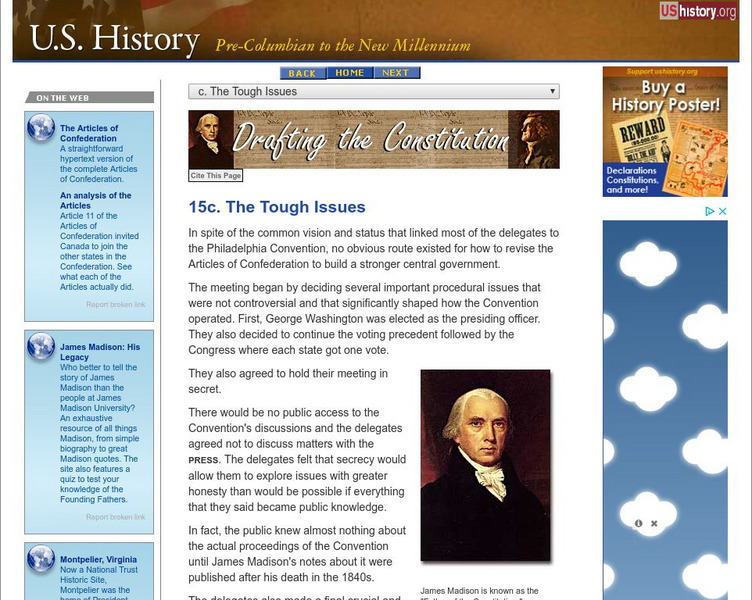
U.s. History: The Tough Issues
Read about the change of plans when delegates to the Philadelphia convention decided to write a new constitution to replace the Articles of Convention. See the ideas delegates had to address concerns of large and small states.
Digital Public Library of America
Dpla: Creating the Us Constitution
The sources in this primary set document the creation of the US Constitution. Includes teaching guide.
Bill of Rights Institute
Bill of Rights Institute: Constitution of the United States of America (1787)
The Constitution was written in the summer of 1787 in Philadelphia, Pennsylvania, by delegates from 12 states, in order to replace the Articles of Confederation with a new form of government. It created a federal system with a national...
US Government Publishing Office
Ben's Guide to u.s. Government: The Constitution
Ben's Guide is a fun way to present U.S. Government to students grades K-12. This site presents a brief history of the Constitution. Links to related sites are available.
Other
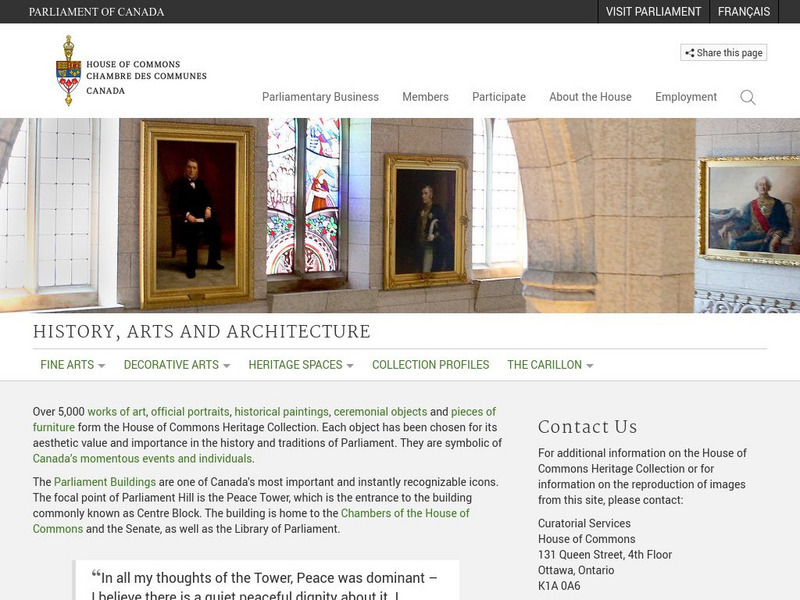
The House of Commons Heritage Collection
This comprehensive site from the Curatorial Services of the House of Commons in Ottawa collects and celebrates the architecture, fine art, and heritage spaces of Canada's Parliament. The Collection Profiles gives students web-based...
Independence Hall Association
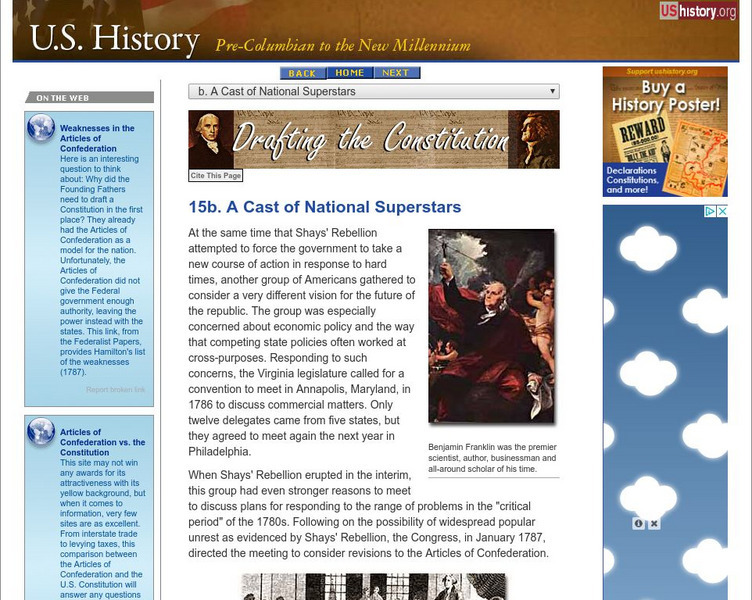
U.s. History: A Cast of National Superstars
A brief look at some of those who served as delegates to the Philadelphia Convention, which morphed into a constitutional convention. Pay attention to the class of people who made up the delegates.
Digital History
Digital History: A Bill of Rights? [Pdf]
There was no Bill of Rights attached to the original Constitution, but it was a topic of discussion. Read a reconstruction of speeches of delegates to the Constitutional Convention who debated for and against the inclusion of a way to...
iCivics
I Civics: Wanted: A Just Right Government
Look at the tensions and differences of opinion that existed among early American states and citizens. Learn about the Articles of Confederation, why the first "constitution" didn't work, and how compromise led to the Constitution.
National Humanities Center
National Humanities Center: America in Class: After Shays' Rebellion
Lesson on the aftermath of Shays' Rebellion as a reflection of the republican nature of American government and the right to vote. Includes primary resources with background information and strategies for analysis.

ClassFlow
Class Flow: A New Government
[Free Registration/Login Required] This flipchart discusses the events following the American Revolution and how the new government developed. The Articles of Confederation and their replacement by the US Constitution are explained....
PBS
Pbs Learning Media: Alexander Hamilton: Lawyer, Writer, and Founding Father
Through a short video and an analysis of two primary sources, learners will examine the life of Alexander Hamilton, an important military and political leader.

The Dirksen Congressional Center
Congress for Kids: Democracy
Aimed at younger students learning about government, this section of the larger 'Congress for Kids' website focuses on Democracy. Links to related topics include democracy vs autocracy, 13 Colonies, Declaration of Independence, and...
Tom Richey
Tom richey.net: The u.s. Constitution: Framing, Principles and Ratification [Ppt]
Presents key ideas for examining how the Articles of Confederation were replaced with the Constitution and the compromises that were reached during debates.
PBS
Wnet: Thirteen: Freedom: A History of Us: Revolution: Continental Congress [Pdf]
A lesson plan from the producers of the 16-episode PBS series "Freedom: A History of US" that examines the rules by which the Continental Congress governed colonial America. Learners will identify people who held positions of leadership...

Bill of Rights Institute
Bill of Rights Institute: John Jay
John Jay epitomized the selfless leader of the American Revolution. Born to a prominent New York family, John Jay gained notoriety as a lawyer in his home state. He favored a moderate approach to Britain but joined his fellow Patriots...
Bill of Rights Institute
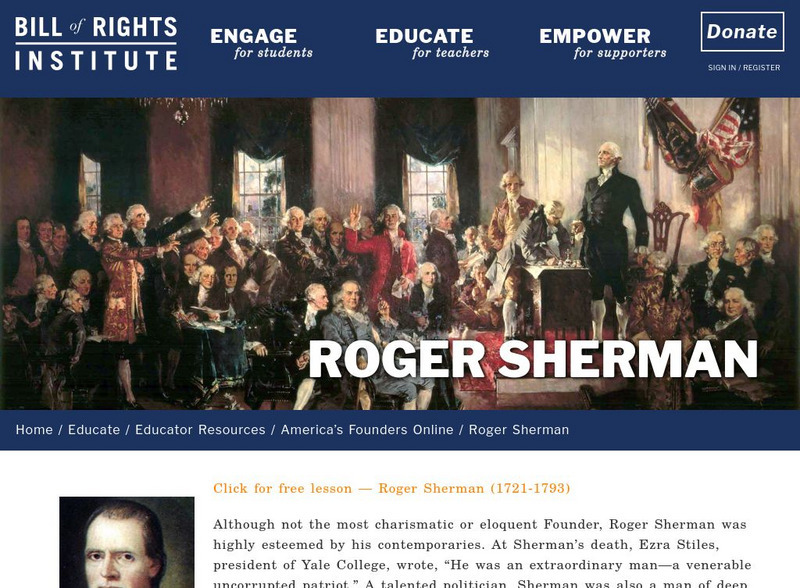
Bill of Rights Institute: Roger Sherman
Although not the most charismatic or eloquent Founder, Roger Sherman was highly esteemed by his contemporaries. At Sherman's death, Ezra Stiles, president of Yale College, wrote, "He was an extraordinary man-a venerable uncorrupted...

Bill of Rights Institute
Bill of Rights Institute: John Dickinson
John Dickinson was called "The Penman of the American Revolution." During the 1760s and 1770s, he authored numerous important essays in defense of American rights, including The Late Regulations Respecting the British Colonies, the...