Hi, what do you want to do?






Thomson Reuters
Find Law: u.s. Supreme Court: Escobedo v. Illinois (1964)
This provides the full text of the oral argument and also links to cases citing the Gideon case in the Supreme Court and Circuit court levels.
Thomson Reuters
Find Law: u.s. Supreme Court: Griswold v. Connecticut (1965)
This Supreme Court case dealt with the issue of contraception. View the the Supreme Court opinion as delivered by Justice Douglas.
OpenStax
Open Stax: Debating Democracy
By the end of this section of a chapter on "Creating Republican Governments," students will be able to explain the development of state constitutions, describe the features of the Articles of Confederation, and analyze the causes and...

US Government Publishing Office
Ben's Guide to u.s. Government: Signers of the Constitution Word Search
A printable wordsearch on thirty-nine of the delegates who signed of the US Constitution.
Siteseen
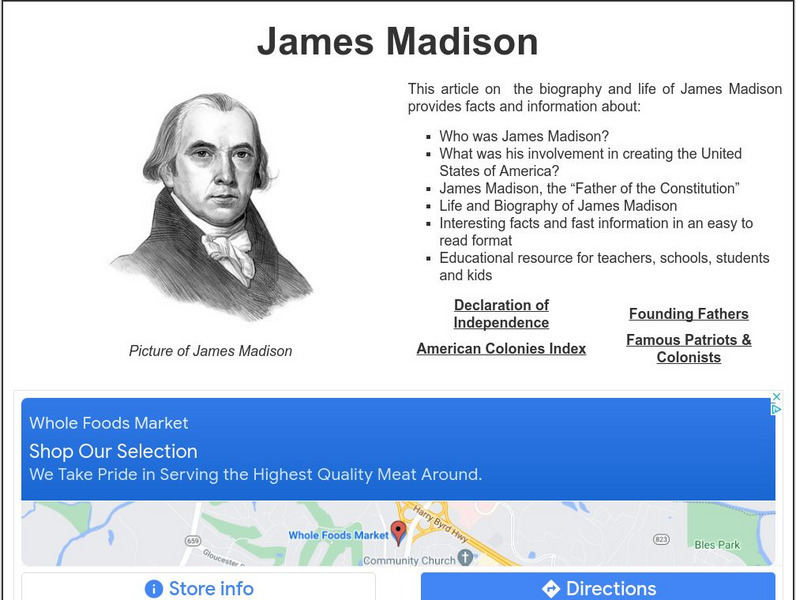
Siteseen: Land of the Brave: James Madison
Overview and biographical facts on the life of James Madison, the "Father of the Constitution".
Siteseen
Siteseen: Government and Constitution: Article 5 of the Us Constitution
Overview and detailed facts on Article 5 of the US Constitution that deals with how to amend the Constitution.

Scholastic
Scholastic: u.s. Constitution Changes With the Times
Clear, concise overview of the "voting" amendments to the Constitution. Includes quotes from 20th century Justices and Presidents about Amendments they thought were needed.
Siteseen
Siteseen: Government and Constitution: Us House of Representatives Facts
Detailed facts and information provide a quick overview of how the US House of Representatives, a part of Congress, works.
Siteseen
Siteseen: Government and Constitution: Us Congress Facts
Article provides an overview and interesting facts about the United States Congress, the legislative branch of the federal government.
Siteseen
Siteseen: Government and Constitution: Judiciary Branch
Article covers the Judiciary Branch of Government, the branch that interprets the law, and its connection to the US Constitution.

Siteseen
Siteseen: Government and Constitution: The Three Fifths Compromise
The Three-Fifths Compromise that was presented at the Constitutional Convention resolved the issue of counting slaves towards the population in regards to representation in the House of Representatives.
Siteseen
Siteseen: Government and Constitution: New Jersey Plan
New Jersey Plan was presented in the form of eleven resolutions drafted by William Paterson. It detailed a legislature of only one house and featured equal representation in which each state had the same number of representatives thus...
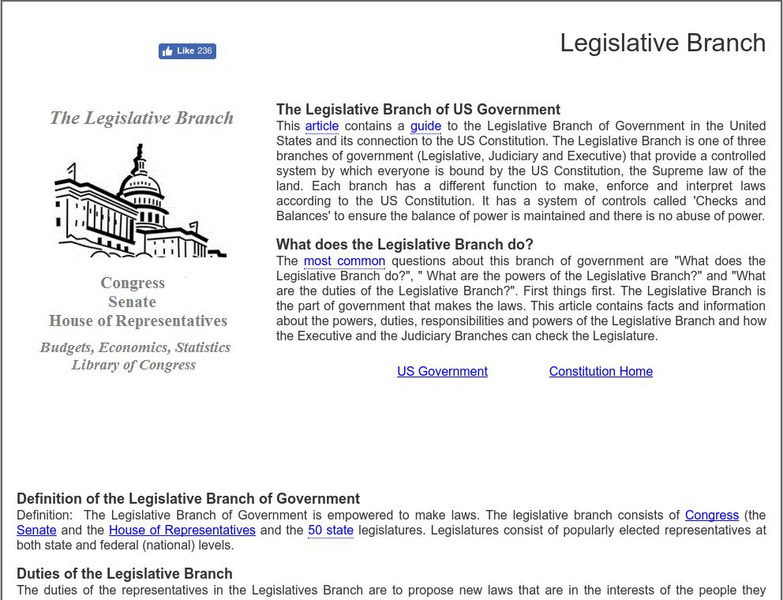
Siteseen
Siteseen: Government and Constitution: Legislative Branch
Article covers the Legislative Branch of Government, the branch that makes the laws, and its connection to the US Constitution.
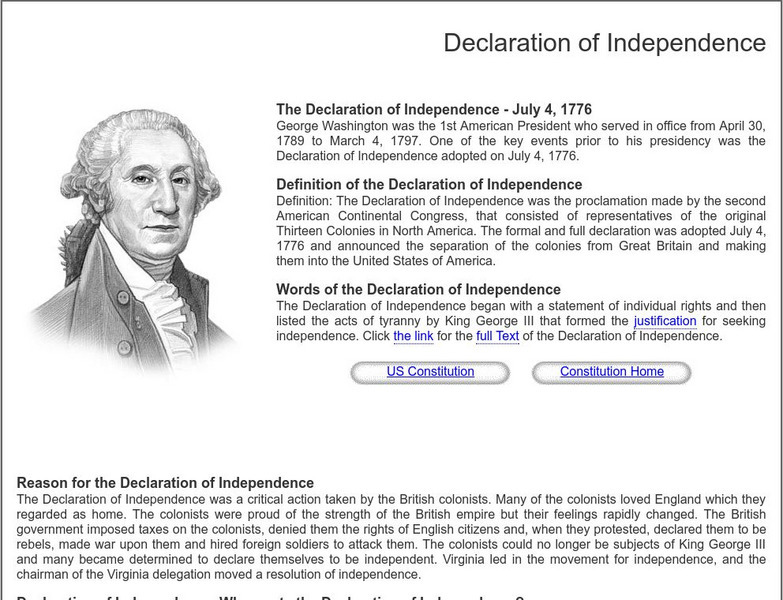
Siteseen
Siteseen: Government and Constitution: Declaration of Independence
The Declaration of Independence, made by the second American Continental Congress and adopted July 4, 1776, announced the separation of the original thirteen North American British colonies from Great Britain making them into the United...
Siteseen
Siteseen: Government and Constitution: The Great Compromise
Covers details of the Great Compromise which was presented at the Constitutional Convention. It consisted of the idea of proportional representation in the lower house (House of Representatives) and equal representation of the states in...

Siteseen
Siteseen: Government and Constitution: Executive Branch
Article provides a guide to the Executive Branch of Government, its connection to the US Constitution, and its role as the branch that enforces the law and is responsible for the daily administration of the government.
Siteseen
Siteseen: Government and Constitution: 10th Amendment
Short, simple summary with the full text of the 10th amendment of the Bill of Rights that states that any powers that the Constitution does not give to the US government, belong to the individual states and the people.
Thomson Reuters
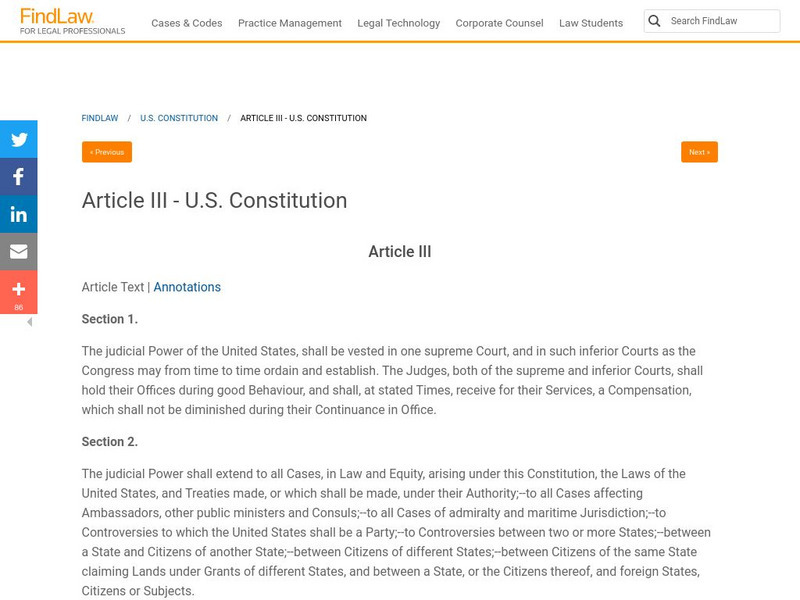
Find Law: Article Iii: Judicial Power
Annotations to Article III on the characteristics and attributes of judicial power as related to specific Supreme Court decisions. The author distinguishes between judicial power and jurisdiction.

Thomson Reuters
Find Law: u.s. Supreme Court: Mapp v. Ohio (1961)
Detailed account of the Supreme Court case of Mapp v. Ohio with the ruling that states are required to exclude evidence seized by illegal search and seizure in violation of the 4th Amendment.

Khan Academy
Khan Academy: Us Government and Civics
An entire course on US government and civics - we don't seem to have any of it; many individual lessons to harvest. Should be cross-checked against embedded videos.
Other
Touro Law Center: William Marbury vs. James Madison
Transcript of the landmark court case that established the constitutional principle of judicial review. Judicial review is the concept that the federal judiciary has final power as to whether an act of the Congress or the Executive...
Other
Pennsylvania Historical & Museum Commission: Independence to the Civil War
Discusses a variety of topics concerning the time period of 1776-1861, including Pennsylvania in the revolution, founding a commonwealth, founding a nation, population and immigration, political developments, industry, transportation,...
Scholastic
Scholastic: Who Shall Judge?
Well-written description of the process, qualifications, and constitutional background on selecting Supreme Court justices.
Thomson Reuters
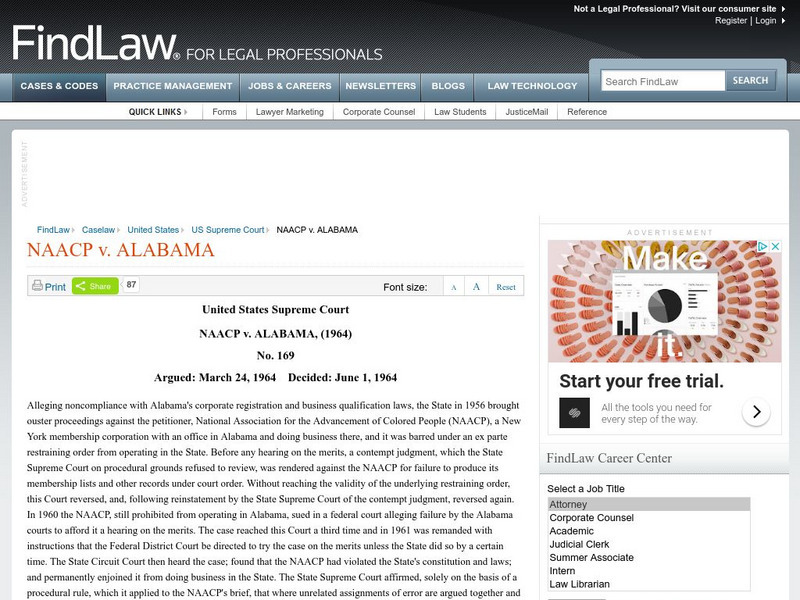
Find Law: u.s. Supreme Court: Naacp v. Alabama (1958)
Use this site to learn about this Supreme Court decision delivered by Justice Harlan in 1958 that dealt with the NAACP conducting business in Alabama and failure to reveal its membership lists.