Hi, what do you want to do?





CK-12 Foundation
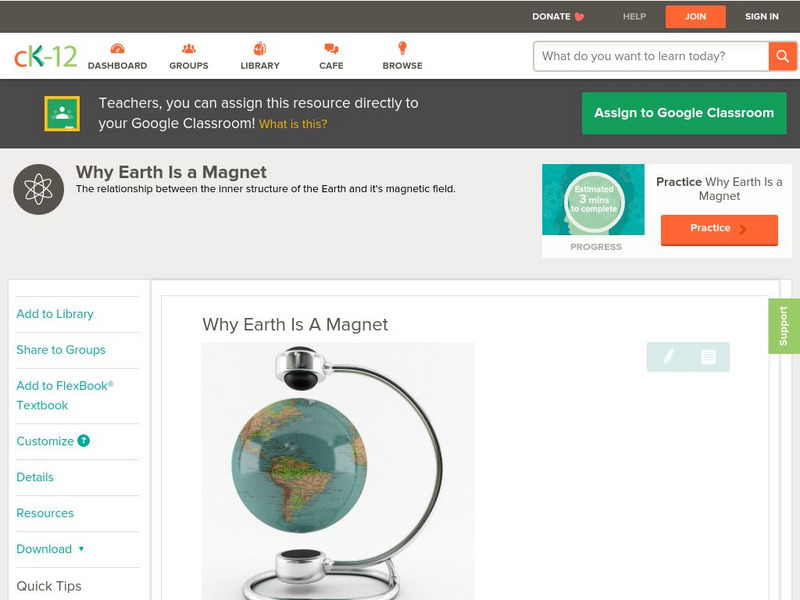
Ck 12: Physical Science: Why Earth Is a Magnet
[Free Registration/Login may be required to access all resource tools.] Why the Earth is a magnet and how its inner structure relates to its magnetic field.

CK-12 Foundation
Ck 12: Fifth Grade Science: Physical Science: Earth as a Magnet
[Free Registration/Login may be required to access all resource tools.] Looks at the Earth as a magnet and how Earth's magnetism benefits living things.

Exploratorium
Exploratorium: Science Snacks: Circles of Magnetism
Create a magnetic field that is stronger than Earth so a compass needle will orient itself to the new field in this activity.
TeachEngineering
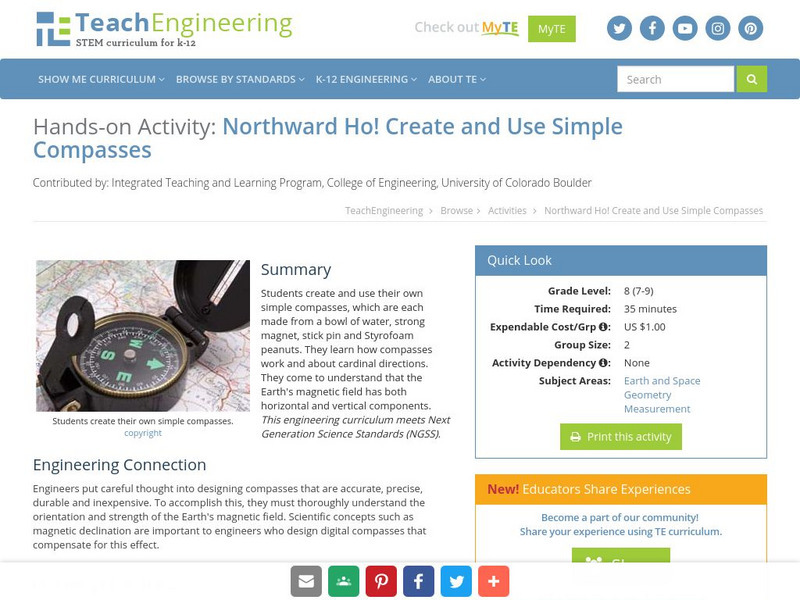
Teach Engineering: Northward Ho!
In this activity, students will create their own simple compass, be able to explain how a compass works, understand that the Earth's magnetic field has both horizontal and vertical components, and learn more about cardinal directions.

PBS
Nova: See a Reversal
The earth's magnetic field is due for a reversal. Find out what causes the magnetic field and view an animated model that shows it reversing.
National High Magnetic Field Laboratory
Magnet Academy: Oersted Satellite, 1999
Named in honor of Danish physicist Hans Christian Oersted, Denmark's first satellite has been observing and mapping the magnetic field of the Earth.
NASA
Nasa: Image Science Center: Ask the Space Scientist Earth
Site from NASA contains a collection of 91 questions pertaining to the Earth's atmosphere, magnetic field, ionosphere, rotation and origin of life.
Texas Instruments
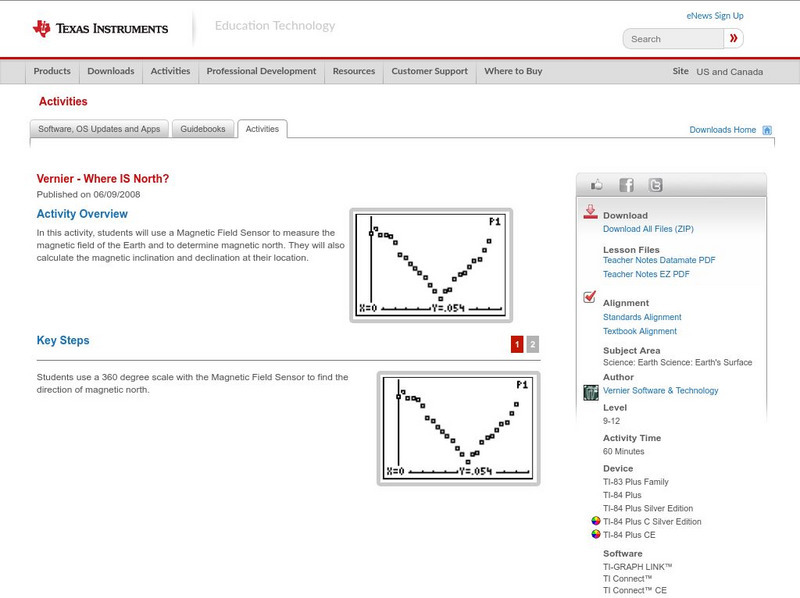
Texas Instruments: Where Is North?
In this activity, Students can use a Magnetic Field Sensor to measure the magnetic field of the Earth and to determine magnetic north. They will also calculate the magnetic inclination and declination at their location.
National High Magnetic Field Laboratory
Magnet Academy: William Gilbert
William Gilbert was an English physician and natural philosopher who wrote a six-volume treatise that compiled all of the information regarding magnetism and electricity known at the time. The work included descriptions of many of...
Other
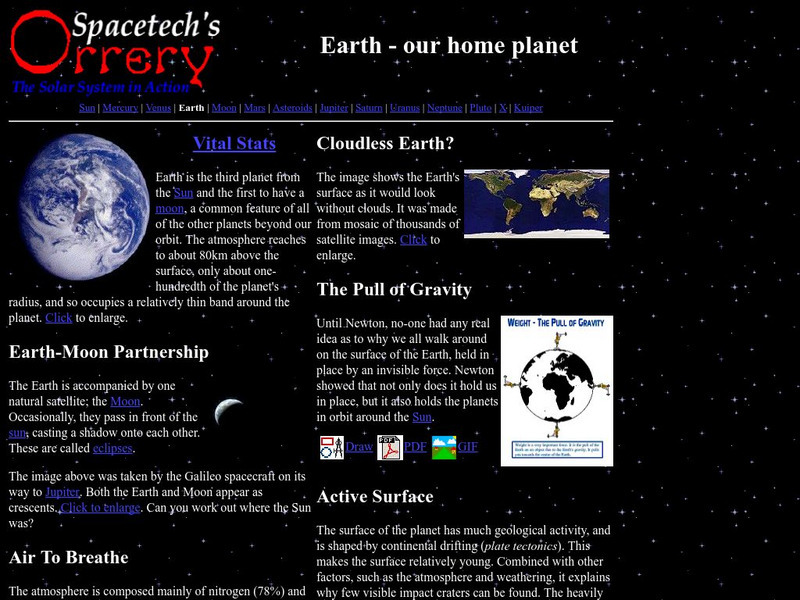
Spacetech's Orrery: Earth Our Home Planet
This site provides a very interesting overview of our home planet, Earth. Content includes a focus on the atmosphere, the pull of gravity, and the active surface.
Other
This Old Earth: Geology Online: Paleomagnetism and Continental Drift
Discusses discoveries that laid the foundation for scientists' understanding of paleomagnetism, continental drift, and magnetic reversals.
Other
Earth ref.org: Magnetics Information Consortium: Essentials of Paleomagnetism
This is the fifth version of a free textbook on paleomagnetism, published in 2018. The material is advanced but does provide information on many different topics for students doing research. Chapters include problems for students to...
Wikimedia
Wikipedia: The Black Hole
This site examines the black hole as an object in astrophysics. Delve into this comprehensive resource that covers this concept from its history, to qualitative physics, the reality of black holes, mathematical physics and more.
CK-12 Foundation
Ck 12: Earth Science: Earth's Interior
[Free Registration/Login may be required to access all resource tools.] Discover how scientists learn about Earth's interior using seismic waves, meteorites, density, and the magnetic field. Additional resources are available for download.
CK-12 Foundation
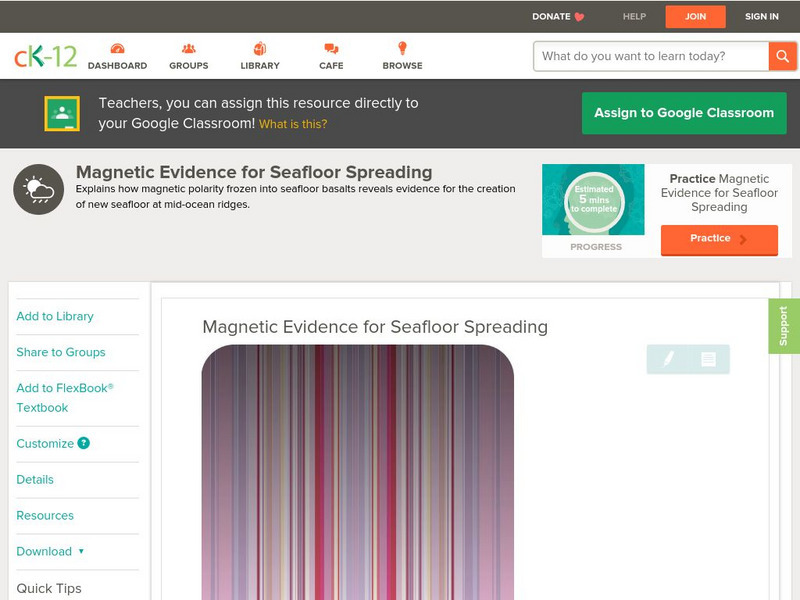
Ck 12: Earth Science: Magnetic Evidence for Seafloor Spreading
How magnetic reversals on the seafloor provide evidence for seafloor spreading. [Free Registration/Login may be required to access all resource tools.]
Other
Space Weather Center: Our Protective Shield
The Earth's magnetosphere helps shield us from cosmic and solar radiation. This segment offers a great explanation of this abstract concept along with numerous images and diagrams. An interactive game is provided as well.
National High Magnetic Field Laboratory
Magnet Academy: Magnetometer 1832
The Earth, the moon, the stars and just about everything in between has a magnetic field, and scientists use magnetometers when they need to know the strength of those fields.
NASA
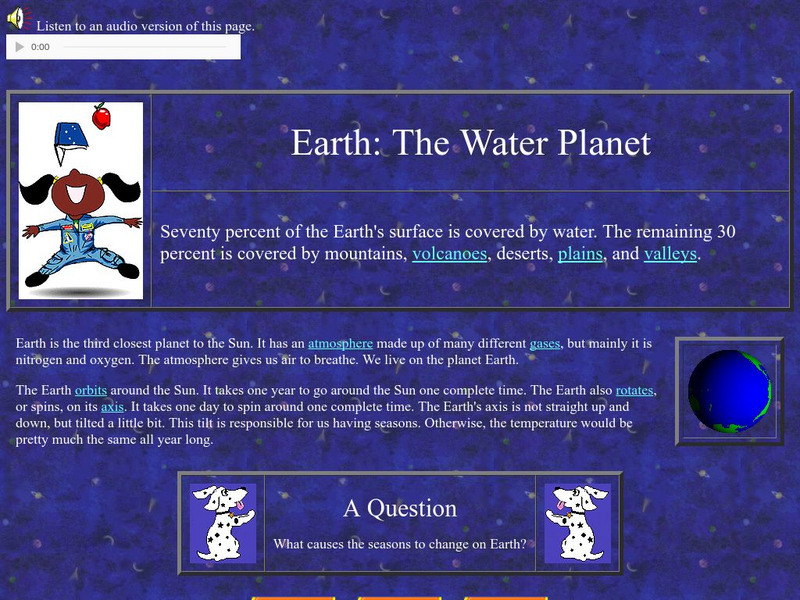
Nasa Star Child: The Planet Earth
Facts about the Earth including its orbit, its atmosphere, and its landforms. Includes a discussion question on seasons, with facts about them, and the answer. A linked page covers similar material in a "Level 2" version, and has a...
Science Education Resource Center at Carleton College
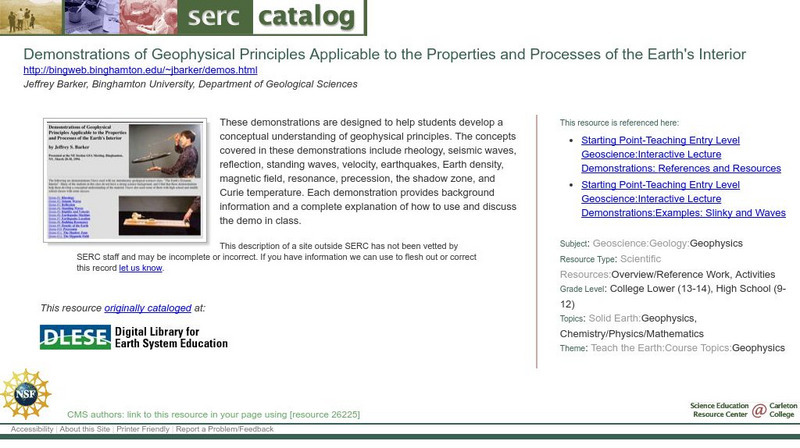
Serc: Geophysical Demos Properties and Processes of Earth's Interior
These demonstrations allow young scholars to develop a conceptual understanding of geophysical principles. Each demonstration provides background information and a complete explanation of how to use and discuss the demo in class.
National High Magnetic Field Laboratory
Magnet Academy: Humphry Davy
Humphry Davy was a pioneer in the field of electrochemistry who used electrolysis to isolate many elements from the compounds in which they occur naturally. Electrolysis is the process by which an electrolyte is altered or decomposed via...
Other
Space weather.com
Want to know what the current weather conditions are in space? Find everything here you may want to know about the latest solar flares, sunspots, asteroids and more. Site also includes essential web links to quench any user's thirst for...
Curated OER
Science Kids: Science Images: Aurora Borealis, Northern Lights
The aurora borealis (also known as the northern lights) is a spectacular light display that can be seen at night in regions near the North Pole (auroras can also be seen near the South Pole). Auroras occur because of charged particles...
NASA
Nasa Space Place: Sunspots and Solar Flares
Learn about sunspots and solar flares and the effects of solar activity on Earth.
Curated OER
Aurora
The Earth's magnetosphere helps shield us from cosmic and solar radiation. This segment offers a great explanation of this abstract concept along with numerous images and diagrams. An interactive game is provided as well.