Hi, what do you want to do?






Curated OER
Early Monarchies
In this online interactive world history worksheet, students answer 21 fill in the blank questions regarding early monarchies. Students may submit their answers to be scored.

Curated OER
U.S. History Knowledge Test 3
In this U.S. history trivia worksheet, learners answer twenty multiple choice questions based on their knowledge of U.S. history. This is an interactive worksheet.

Curated OER
Scatter Graphs
In this scatter graphs worksheet, students learn a way of illustrating information about two related values. Students complete 30 questions about the graphs. Note: One of the graphs has English pounds. This is intended as an online...

Curated OER
Fact and Opinion Pre-Test
In this fact/opinion instructional activity, students complete 10 multiple choice questions. Students may click on a link to view correct answers.

Curated OER
Make a Tally
For this tally chart worksheet, students read the word problems and use the information within the problem to make a tally chart. Students use the tally charts to help them finish and solve the word problem.

Curated OER
Literacy Map Activity
Students write directions using maps and ad, they define driving directions and convert cardinal numbers to there ordinals. They write directions which are given orally in these multi-level literacy activities.

Curated OER
Ireland-Home Rule
In this worksheet on home rule in Ireland, students read about William Gladstone, the church and land. A link to additional activities is present.

Curated OER
Flip Flop Diplomacy
Ninth graders examine the dress of diplomats. In this American Government lesson plan, 9th graders read an article and answer guided questions. Students participate in a quiz on the reading.

Curated OER
Politics (1)
In this online interactive world history worksheet, students answer 26 matching questions regarding politics. Students may submit their answers to be scored.
Yale University
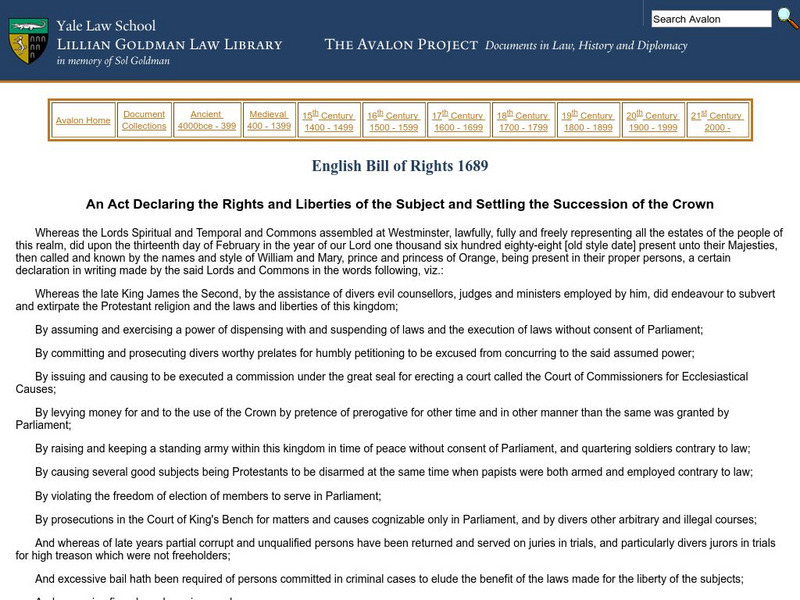
The Avalon Project: The English Bill of Rights 1689
An electronic version of the original English Bill of Rights, written in 1689, which influenced the writings of Thomas Jefferson, Benjamin Franklin, and John Adams, and laid the basis for American Democracy and common law.
![Our Courts: Bill of Rights: You Mean I've Got Rights? [Pdf] Lesson Plan](https://statictemp.lp.lexp.cloud/images/attachment_defaults/resource/large/FPO-knovation.png "Our Courts: Bill of Rights: You Mean I've Got Rights? [Pdf] Lesson Plan")
Other
Our Courts: Bill of Rights: You Mean I've Got Rights? [Pdf]
A great, active lesson about the Bill of Rights. Students compare rights they think they should have with the rights in the actual amendments to the U.S. Constitution. The language of the amendments is broken down into simpler English so...
Teaching American History
Teaching American History: The Documentary Origins of the Bill of Rights I
Explore both the British and state influences on the U.S. Bill of Rights. Understand the origins of each amendment to the Constitution.
W. W. Norton
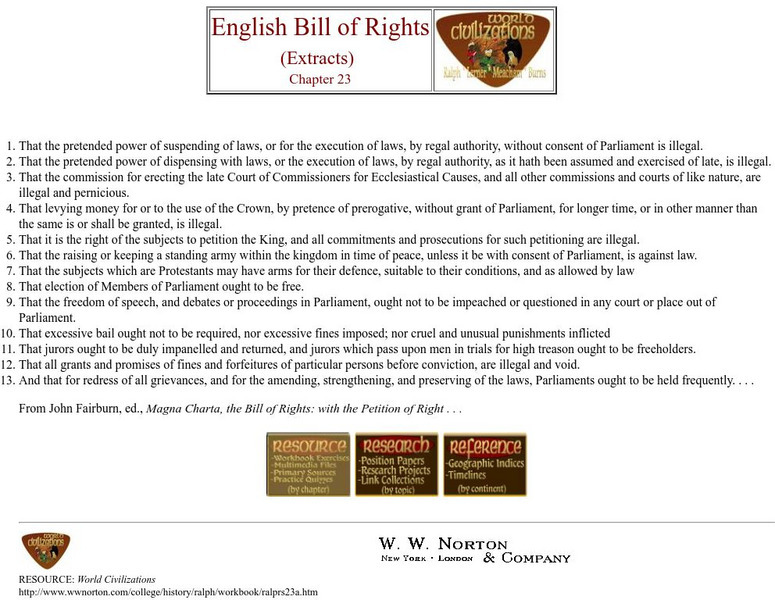
W.w. Norton & Company: English Bill of Rights (Extracts): Chapter 23
Read thirteen extracts from the English Bill of Rights covering limitation of the royal authority, empowering Parliament to levy taxes, and establishing legislative representation.
Wikimedia
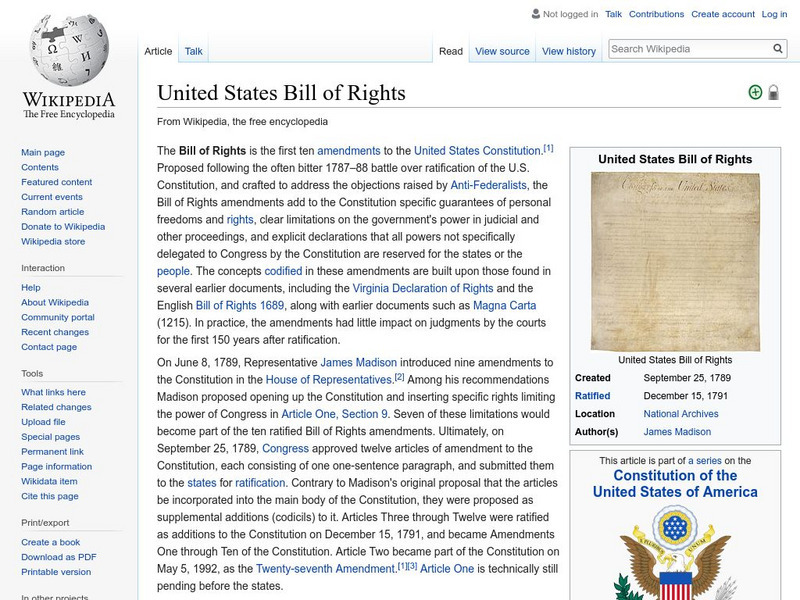
Wikipedia: United States Bill of Rights
This encyclopedia article from Wikipedia gives some background history to the creation of the Bill of Rights and contains a transcription of the first ten amendments to the Constitution in their original form.
Other
Lesson Plans for Teaching the First Amendment
This FreedomForum.org site lists the three English documents that were precursors to the American Bill of Rights.
Digital History
Digital History: The Emergence of New Ideas About Personal Liberties
American colonists expected to have "English rights" as supported by the Magna Carta and the English Bill of Rights. See how these rights were applied in the trial of John Peter Zenger, whose acquittal reflected the right of freedom of...
iCivics
I Civics: Colonial Influences
Where did the American colonists get their ideas that lead to a revolution and a whole new kind of government? This lesson plan explores the Magna Carta, Mayflower Compact, English Bill of Rights, Cato's Letters, and Common Sense.

Yale University
Yale Law School: Resolutions of the Continental Congress, 1765
Contains the primary text of the resolutions against the Stamp Act sent to King George III.
This Nation
This nation.com: Resolutions of the Stamp Act Congress
This site provides the full text of the resolutions of the Stamp Act Congress.

University of Groningen
American History: Outlines: The Frontier Fosters Self Reliance
Based on the theory that because the King had given the colonists so many freedoms, and he had problems on the home-front, the colonists' will was strengthened. This contributed to the Revolution. There are links to Virginia's First...
National Endowment for the Humanities
Neh: Edsit Ement: Background on the Patriot Attitude Toward the Monarchy
In this lesson plan, learners will consider "Background on the Patriot Attitude Toward the Monarchy." The plan includes worksheets and other student materials that can be found under the resource tab.
University of Groningen
American History: Outlines: Emergence of Colonial Government
Detailed essay which shows how colonial self-government developed prior to the Revolutionary War.
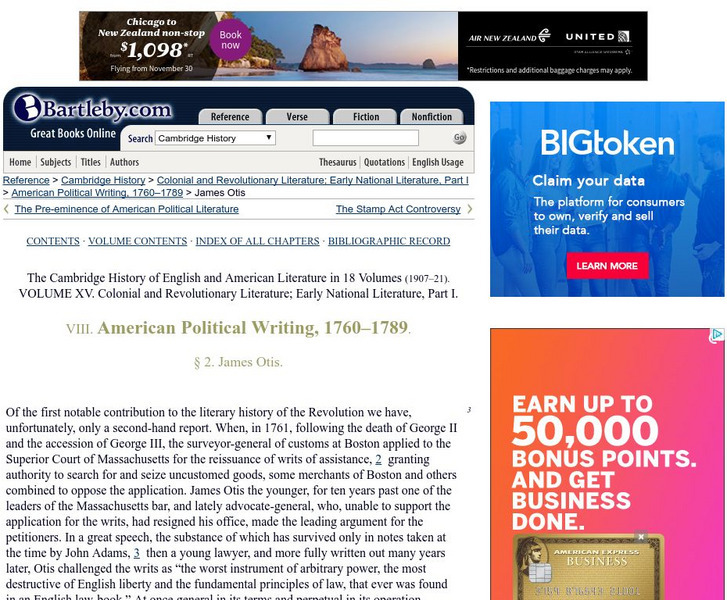
Bartleby
Bartleby.com: American Political Writing James Otis
This site discusses the political writings of James Otis concerning the British authority to search for smuggled goods with writs of assistance. Otis argued they were the worst violation of English liberties. This site contains quotes...

CPALMS
Florida State University Cpalms: Florida Students: Colonists: What Were They Thinking?
This tutorial looks at the British political traditions that influenced the American colonists as they gained their independence from Britain and created their own form of government. A PDF file of the tutorial is available.