Hi, what do you want to do?





Science Education Resource Center at Carleton College
Serc: Investigating Gravity: Predicting Time to Hit the Ground
Students will drop and shoot horizontally "Nerf" balls from a variety of known heights then record the amount of time it takes for the ball to hit the ground for each trial. They will plot height vs. time data and create a trend line for...

Other
Bscs: Forces and Motion Content Background Document
In this document, we will try to answer a fundamental question of physical science, "Why do things start to move, slow down, speed up, stop moving or change direction?" In answering these core questions we can develop concepts that can...
Science Struck
Science Struck: A Comprehensive List of All the Physics Formulas
Provides a long list of physics formulas for easy reference.
Oklahoma Mesonet
University of Oklahoma: High and Low Pressure
This University of Oklahoma meteorology tutorial explores both high and low pressure systems--how they form and the different forms they take.
Physics Classroom
The Physics Classroom: Energy Conservation on an Incline
This site is a discussion and animation about whether the total mechanical energy of a cart rolling down an incline is conserved, which can be determined if there are any external forces acting upon it.
CK-12 Foundation
Ck 12: Physical Science: Friction
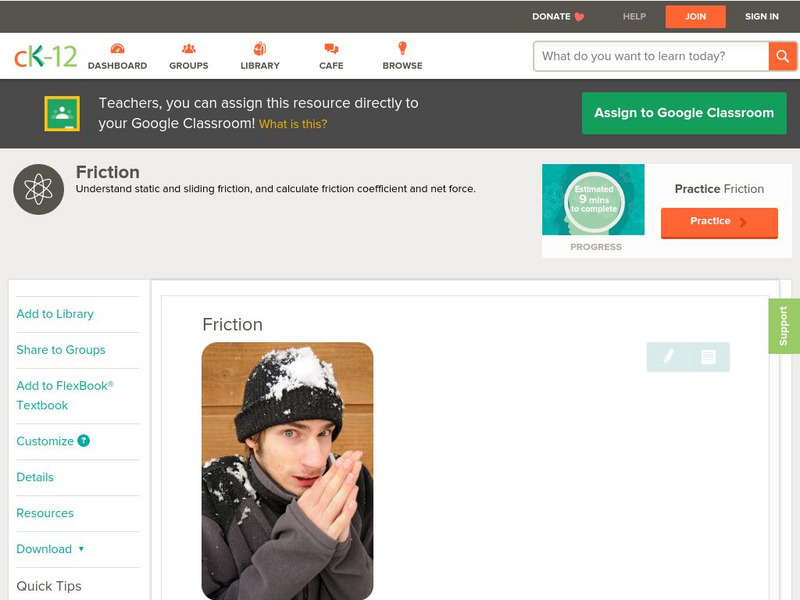
[Free Registration/Login may be required to access all resource tools.] Definition of friction, why it occurs, and the factors that affect it.

Science Education Resource Center at Carleton College
Serc: Inertia: An Object in Motion Will Tend to Stay in Motion
This activity is a take off of Galileo's experiment with the inclined planes to show that an object in motion would stay in a straight line motion if no outside forces acted were acting on it. In this version, young scholars will roll a...
Exploratorium
Exploratorium: The Science of Sports Cycling
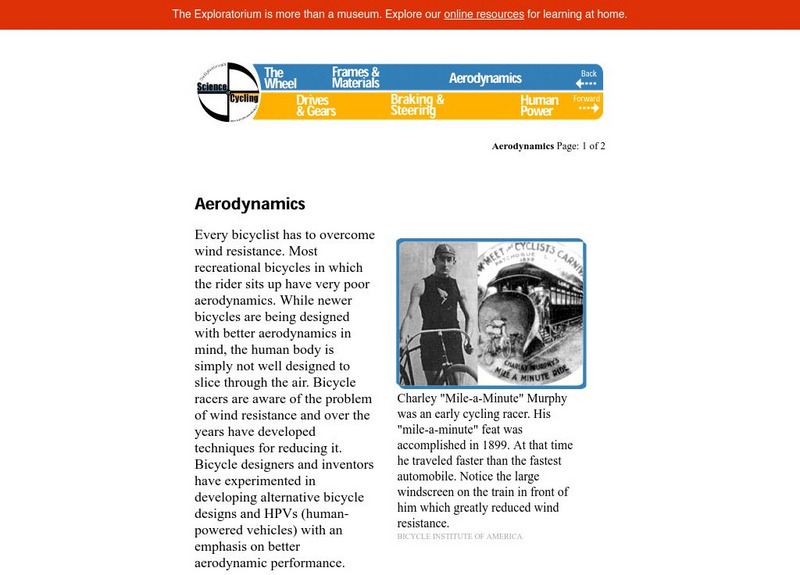
A detailed look at the aerodynamic principles associated with cycling. Good science and even better web page design. Includes an online calculator that allows the user to calculate the aerodynamic drag and propulsive power of a bicyclist...
TeachEngineering
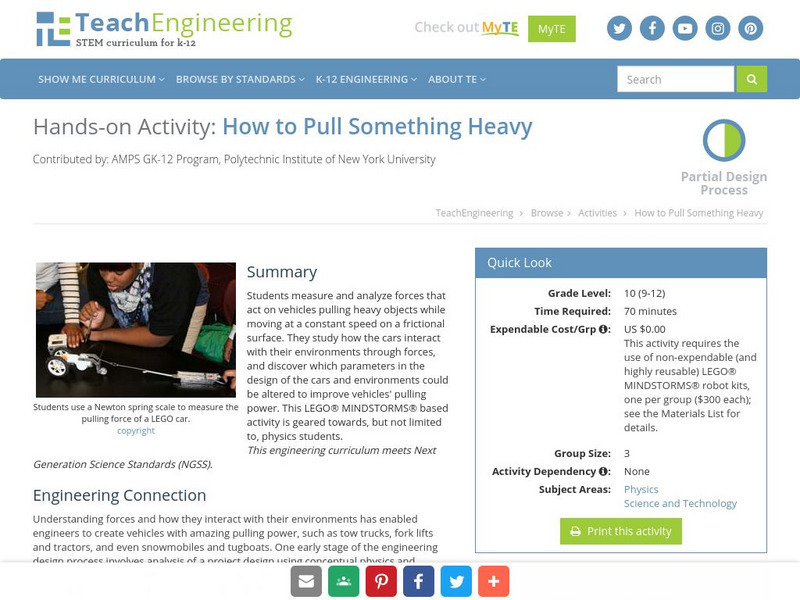
Teach Engineering: How to Pull Something Heavy
Students measure and analyze forces that act on vehicles pulling heavy objects while moving at a constant speed on a frictional surface. They study how the cars interact with their environments through forces, and discover which...
TeachEngineering
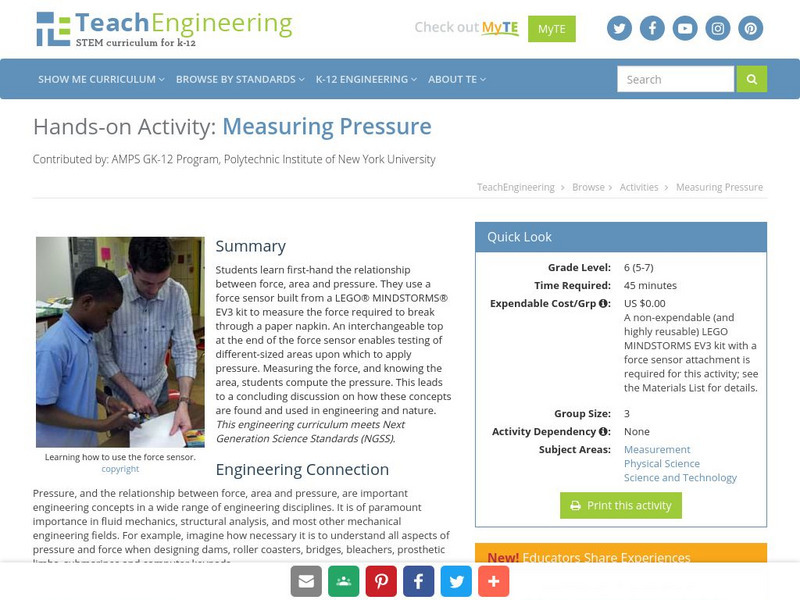
Teach Engineering: Measuring Pressure
Students learn first-hand the relationship between force, area and pressure. They use a force sensor built from a LEGO MINDSTORMS NXT kit to measure the force required to break through a paper napkin. An interchangeable top at the end of...
TeachEngineering
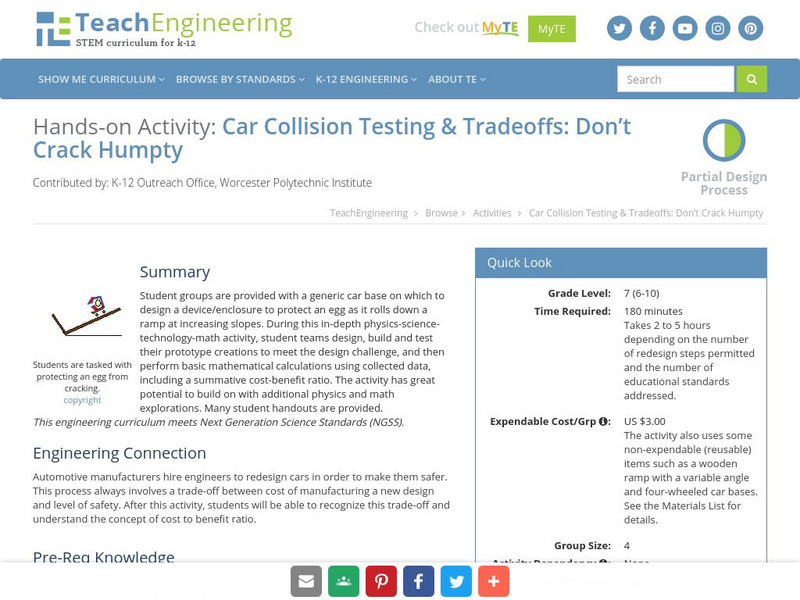
Teach Engineering: Car Collision Testing & Tradeoffs: Don't Crack Humpty
Student groups are provided with a generic car base on which to design a device/enclosure to protect an egg as it rolls down a ramp at increasing slopes. During this activity, student teams design, build and test their prototype...

Khan Academy
Khan Academy: Friction Review
Review the key concepts, equations, and skills for friction, including how to find the direction and magnitude of the friction force.
TeachEngineering
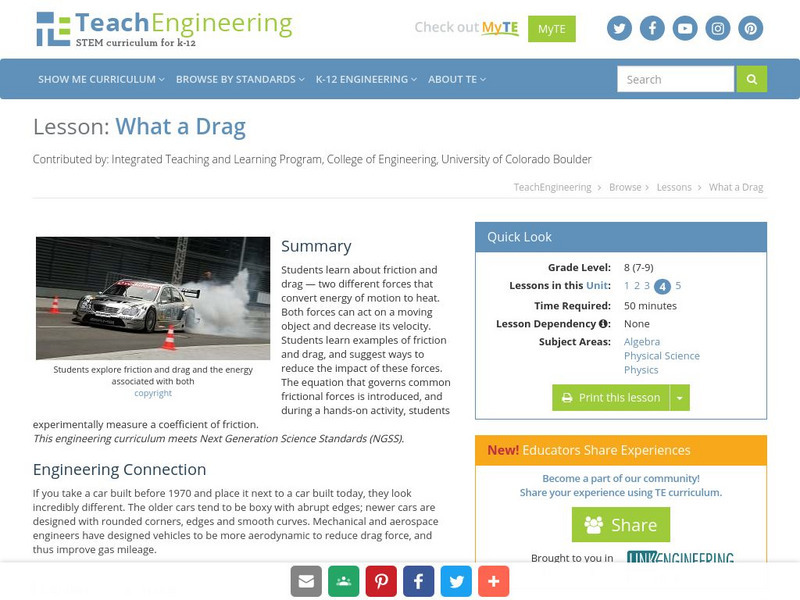
Teach Engineering: What a Drag
Students learn about friction and drag - two different forces that convert energy of motion to heat. Both forces can act on a moving object and decrease its velocity. Students learn examples of friction and drag, and suggest ways to...
Physics Aviary
Physics Aviary: Practice Problems: Work Done by Force With No Friction
Students must determine the work done by a horizontal force when there is no friction acting on the box. Students must then find the speed of the box after this work has been added to the box.
Massachusetts Institute of Technology
Mit: Open Course Ware: Force and Potential Energy
The activity investigates conservation of energy. Some topics explored are friction, kinetic energy, conservation of energy, and potential energy. The resource consists of video clips, lecture notes, practice problems, and exam...
Physics Aviary
Physics Aviary: Practice Problems: Acceleration on Incline Problem Medium
Students must calculate the acceleration of an object down an incline when there is friction present. Mass, angle and coefficient of friction will be generated randomly.
Physics Aviary
Physics Aviary: Practice Problems: Motion on Incline Level 2
Students must calculate the distance an object will move up an incline using Newton's Laws. Mass, angle, gravitational field, coefficient of friction and initial speed will be generated randomly.

TeachEngineering
Teach Engineering: Ramp and Review (For High School)
In this hands-on activity - rolling a ball down an incline and having it collide into a cup - the concepts of mechanical energy, work and power, momentum, and friction are all demonstrated. During the activity, students take measurements...
Physics Aviary
Physics Aviary: Practice Problems: Motion on Incline Level 3
Students must calculate the speed of a block when it returns to its original location on an incline using Newton's Laws. Mass, angle, gravitational field, coefficient of friction and initial speed will be generated randomly.
Physics Aviary
Physics Aviary: Practice Problems: Work Done by Force (Force on Angle)
Students must determine the amount of work that is done by tension and the amount of work done by friction. Then students must find the work that turned into KE.
Physics Aviary
Physics Aviary: Forces on an Incline Lab
This lab was designed to have students look at the factors that might affect the angle at which an object will start to move when it is placed on an inclined plane. The friction coefficient of the surfaces, the strength of the...
Science4Fun
Science4 Fun: What Is Friction
What is friction? Illustrated discussion of friction including the three types, its importance, and why it is avoided.
Sophia Learning
Sophia: Static Friction Revisited: Lesson 2
This lesson introduces the concept of static friction and explains how it depends on the surface an object is resting on. It is 2 of 2 in the series titled "Static Friction Revisited."
Physics Classroom
The Physics Classroom: Circular and Satellite Motion: Roller Coaster Model
An interactive playground for students to explore the physics of roller coasters. Learners investigate by changing the variables of force, velocity, friction, and vectors. Energy bar charts are displayed as the coaster car moves along...