Hi, what do you want to do?





Texas Education Agency
Texas Gateway: 5 Newton's Laws: Friction, Drag, and Elasticity: Summary
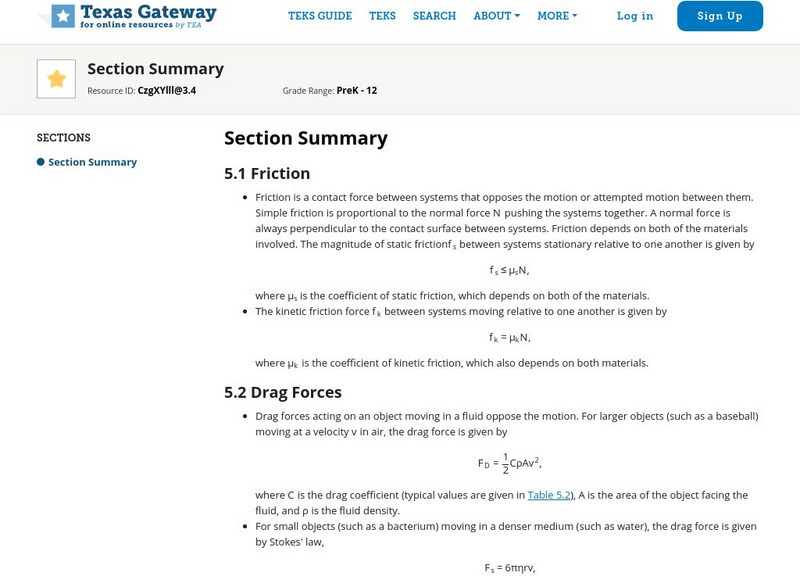
This page summarizes each section of Chapter 5: Further Applications of Newton's Laws: Friction, Drag, and Elasticity from the AP Physics online text. These include friction, drag force, and elasticity: stress and strain.
Other
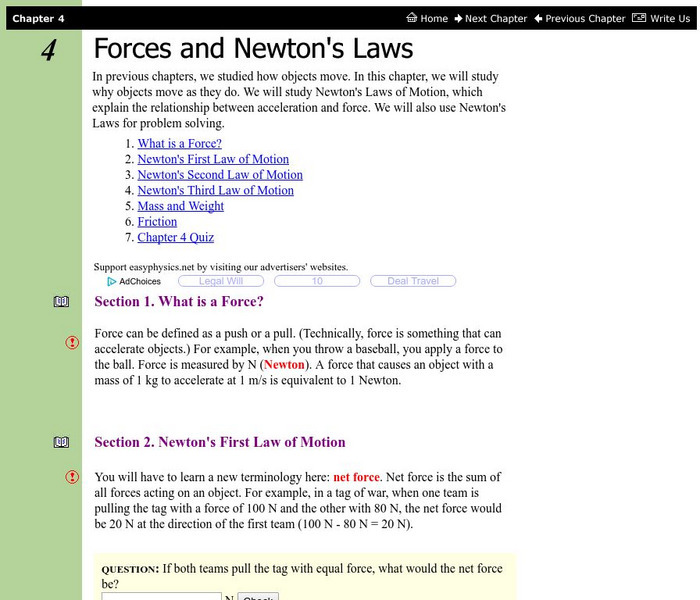
Easyphysics: Chapter 4 Forces
Learners investigate forces and Newton's laws. Some topics examined are mass, friction, and Newton?s laws of motion. The resource includes example problems with solutions and a chapter quiz.
Texas Education Agency
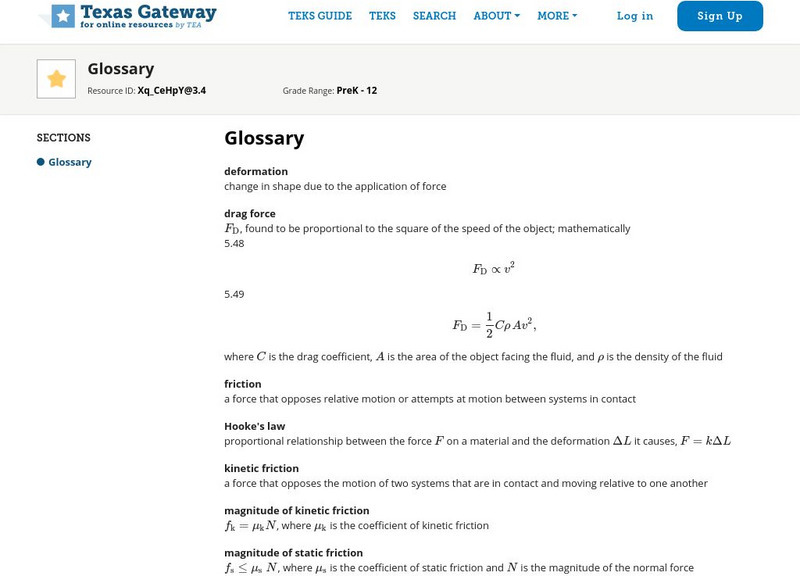
Texas Gateway: Glossary for Newton's Laws: Friction, Drag, and Elasticity
This is a glossary of terms and definitions used in Chapter 5: Further Applications of Newton's Laws: Friction, Drag, and Elasticity from the AP Physics online text.

Other
Center for Education Partnerships: The Marble Roll
In this Science-athon, students try to make their marble roll the farthest across a flat surface, using their knowledge of forces, motion, and energy to guide them through their apparatus design. Teachers must enroll online.
Physics Classroom
The Physics Classroom: Inertia and Mass
This is part of a lesson on Newton's Laws of Motion that focuses on inertia and mass. It restates Newton's first law of motion. The lesson also gives a helpful visual description concerning friction.
Science Struck
Science Struck: Static Friction vs. Kinetic Friction: The Differences
Teaches what friction force is, the difference between static and kinetic friction, and how friction force is calculated.
University of Oregon
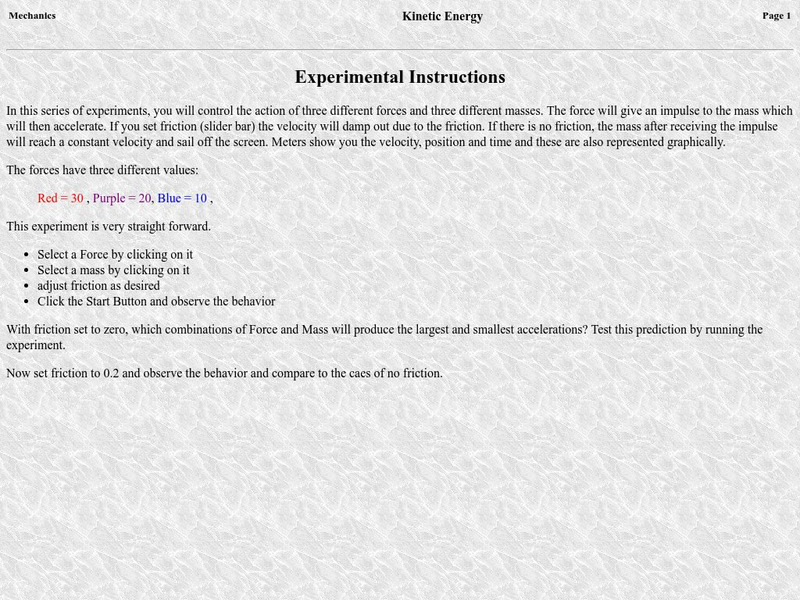
University of Oregon: Experimental Instructions
Visit this summary of friction. Use the interactive JAVA window to run friction simulations.
Concord Consortium
The Concord Consortium: Molecular Workbench: Friction and Movement
Explore how friction between a surface and tires affects the movement of a bicycle.
Concord Consortium
The Concord Consortium: Molecular Workbench: Weight Balance on a Pulley
Watch how the placement of two weights attached to a chain on different sides of a pulley affect the movement of the system. You can adjust the heaviness of the weights.

CK-12 Foundation
Ck 12: Plix Series: Friction
[Free Registration/Login Required] Use given friction formulas and an interactive diagram for an inclined plane to solve a motion problem. After the activity, answer a challenge question to check for understanding.

Khan Academy
Khan Academy: What Is Newton's First Law?
Newton's First Law also called the law of inertia is the most important thing to realize about motion. This article offers more information on motion and explains solved problems involving Newton's First Law. Also included is a video...
TeachEngineering
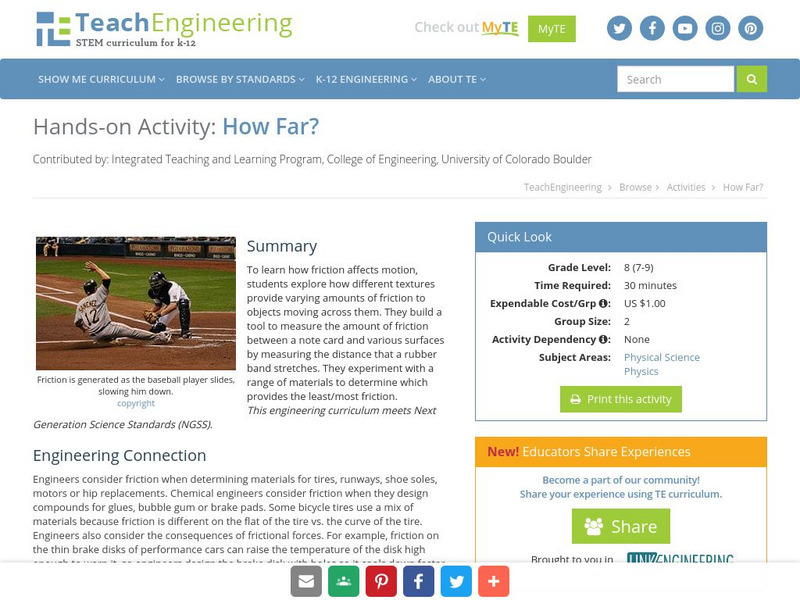
Teach Engineering: How Far?
To learn how friction affects motion, students explore how different textures provide varying amounts of friction to objects moving across them. They build a tool to measure the amount of friction between a note card and various surfaces...
TeachEngineering
Teach Engineering: Mechanics Mania
Through ten lessons and numerous activities, students explore the natural universal rules engineers and physicists use to understand how things move and stay still. Together, these rules are called "mechanics." The study of mechanics is...
Children's Museum
The Children's Museum of Indianapolis: Build a Parachute
Students create a parachute to explore how air pushes up against an object and slows it down as it falls.
TeachEngineering
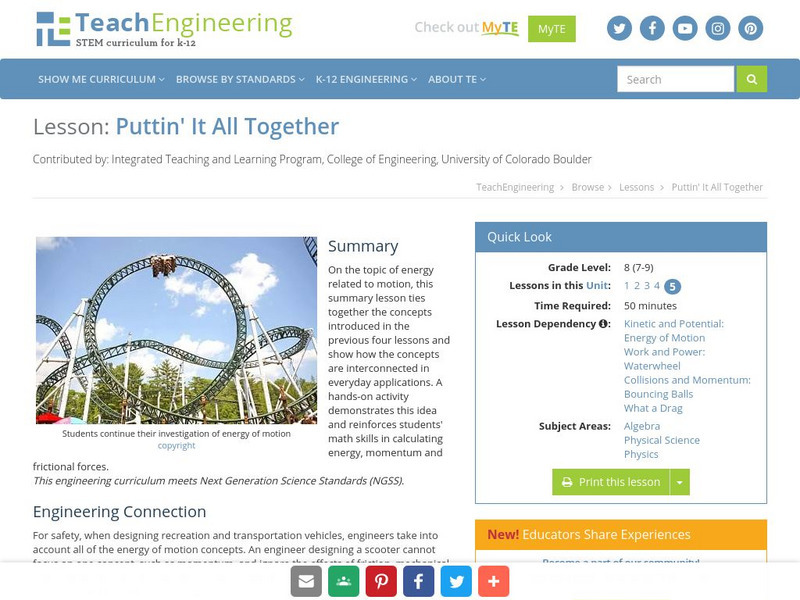
Teach Engineering: Puttin' It All Together
On the topic of energy related to motion, this summary lesson is intended to tie together the concepts of work, power, collisions, momentum and drag. A hands-on activity demonstrates this idea and reinforces young scholars' math skills...
Walter Fendt
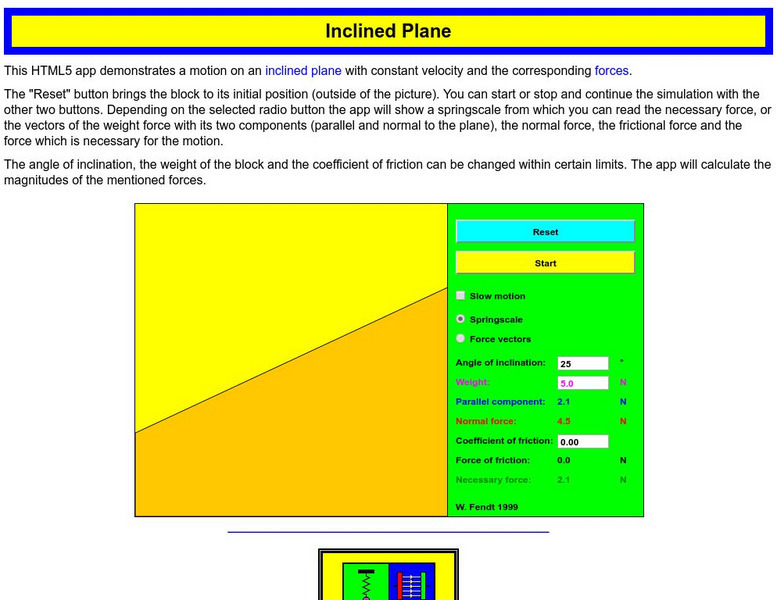
Walter Fendt: Inclined Plane
This site is an interactive app of an inclined plane showing the effect of the angle, the weight of the block, and the friction as a block is pulled up an incline.
TeachEngineering
Teach Engineering: Ramp and Review
In this hands-on activity - rolling a ball down an incline and having it collide into a cup - the concepts of mechanical energy, work and power, momentum, and friction are all demonstrated. During the activity, students take measurements...
TeachEngineering
Teach Engineering: Building Roller Coasters
In this hands-on activity students learn about the laws of physics by creating a marble roller coaster.
Famous Scientists
Famous Scientists: Charles Augustin De Coulomb
A short biography about Charles Coulomb, known for developing Coulomb's law, the definition of the electrostatic force of attraction and repulsion.
Concord Consortium
Concord Consortium: Spring and Mass Model
An interactive tool where students can explore how a spring behaves, and how changing the elasticity, mass, push/pull force, and friction affect its motion or period. As the spring moves, its motion is shown on a distance-time graph.
TeachEngineering
Teach Engineering: Natural Disasters
Students are introduced to our planet's structure and its dynamic system of natural forces through an examination of the natural hazards of earthquakes, volcanoes, landslides, tsunamis, floods and tornados, as well as avalanches, fires,...
Wikimedia
Wikipedia: Charles Augustin De Coulomb
Spanish-language site lets students discover the life and work of this physicist and engineer, who is known for his studies of electric charges.
Physics Aviary
Physics Aviary: Practice Problems: Work Done by Force on Angle With No Friction
Students must determine the work done by a force on an angle when there is no friction present between the box and the table. Students must also find the final speed of the box after this work has been added to the box.
Physics Aviary
Physics Aviary: Practice Problems: Car Stopping Distance
Students must calculate the time it takes for a car to come to a rapid stop and the distance the car covers when stopping.