Hi, what do you want to do?





TeachEngineering
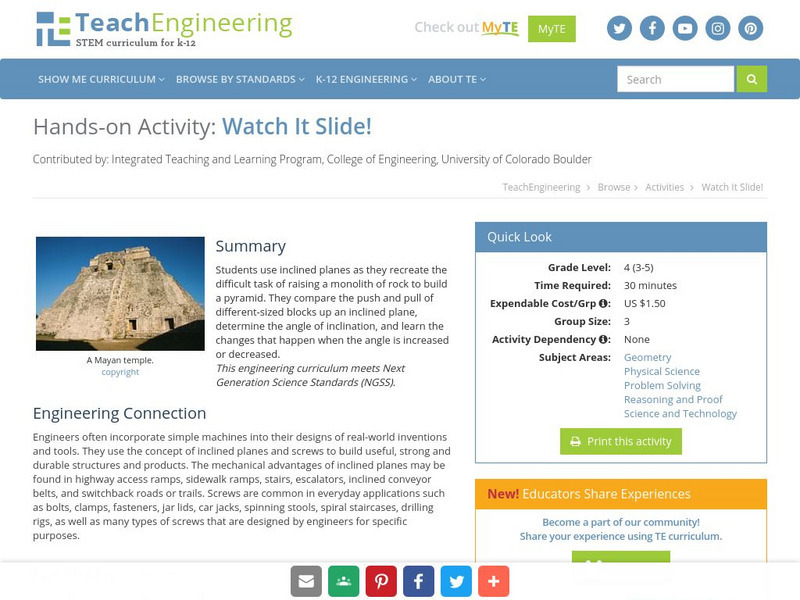
Teach Engineering: Watch It Slide!
Students use inclined planes as they recreate the difficult task of raising a monolith of rock to build a pyramid. They compare the push and pull of different-sized blocks up an inclined plane, determine the angle of inclination, and...
Concord Consortium
The Concord Consortium: Molecular Workbench: Mass Connected to 2 Springs
Observe how friction affects a mass connected to two springs that are on opposite sides of the mass. Create a graph while the friction is on or off.
University of Virginia
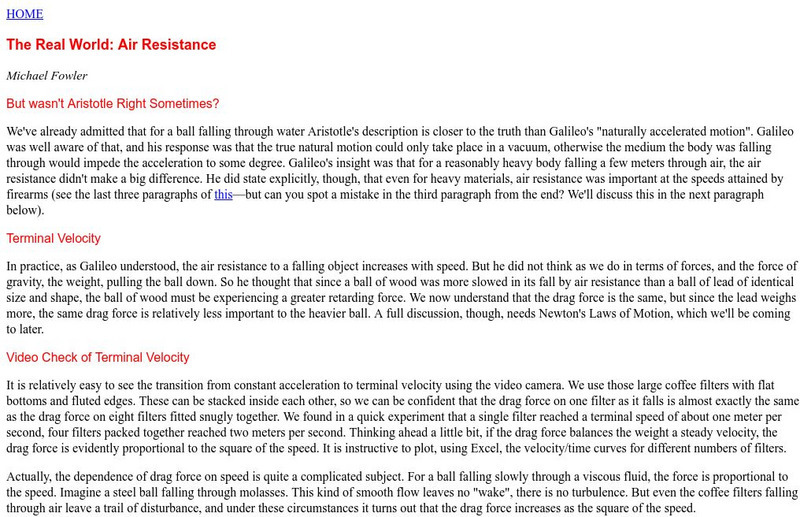
Uva: The Real World Air Resistance
A contrast of Galileo and Aristotle's view of inertia and motion. Describes air resistance force and how its reality seems to initially support Aristotle's view.
TeachEngineering
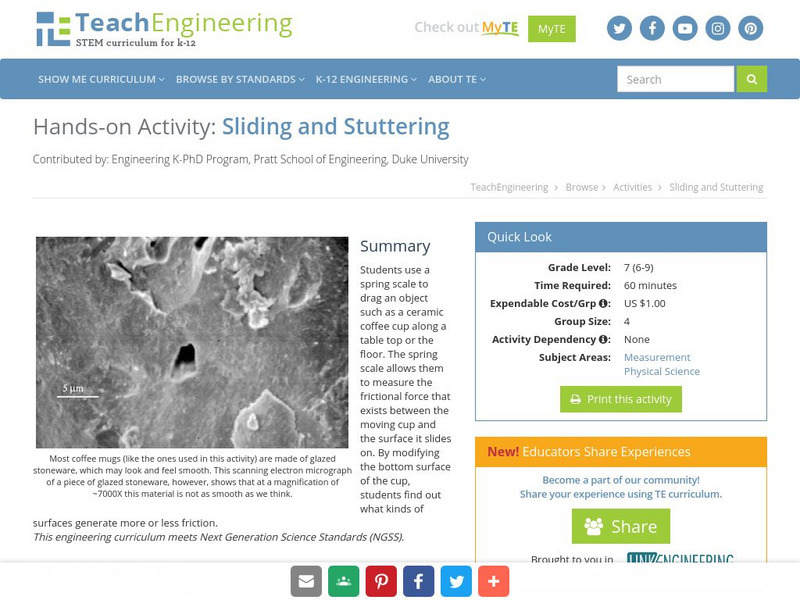
Teach Engineering: Sliding and Stuttering
Students use a spring scale to drag an object such as a ceramic coffee cup along a table top or the floor. The spring scale allows them to measure the frictional force that exists between the moving cup and the surface it slides on. By...
TeachEngineering
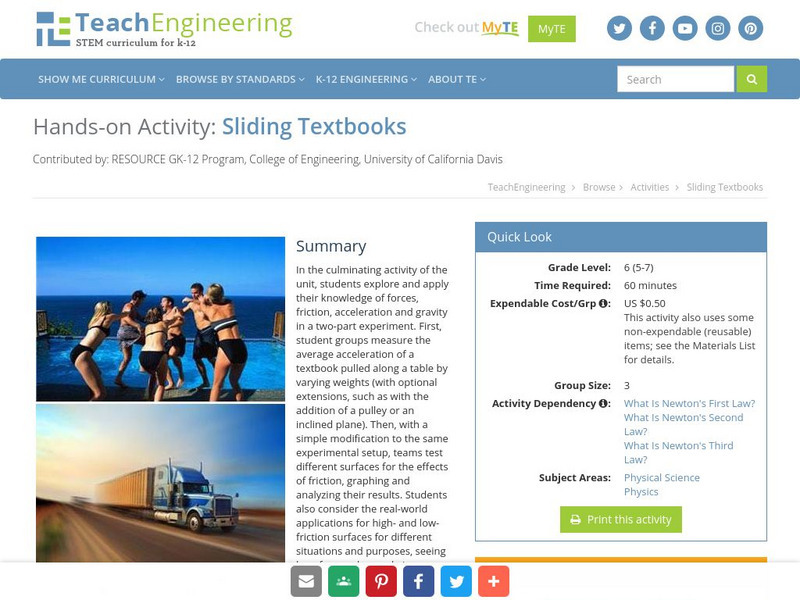
Teach Engineering: Sliding Textbooks
In this culminating activity of the unit which highlights how forces play a role in engineering design and material choices, students explore and apply their knowledge of forces, friction, acceleration, and gravity in a two-part experiment.

Science Struck
Science Struck: Guide to Free Body Diagrams in Physics
A detailed explanation of the different types of forces that can be applied to an object and how to represent them in a free body diagram. Includes examples and some practice problems to try, with solutions provided.
Massachusetts Institute of Technology
Mit: Open Course Ware: Courses: Physics: Classical Mechanics
College-level online course highlighting the study of classical mechanics. This course focuses on Newtonian mechanics, fluid mechanics, and kinetic gas theory. Course features include a 35 video lecture series by Walter Lewin. Also link...

Exploratorium
Exploratorium: Skateboard Science
This site is on the science and art of skateboard design, including equipment, tricks, glossary of terms, and a live webcast of a skateboard performance.
University of Oregon
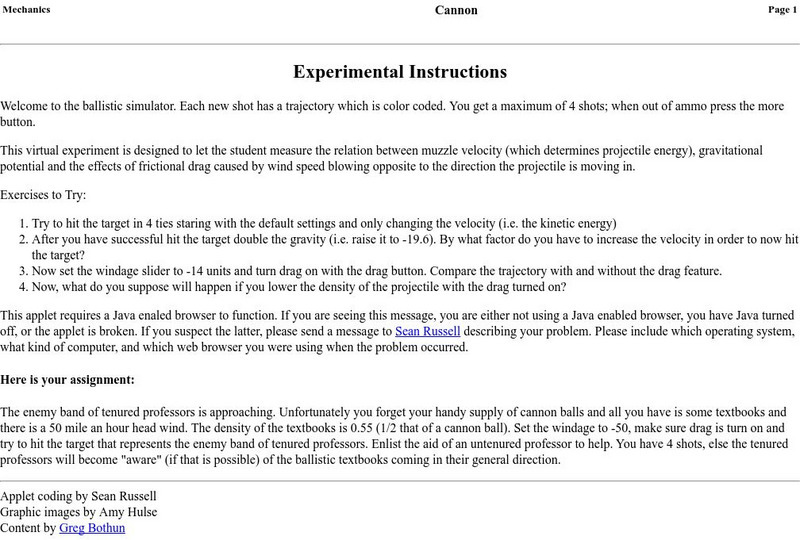
Uo: Cannon Simulator: Experimental Instructions
This virtual experiment is designed to let the student measure the relation between muzzle velocity (which determines projectile energy), gravitational potential and the effects of frictional drag caused by wind speed blowing opposite to...

PBS
Pbs Teachers: Tower of Coins Experiment
Demonstrate inertia by pushing a nickel out of the bottom of a stack without disturbing the rest of the stack.
TryEngineering
Try Engineering: Engineered Sports
Students work in teams to investigate how aerospace engineering relates to sports, especially golf ball design and the physics of bounce. They use this information to determine whether these aerospace principles can be applied to...
BBC
Bbc: Gcse Bitesize: What Is Electric Charge? Ocr 21 C
This lesson focuses on electric charges. Electric current is the flow of electric charge. Some insulating materials become electrically charged when they are rubbed together. A substance that gains electrons becomes negatively charged,...
Sophia Learning
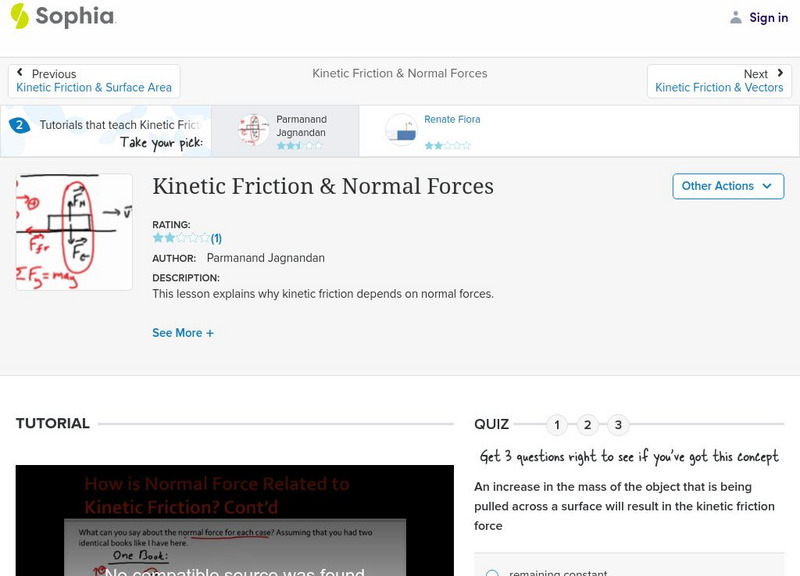
Sophia: Kinetic Friction & Normal Forces: Lesson 1
This lesson explains why kinetic friction depends on normal forces. It is 1 of 2 in the series titled "Kinetic Friction & Normal Forces."
McREL International
Mc Rel: Whelmer #31 Activity: Static Charged 2x4s
A simple activity that investigates the basic principles behind static electricity. The activity is in lesson plan format that meets NSES standards.
McREL International
Mc Rel: Whelmer #9 Learning Activity: Nickel Karate
An easy to do activity that investigates the basic theories of inertia. The activity is in lesson plan format that meets NSES standards.
TryEngineering
Try Engineering: Give Me a Brake
Activity investigates the concept of how bicycle brakes use force and friction to stop or slow mechanical motion. Students work in teams to devise a simple braking system while suggesting improvements to current bicycle brake design.

American Association of Physics Teachers
Com Padre Digital Library: Open Source Physics: Sliding Down an Incline Plane
Here is a simulation demonstrating an object placed on an inclined plane. The user will vary the slope of the plane to see the relationship the slope has on the gravity of the object and the static friction.
Science Education Resource Center at Carleton College
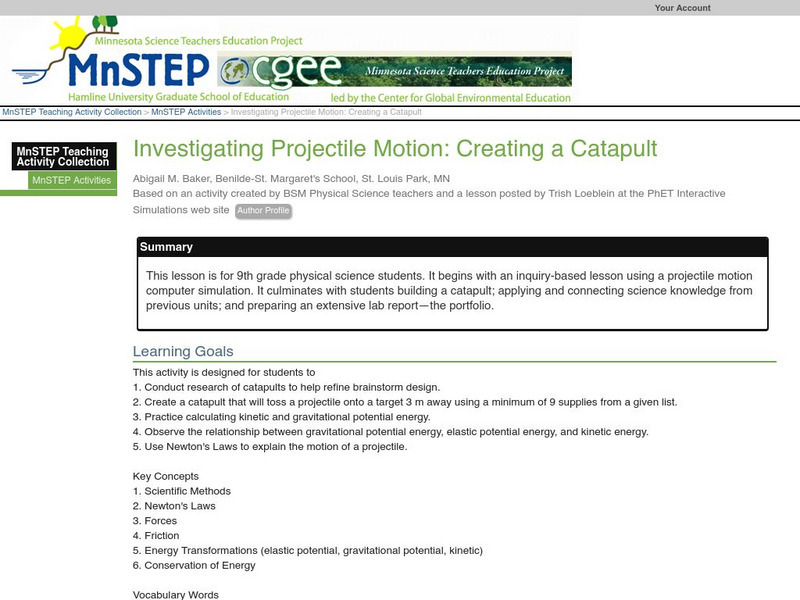
Serc: Investigating Projectile Motion: Creating a Catapult
This instructional activity is for 9th grade physical science students. It begins with an inquiry-based instructional activity using a projectile motion computer simulation. It culminates with students building a catapult; applying and...
Annenberg Foundation
Annenberg Learner: Amusement Park Physics: Roller Coaster
This interesting and interactive exhibit demonstrates how Newton's Laws of Motion impact the design and safety of roller coasters.

ClassFlow
Class Flow: Friction
[Free Registration/Login Required] In this unit children build on their existing knowledge of forces and learn that forces can be measured and compared. The unit focuses on friction.
Curated OER
Friction Is a Force That Moves in an Opposite Direction to Movement.
This resource provides a brief overview of friction. Its' affects on solids, liquids and gases is described with diagrams. An explanation of how friction is measured is included in the discussion. An online quiz can be used to check your...
American Association of Physics Teachers
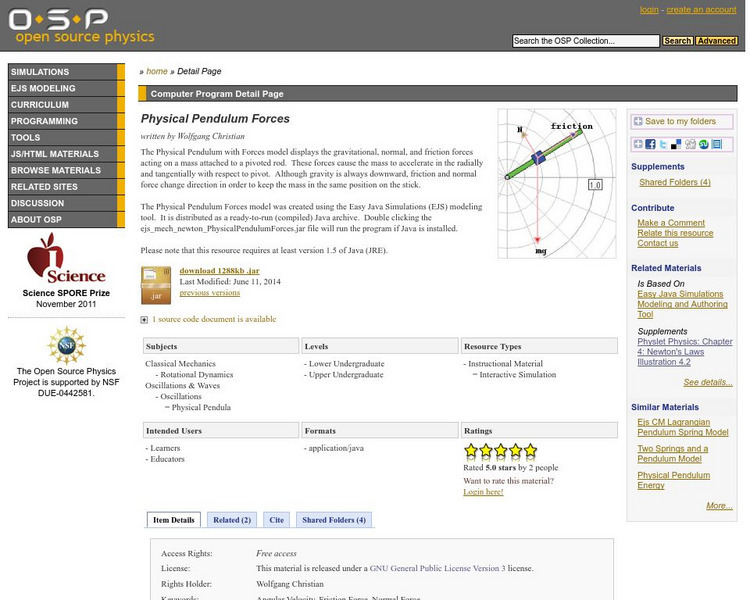
Com Padre Digital Library: Open Source Physics: Physical Pendulum Forces
This simulation of a pendulum will demonstrate how friction and force have to change to keep the mass in the same position on the pivoted rod.

Khan Academy
Khan Academy: Lesson Summary: Unemployment
In this lesson plan summary review and remind yourself of the key terms and calculations used in measuring unemployment, the labor force, the unemployment rate, the labor force participation rate, and the natural rate of unemployment....
Exploratorium
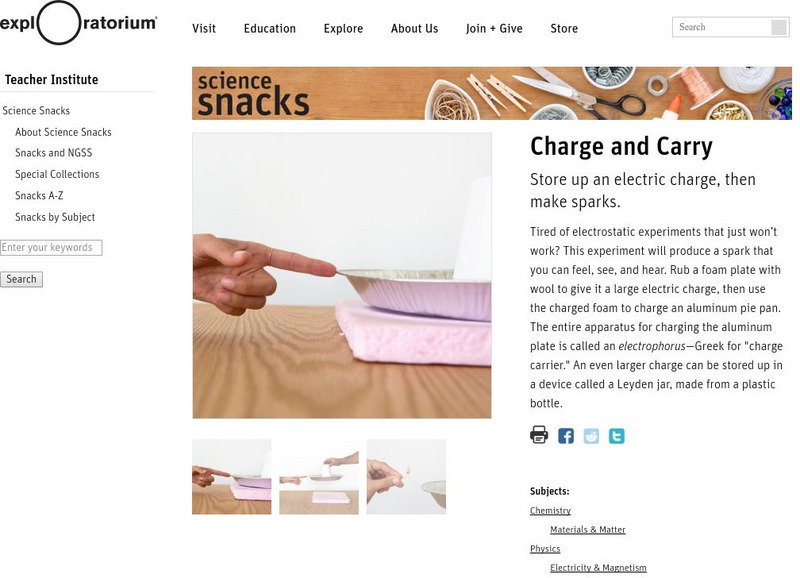
Exploratorium: Science Snacks: Charge and Carry
This site from The Exploratorium Museum is a full description of a short activity. An electrophorus plate and a Leyden jar are made. The electrophorus is charged by induction. Its charge is transferred to the Leyden jar by conduction...