Hi, what do you want to do?






Curated OER
Supply and Demand Worksheet
In this international economics worksheet, students use their problem solving skills to respond to 25 questions about supply and demand.

Curated OER
Barter Day
Students explore trading and bartering. They participate in a Barter Day in which they bring in hand crafted or homemade wares to school to barter with classmates.

Curated OER
Hometown Travel Journalism
Steinbeck’s witty memoir, “Travels with Charley: In Search of America,” inspires kids to investigate their neighborhoods as local travel journalists.

Cornell University
Electroplating
Silver pennies and copper nickels are made possible by applying some chemistry. Learners use electrolysis to coat a penny with zinc sulfate and a nickel with copper sulfate. Their investigation builds an understanding of electroplating...

Curated OER
Truth Or Consequences
Students examine historical works of art and analyze how these paintings could be used for personal, cultural, and/or political purposes. This exploratory lesson on art ideology includes two handouts/worksheets for student use and...

Curated OER
Solving a Legend- Exponents, Recursive and Explicit Equations.
Eighth graders play a game to solve problems. In this exponents and scientific notations lesson, 8th graders play a game in small groups to move colored disks from location A to location C. Students identify recursive patterns to solve...

Curated OER
Patriotic Symbols
Students define what a patriotic symbol means, as well as sing a patriotic song. In this social science lesson students work in groups to write about a patriotic symbol. Groups draw pictures of their symbols.

Curated OER
Making Blood!
students research blood's components, and use their math skills to recreate a model of whole blood using commonly found food items.

Curated OER
Valentine's Day hearts
Students use Valentine's Day to use figurative language in English. This is a great lesson for ESL students (who may not have much experience with this holiday), to engage in social conversation with their peers.

Curated OER
Shapes and Shelters
Students are be able to analyze primary sources (photographs) for evidence of Ancient Egyptian culture and design meaningful objects. They are grouped in pairs and instructed to choose someone that they admire, either living or...

Curated OER
"An Eye For An Eye, A Tooth For A Tooth"
Sixth graders debate their reactions to two different historical documents about managing a society. In this U.S. history lesson, 6th graders read two articles on codes and laws from different time periods and debate their...

Curated OER
Tobacco Road
Students use court records to learn that tobacco was used a source of currency in early Delaware history. Students choose something in their culture to use as currency instead of money.

Curated OER
Pioneer Currency in Utah: Have you got change for 5?
Eleventh graders examine why pioneer society needed a uniform medium of exchange -- not so much among themselves, but for use with non-Mormon suppliers and California immigrants.

Curated OER
African Art and Personal Adornment: Jewelry
Learners observe and identify examples of personal adornment in African art and recall how African jewelry relates to beauty, status, and wealth. They create their own clay pendants or other personal adornments.

Cato Institute
The Gold Standard: An Analysis of Some Recent Proposals
Summarizes specific and recent proposals set forth to return the U.S. to the gold standard. Includes detailed information on the gold "price rule," "classical" gold standard, and other important terms.
Curated OER
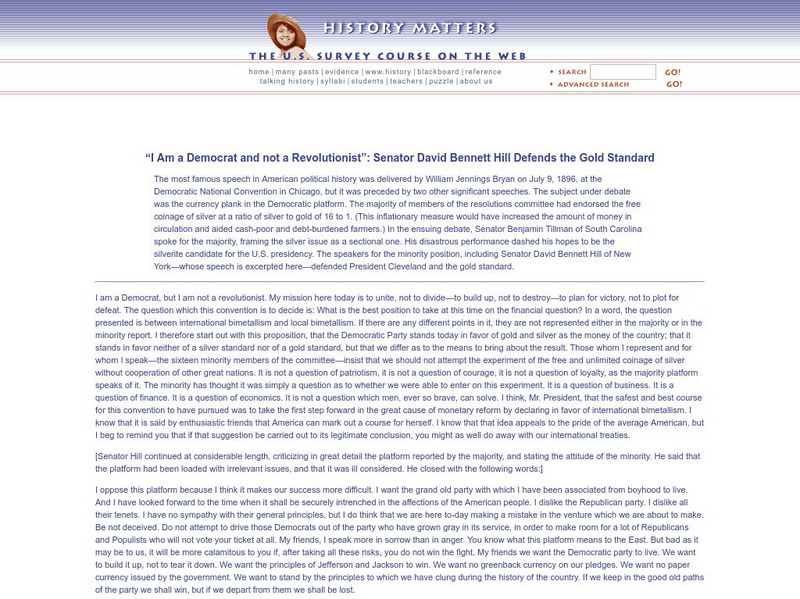
History Matters: Senator David Bennett Hill Defends the Gold Standard
Read this speech given by Senator David Bennet Hill of New York at the Democratic Convention in 1896. A key issue in that convention was whether the United States should go back on the gold standard. This speech clearly shows that Hill...
Robert Schenk, PhD
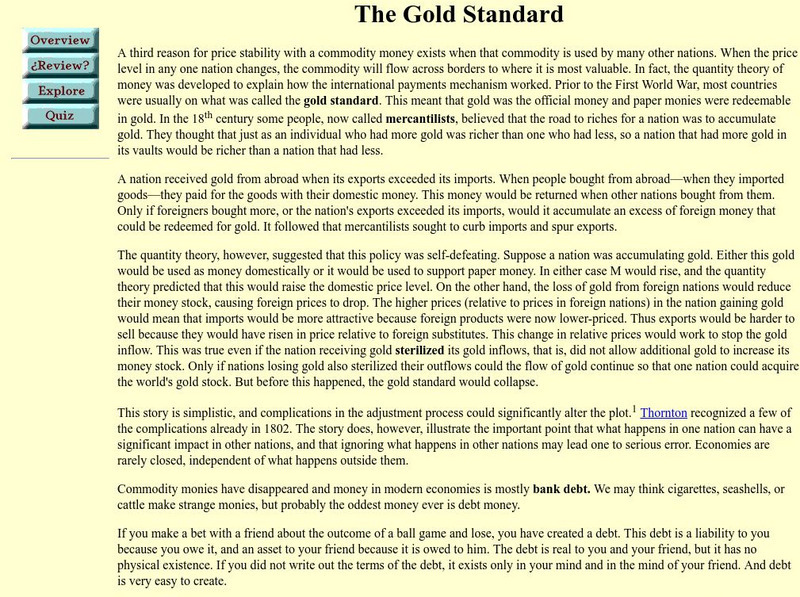
Money Matters: The Gold Standard
This site provides a great article that explains the gold standard and why it didn't work for the United States and many other nations.
Robert Schenk, PhD
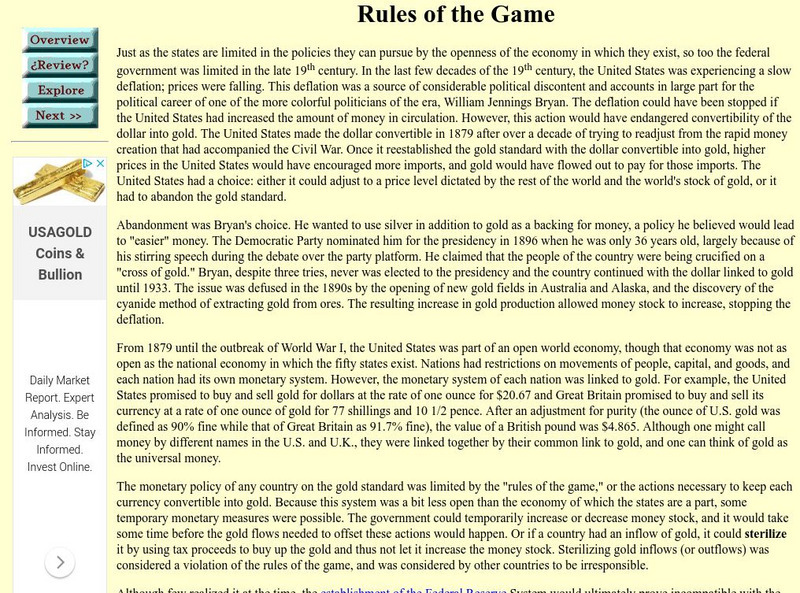
Rules of the Game Gold Standard & Macroeconomic Policy
A basic description of the struggles with the gold standard of the late 19th century in the United States, and William Jennings Bryan's attempts to abandon this.
Auburn University
Auburn University: The "Costs" of a Gold Standard
Take a look at the cost involved in having a gold standard. If you need more information after reading this article, a list of references is provided.
Other
Myth: The Gold Standard Is a Better Monetary System
Discusses the gold standard and the history of monetary systems.
Vassar College
Vassar College: 1896: The Currency Question: The Gold Standard
This site is provided for by the Vassar College. "The bitter controversy surrounding the issues of `Free silver' and `sound money,' so central to the 1896 campaign, has proved difficult for historians to explain." However, this 1896, a...
Massachusetts Institute of Technology
Mit: The Dismal Science: The Gold Bug Variations
This page provides access to the article, "The Gold Bug Variations: The gold standard-and the men who love it." In it, Paul Krugman discusses the relationship between the gold standard and monetary policy. (Nov. 22, 1996)

PBS
Pbs: American Experience: William Jennings Bryan "Cross of Gold" Speech
Read the famous Cross of Gold speech given by William Jennings Bryan, Democratic party presidential candidate in 1896. The party platform was against the establishment of the gold standard.
Northern Illinois University
Illinois in the Gilded Age: 1896: The Cross of Gold
This is a very informative look at the politics involved in the campaign of 1896 where one of the main issues was the conflict between the gold standard and free silver. Read about the results of the election and the defeat of Populist...