Hi, what do you want to do?





TeachEngineering
Teach Engineering: Ring Around the Rosie
Students learn the concept of angular momentum and its correlation to mass, velocity and radius. They experiment with rotation and an object's mass distribution. In an associated literacy activity, students use basic methods of...

Physics Classroom
The Physics Classroom: Circular and Satellite Motion: Centripetal Force
Through illustrated examples and practice problems, students explore the centripetal force requirement. So for an object moving in a circle, there must be an inward force acting upon it in order to cause its inward acceleration.
Pennsylvania State University
Kettering University: The Simple Harmonic Oscillator
The motion of three simple harmonic oscillators is animated to illustrate the effects of mass and spring constant upon the motion. Several equations and a lengthy discussion accompany the animations.
Sophia Learning
Sophia: Newton's First Law: Lesson 1
This lesson introduces Newton's First Law, that inertia causes objects at rest to remain at rest, and objects in motion to remain in motion. It is 1 of 3 in the series titled "Newton's First Law."
Sophia Learning
Sophia: Newton's First Law: Lesson 2
This lesson introduces Newton's First Law, that inertia causes objects at rest to remain at rest, and objects in motion to remain in motion. It is 2 of 3 in the series titled "Newton's First Law."
University of Virginia
Uva: The Real World Air Resistance
A contrast of Galileo and Aristotle's view of inertia and motion. Describes air resistance force and how its reality seems to initially support Aristotle's view.
Exploratorium
Exploratorium: Bicycle Wheel Gyro
Description of a museum exhibit in which the spinning bicycle wheel induces the rotation of a student in a rotating chair. Excellent demonstration idea.
TeachEngineering
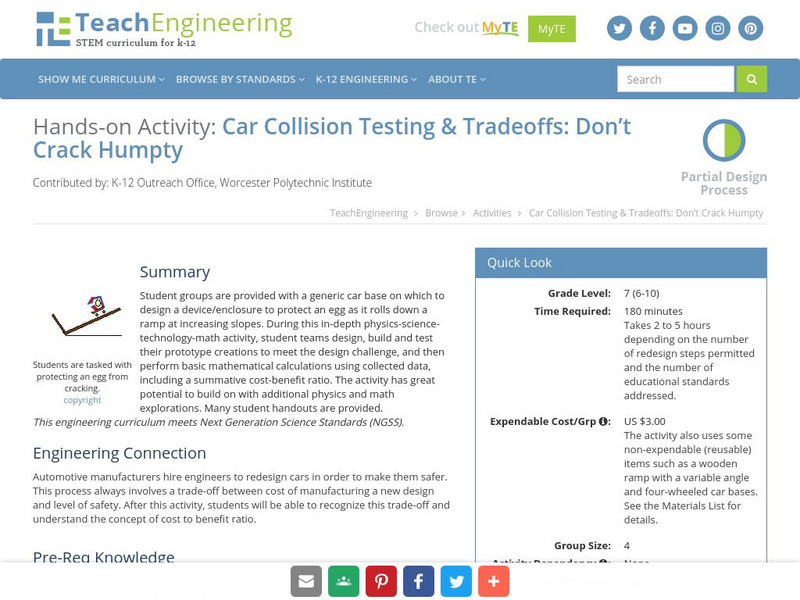
Teach Engineering: Car Collision Testing & Tradeoffs: Don't Crack Humpty
Student groups are provided with a generic car base on which to design a device/enclosure to protect an egg as it rolls down a ramp at increasing slopes. During this activity, student teams design, build and test their prototype...
TeachEngineering
Teach Engineering: Action Reaction! Rocket
Students construct a rocket from a balloon propelled along a guide string. They use this model to learn about Newton's three laws of motion, examining the effect of different forces on the motion of the rocket.

University of Guelph
University of Guelph: Physics Tutorials: Torque and Angular Acceleration
Words and equations are used to explain the relationship between angular acceleration and the torque exerted upon an object. Well-written; great graphics.
BBC
Bbc: Gcse Bitesize: Forces, Acceleration and Newton's Laws Aqa
This lesson focuses on Newton's First Law: an object remains in the same state of motion unless a resultant force acts on it. If the resultant force on an object is zero, this means: a stationary object stays stationary; a moving object...
NASA
Nasa: The Way Things Fall
This site from NASA compares free falling motion to falling with air resistance. Discusses Galileo's experiment. Explains why we believe all objects free fall with the same acceleration.

Khan Academy
Khan Academy: What Is Weight?
This article on weight will help you prepare for the AP Physics test. Included are example problems to help you practice.
Texas Education Agency
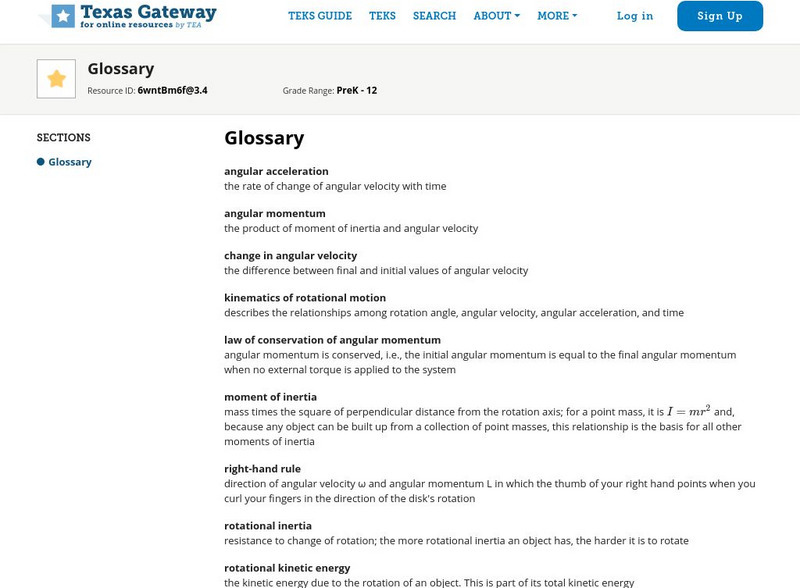
Texas Gateway: Rotational Motion and Angular Momentum: Glossary
This is the glossary of terms and definitions used in Chapter 10: Rotational Motion and Angular Momentum from the AP Physics online text.
McGraw Hill
Mc Graw Hill Learning Center: Rigid Bodies and Rotational Motion
From the companion web site for the Contemporary College Physics web site. The collection of pages indexed from this page lead to a variety of useful resources pertinent to Chapter 9 (Rigid Bodies and Rotational Motion) of the book. Such...
Exploratorium
Exploratorium: Gyroscope
Description of a museum exhibit in which the forces exerted by two gyroscope wheels are analyzed. Excellent demonstration idea.
TeachEngineering
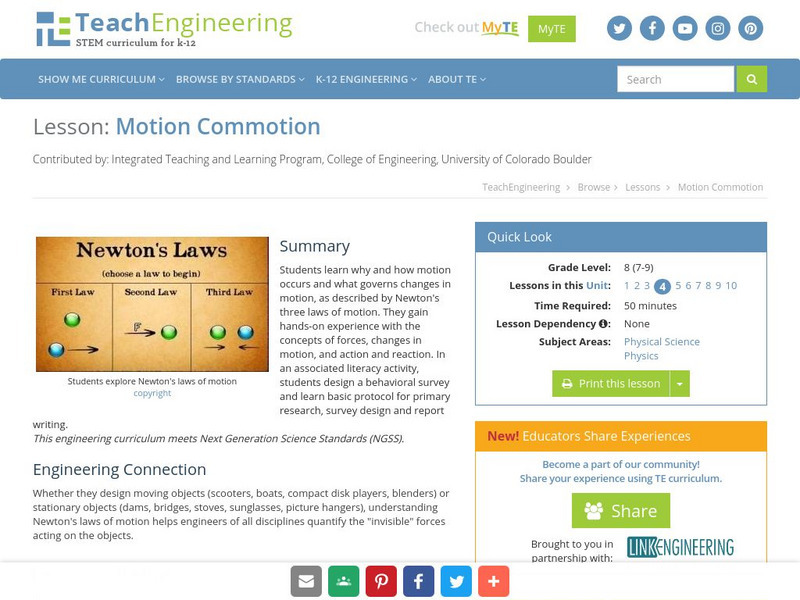
Teach Engineering: Motion Commotion
Students learn why and how motion occurs and what governs changes in motion, as described by Newton's three laws of motion. They gain hands-on experience with the concepts of forces, changes in motion, and action and reaction. In an...
Other
Easy Science for Kids: All About Force: Pushing and Pulling
Students will understand that pushes and pulls can have different strengths and directions. Students investigate the effects of these different pushes and pulls.

Other
Stat Soft: Statistics Glossary
Dozens of statistical terms are defined and illustrated in this glossary.
Other
Bscs: Forces and Motion Content Background Document
In this document, we will try to answer a fundamental question of physical science, "Why do things start to move, slow down, speed up, stop moving or change direction?" In answering these core questions we can develop concepts that can...
Upper Canada District School Board
Tom Stretton's Chemistry Pages: Dynamics Bodies in Motion
Through an online slide-show format, learn about the physics of motion, including Newton's laws of motion.
Science Education Resource Center at Carleton College
Serc: Newton's Second: Having a Ball With Motion
Students will create a gravity ball launcher to demonstrate their understanding of mass, force, momentum, and motion. The students will use critical thinking, measurement, and observation and analysis of data to make changes and improve...