Hi, what do you want to do?





PBS
Nova: Atom Builder
Find out if you know enough about atoms to build them. The goal of the activity is to build an atom of a particular element by dragging the correct numbers of neutrons, protons and electrons into the atom.
Lawrence Berkeley National Laboratory
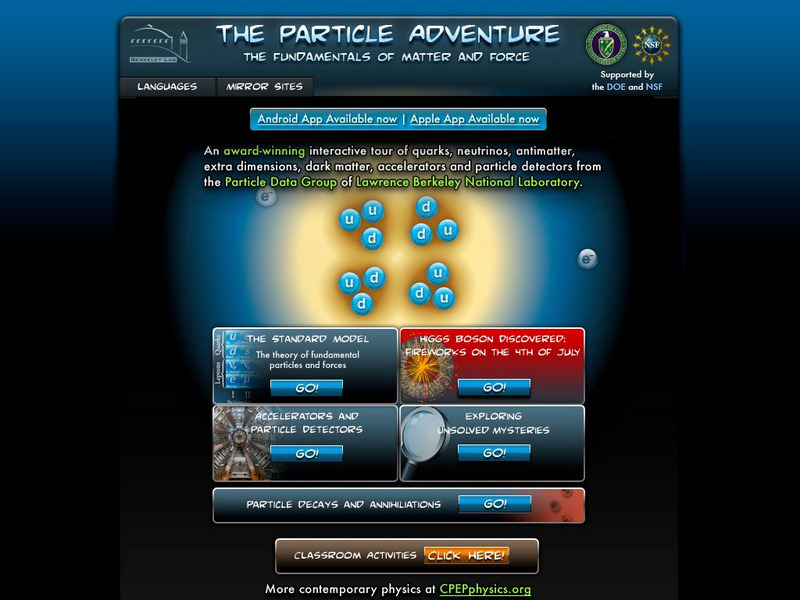
Berkeley Lab: The Particle Adventure
Visit this site for an interactive tour of the atom and all aspects of particle physics. View the animations available with almost every description on this site. A great place for the fundamentals of particles and forces including a...
CK-12 Foundation
Ck 12: Physical Science: Atomic Nucleus
[Free Registration/Login may be required to access all resource tools.] The nucleus of an atom and what holds it together.
Simon Fraser University
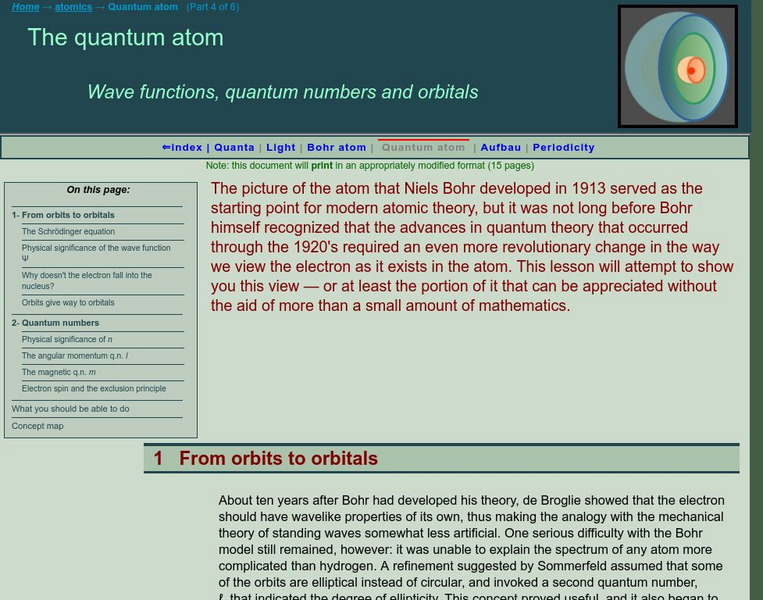
Chem1 Virtual Textbook: Movement of the Electron
Acting as a subtopic of the General Chemistry Virtual Textbook's section on Atoms and the Periodic Table, this site seeks to answer the question, "Why doesn't the electron fall into the nucleus?"
Khan Academy
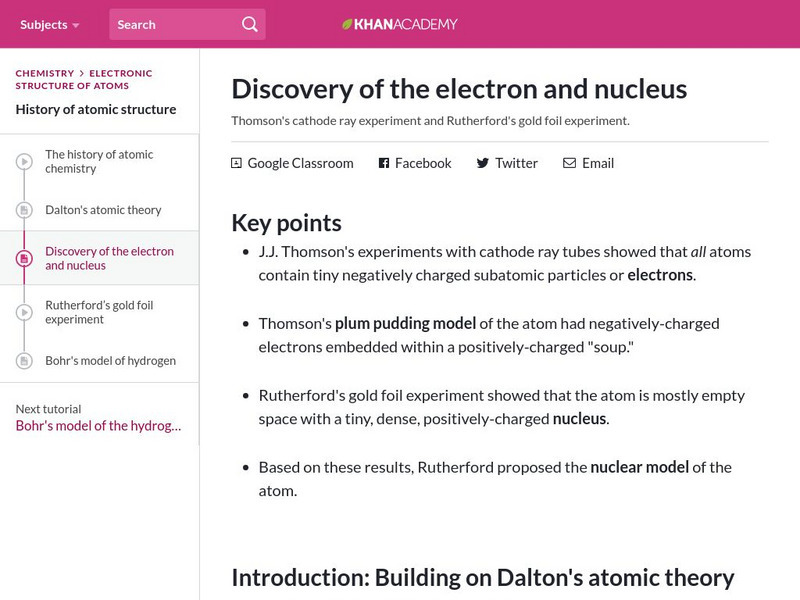
Khan Academy: Discovery of the Electron and Nucleus
Learn about Thomson's cathode ray experiment and the plum pudding model and Rutherford's gold foil experiment.
Chem4kids
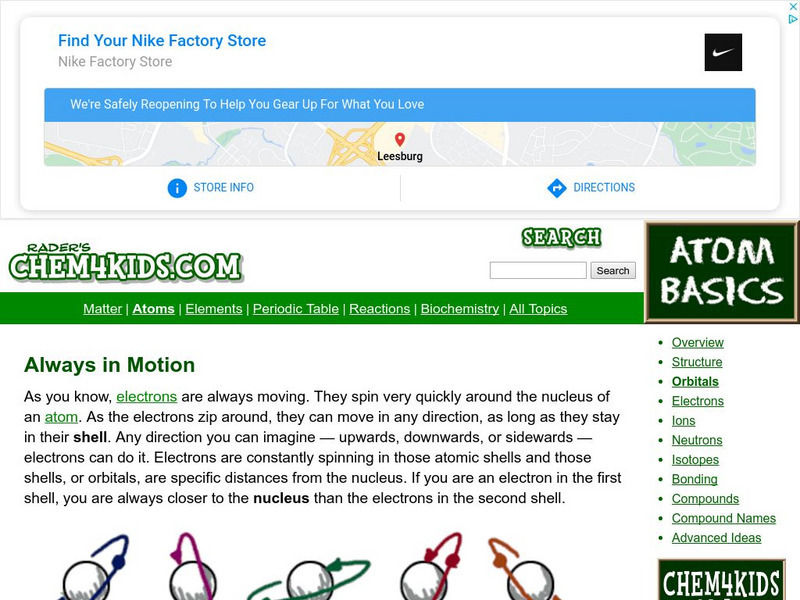
Chem4 Kids: Atoms: Orbitals
The website provides an explanation of the electrons' position in their orbitals as they spin around the nucleus. Quantum theory is also explored by explaining that the exact location of a specific electron is a not exact but a guess.
Concord Consortium
The Concord Consortium: Molecular Workbench Zoom It
See examples of scales based on a range from ten to the twelfth meters to ten to the negative twelth meters. Examples range from parts of our solar system to the nucleus of an atom.
BBC
Bbc: Gcse Bitesize: What Does the Periodic Table Tell Us About the Elements?
The number of protons in the atom of an element determines its place in the Periodic Table. The number of electrons in an atom is the same as the number of protons. These electrons are arranged in shells or 'energy levels' around the...
Sophia Learning
Sophia: The Atom: Lesson 2
This lesson will illustrate that an atom is mostly empty space and has a positively charged, massive core (containing both protons and neutrons called the nucleus) surrounded by negatively charged electrons. It is 2 of 3 in the series...

Museum of Science
The Atoms Family: Spectroscope of an Atom
"The Phantom has provided you with a simulated spectroscopy of an Atom! Amuse the Phantom by observing the spectroscope and you'll learn more about the Atom." Observe and review the structure of the atom.
Thomas Jefferson National Accelerator Facility
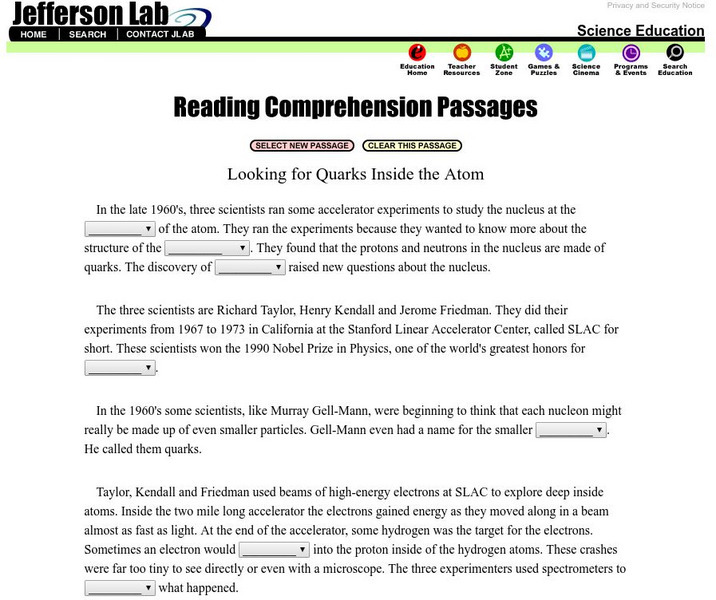
Jefferson Lab: Reading Passages: Looking for Quarks Inside the Atom
Read and fill in the blanks of this passage explaining quarks inside the atom. Each blank has a dropdown menu with choices. When you finish, click CHECK MY ANSWERS. If you pick a wrong answer, the right answer will be displayed along...
Sophia Learning
Sophia: Subatomic Particles: The Electron: Lesson 3
This lesson will explain that electrons are negatively charged particles with negligible mass and are found in pairs in orbitals surrounding the nucleus of an atom. It is 3 of 3 in the series titled "Subatomic Particles: The Electron."
Sophia Learning
Sophia: Subatomic Particles: The Proton: Lesson 2
This lesson will explain that protons are positively charged particles having a mass of one amu and are found in the nucleus of the atom. It is 2 of 3 in the series titled "Subatomic Particles: The Proton."
Sophia Learning
Sophia: Subatomic Particles: The Neutron: Lesson 2
This lesson will explain that neutrons are particles in the nucleus that have no charge and a mass of one amu. It is 2 of 3 in the series titled "Subatomic Particles: The Neutron."
CK-12 Foundation
Ck 12: Physical Science: Rutherford's Atomic Model
[Free Registration/Login may be required to access all resource tools.] Rutherford's discovery of the nucleus and his planetary model of the atom.
Concord Consortium
Concord Consortium: Structure of an Atom
Observe the probable location of electrons around an atom. Trace the electrons over time to draw conclusions about where electrons are likely to be found around an atom's nucleus. How does the trace pattern relate to the electron cloud...
PBS
Pbs Learning Media: Atomic Structure
Take a look at the parts of an atom and learn about its properties.
Science Struck
Science Struck: What Makes Up an Atom?
Describes the structure of an atom and the characteristics of the electrons, neutrons, and protons inside it. Includes some interesting facts about atoms.
Nobel Media AB
The Nobel Prize: Structure of Matter
This site provides an illustrated and animated story that seeks to answer several questions. What are atoms made of? What is keeping a nucleus intact? What happens if you try to separate two quarks? Are quarks fundamental?
Chem4kids
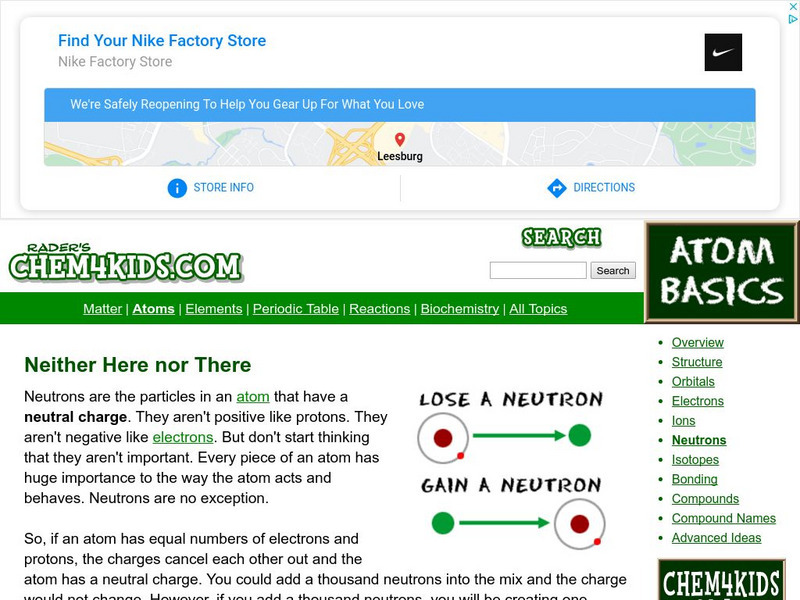
Chem4 Kids: Atoms: Neutrons
Students will find an explanation of the neutron particle located inside the atom's nucleus. Website also defines isotopes and the process of radioactive decay.
Other
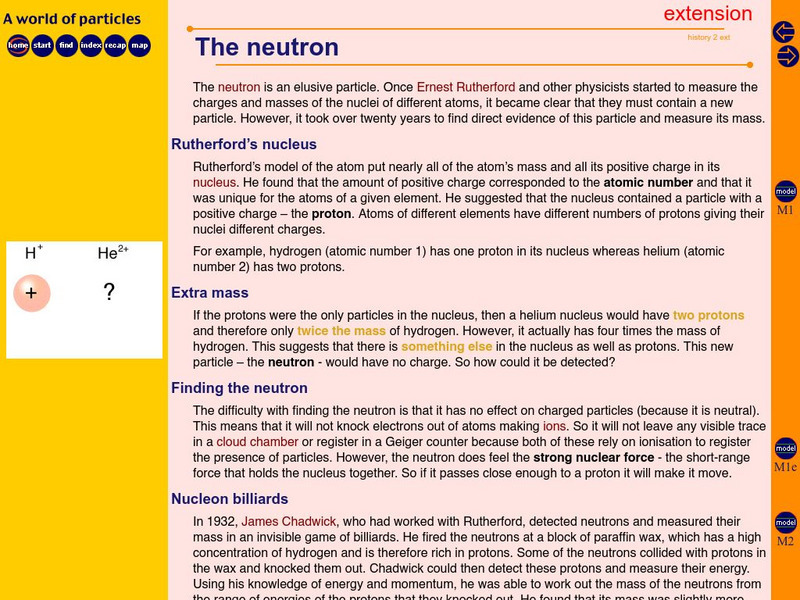
A World of Particles: The Neutron
A World of Particles offers a history of the discovery of the neutron, an exclusive particle in an atom.
Thomas Jefferson National Accelerator Facility
Jefferson Lab: Coloring Book: Quarks More Than Meets the Eye
Understand and appreciate the research conducted at Jefferson Lab about the smallest particle, the quark.
Other
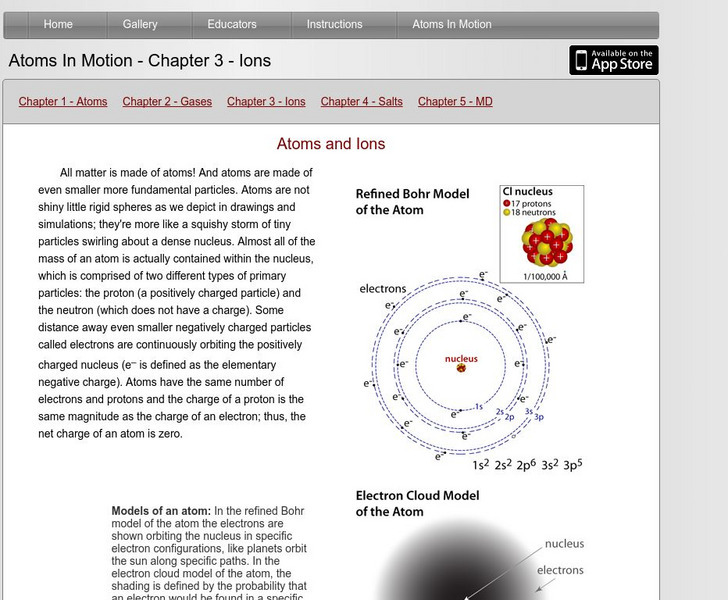
Atoms in Motion: Atoms and Ions
All matter is made of atoms! And atoms are made of even smaller more fundamental particles. Atoms are not shiny little rigid spheres as we depict in drawings and simulations; they're more like a squishy storm of tiny particles swirling...
CK-12 Foundation
Ck 12: Chemistry: Gold Foil Experiment: Rutherford's Atomic Model
[Free Registration/Login may be required to access all resource tools.] This site explains Rutherford's discovery of the nucleus and the planetary model of the atom and the role of gold foil experiment in refining the atomic model. It...