Hi, what do you want to do?





Better Lesson
Better Lesson: A Day to Celebrate Our Planet Earth
Students will compare an informational text versus a narrative text about Earth Day. Included in this lesson are videos and pictures of the lesson in action, a printable Earth Day Venn Diagram, and a recycling activity.

Nine Planets
The Nine Planets: Earth Facts
Find lots of information about our planet Earth here. Covers basic facts, Earth's history, layers of the Earth, plate tectonics, composition of the atmosphere, Earth's magnetic field, and some facts about our moon.

Ducksters
Ducksters: Astronomy for Kids: The Planet Earth
This site is astronomy for kids and teachers! Here students can learn about the planet Earth of the Solar System including fun facts, mass, day, year, and distance from the Sun.

PBS
Pbs Learning Media: Precipitation on the Planet
Precipitation affects many aspects of our lives, from drinking water and food to devastating rain or snow storms. NASA gathered information from satellites to study factors that influence precipitation. View these narrated and unnarrated...
Nine Planets
The Eight Planets: Earth
Excellent Eight Planets site that provides a vast amount of information about planet Earth. Very comprehensive and complete site.
Science Buddies
Science Buddies: How Big Are the Planets in Our Solar System?
This activity explores the relative size of the eight planets that circle around the Sun.
PBS
Pbs Learning Media: All Planet Sizes
This illustration from the Lunar and Planetary Laboratory shows the approximate sizes of the planets relative to each other. Note that the planets are not shown at appropriate distances from the Sun.
PBS
Pbs Learning Media: Epic Earth
This mesmerizing video shows seven views of the earth taken by NASA's camera. Watch the moon cross over the earth, storms in the ocean, and smoke from a wildfire. Included are teaching tips for teachers and background information.
Nine Planets
The Nine Planets: Earth
A detailed physical description of Earth. Content includes information on the Earth's layers and geology of the surface, along with links to additional information.
Nine Planets
The Nine Planets: The Moon
Explore the mythology, structure, observational history, gravitational force, and orbit of Earth's Moon.

NASA
Nasa: Earth Observatory: The Carbon Cycle
Learn about the element carbon and its importance on the Earth's atmosphere and sustainability of life on the planet. Additionally, understand the role the carbon cycle plays in global climate change over time.
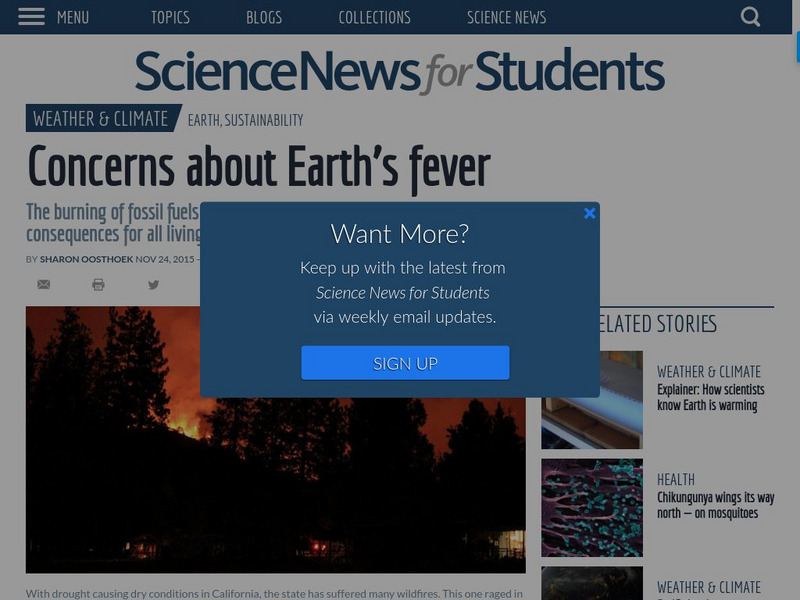
Society for Science and the Public
Science News for Students: Concerns About Earth's Fever
Burning fossil fuels is causing the planet to heat up, causing weather patterns to change, sea levels to rise and diseases to spread. Scientists are concerned with the rising temps of Earth.

TED Talks
Ted: Ted Ed: Climate Change: Earth's Giant Game of Tetris
There's a game of Tetris happening on a global scale: The playing space is planet Earth, and all those pesky, stacking blocks represent carbon dioxide- a greenhouse gas that is piling up ever more rapidly as we burn the fossil fuels that...

TED Talks
Ted: Ted Ed: The Otherworldly Creatures in the Ocean's Deepest Depths
Although the deep ocean zone seems like an inhospitable and remote corner of the planet, it is actually one of the greatest habitats on Earth. Lidia Lins explores how so many species thrive in this mysterious underwater world. [5:02]
University Corporation for Atmospheric Research
Ucar: Planet Magnet
Students use iron filings to explore the magnetic field around a magnet and record their observations then apply their experience with the magnet to understand the magnetic field around Earth.

Society for Science and the Public
Science News for Students: So Many 'Earths'
Article reports on the recent discovery that many suns in the universe host "Earth-like" planets. Includes a vocabularly list.
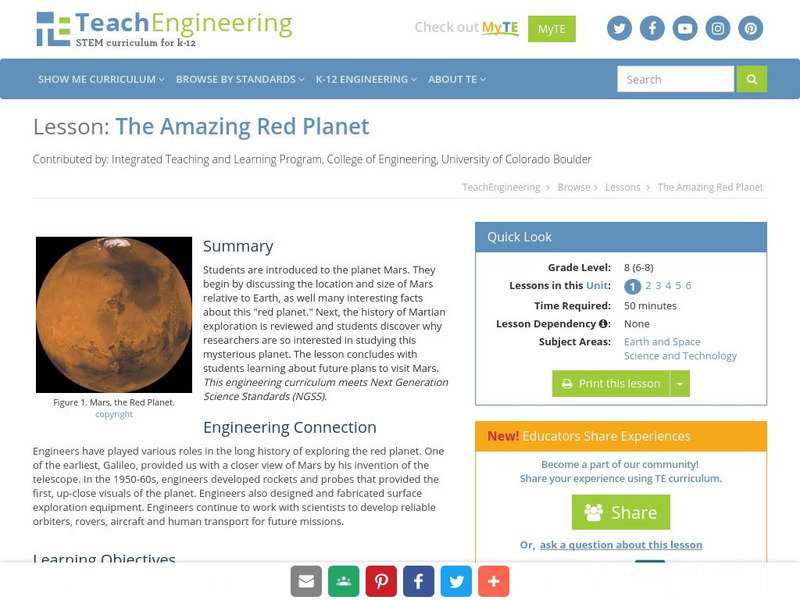
TeachEngineering
Teach Engineering: The Amazing Red Planet
The purpose of this lesson plan is to introduce students to the planet Mars. This lesson plan will begin by discussing the location and size of Mars relative to Earth, as well as introduce many interesting facts about this red planet....
University Corporation for Atmospheric Research
Ucar: The Greenhouse Effect
Students will learn how greenhouse gases temporarily trap heat within Earth's atmosphere, warming the planet via the greenhouse effect.
University of Virginia
University of Virginia: How the Greeks Used Geometry to Understand the Stars
An article explaining how the Greeks were able to use their science and mathematics to predict where astronomical objects such as the Planets could be found in the nighttime sky even though their underlying premise was that the earth did...
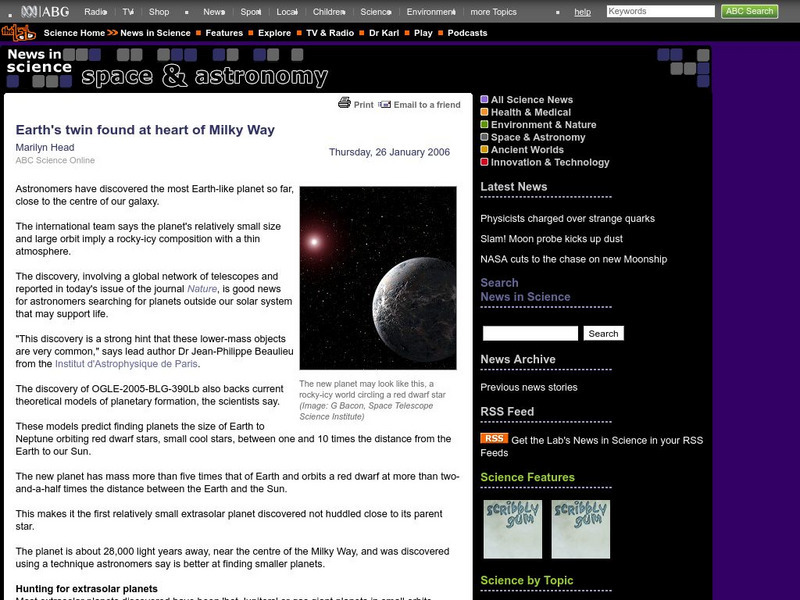
Australian Broadcasting Corporation
Australian Broadcasting Corporation: News in Science: Earth's Twin Found at Heart of Milky Way
From ABC News in Science, Marilyn Head's article centers on research behind the discovery of the planet in the Milky Way which most closely resembles the planet Earth.
University of Texas at Austin
The University of Texas Mc Donald Observatory: Earth's Moon
Discover interesting facts about Earth's partner, the moon, which is more like a double planet than a planet and a moon.

NASA
Nasa: Jet Propulsion Laboratory: Planet Quest: Exoplanet Exploration
Constellation of articles, images, diagrams, posters, videos, and more on the subject of the search for planets, particularly Earth-like planets, outside our solar system.
Lonely Planet
Lonely Planet: Cyprus
This Lonely Planet site offers a down-to-earth summary of the culture of Cyprus. Read about ancient relics, religion, and food.
Harvard University
Harvard University: The Solar System
These hands-on activities are a great way for students to gain perspective on the relative sizes and distances of each planet, the relationship between the sun and Earth, and much more.