Hi, what do you want to do?






Curated OER
What Can Animals Do?
In this science related worksheet, students discuss and brainstorm what animals can and cannot do and then answer twelve true and false questions regarding the subject.

Curated OER
Classifying Living Things
In this classification learning exercise, students read a description of how all living things are related and describe a diagram showing how this taxonomy works. Students answer five questions related to their reading.

Curated OER
Queen Elizabeth
In this famous leaders worksheet, students read a passage about Queen Elizabeth and then complete a variety of in-class and homework activities to support comprehension, including partner interviews, spelling, cloze, synonym...

Curated OER
Bat Ecology
Students, through hands on games and activities, discover how bats live and how bats benefit ecosystems. They play a game designed to show them how echolocation works and another to show how mother bats locate their young through their...

Curated OER
Asexual Reproduction
Sixth graders investigate how asexual reproduction produces single-parent offspring. They use plants and yeast to demonstrate vegetative propagation and budding in a laboratory. Students draw five different types of asexual reproduction.
![Panhandle Area Educational Consortium: The Six Kingdoms of Life [Pdf] Handout](https://statictemp.lp.lexp.cloud/images/attachment_defaults/resource/large/FPO-knovation.png "Panhandle Area Educational Consortium: The Six Kingdoms of Life [Pdf] Handout")
Other
Panhandle Area Educational Consortium: The Six Kingdoms of Life [Pdf]
Scientists look at the evolutionary history of organisms to divide them into kingdoms. For awhile, there has been 5 kingdoms, but many scientist are now using 6 kingdoms.
Other
Secondary Science Program: The Six Kingdoms
A short overview of the six kingdoms in our scientific classification system: Plants, Animals, Protists, Fungi, Archaebacteria, and Eubacteria.

Tom Richey
Slide Share: Overview of Six Kingdoms
This slideshow provides an overview of the six kingdoms.
Curated OER
Secondary Science Program: The Six Kingdoms
A short overview of the six kingdoms in our scientific classification system: Plants, Animals, Protists, Fungi, Archaebacteria, and Eubacteria. A good explanation of how organisms are placed in their particular kingdom.
Curated OER
Secondary Science Program: The Six Kingdoms
A short overview of the six kingdoms in our scientific classification system: Plants, Animals, Protists, Fungi, Archaebacteria, and Eubacteria. A good explanation of how organisms are placed in their particular kingdom.
Curated OER
Secondary Science Program: The Six Kingdoms
A short overview of the six kingdoms in our scientific classification system: Plants, Animals, Protists, Fungi, Archaebacteria, and Eubacteria. A good explanation of how organisms are placed in their particular kingdom.
Curated OER
Secondary Science Program: The Six Kingdoms
A short overview of the six kingdoms in our scientific classification system: Plants, Animals, Protists, Fungi, Archaebacteria, and Eubacteria. A good explanation of how organisms are placed in their particular kingdom.
Alabama Learning Exchange
Alex: Organism Power Points/ Booklets
This lesson requires students to use technology to research information on any organism from one of the six kingdoms. Students use the information to produce a PowerPoint presentation or booklet to present to their classmates. This...
Other
Math and Science Activity Center: Classification of Living Things
Kingdom is the highest rank used in the biological taxonomy of all organisms. There are 6 kingdoms in taxonomy. Every living thing comes under one of these 6 kingdoms. The six kingdoms are Eubacteria, Archae, Protista, Fungi, Plantae,...
Mocomi & Anibrain Digital Technologies
Mocomi: Kingdom Classification of Living Organisms
Learn about who created the classification of living things, how they are classified, and the six different kingdoms.
CK-12 Foundation
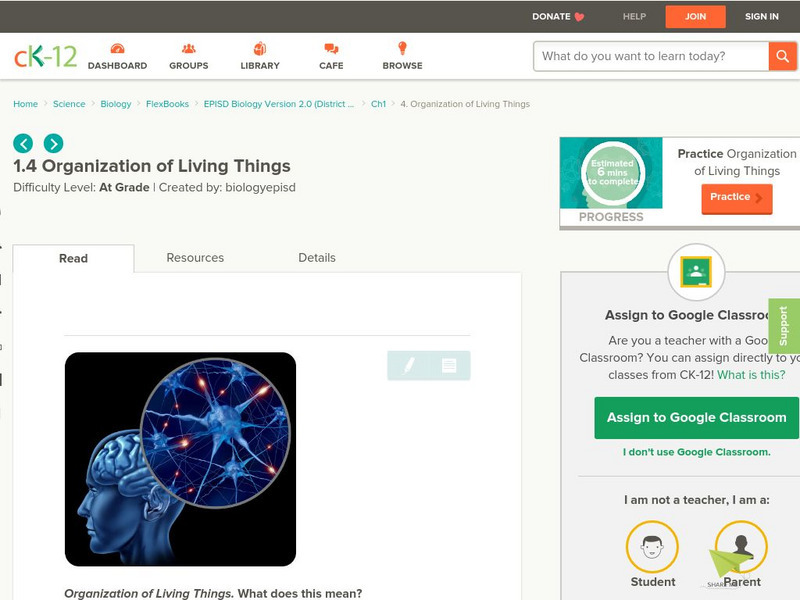
Ck 12: Organization of Living Things
[Free Registration/Login may be required to access all resource tools.] This lesson explains the levels of organization within the biological world. It looks at the cell to organism hierarchy, and at the population to biosphere...

Other
Southwest Tennessee Community College: Classification of Organisms
College-level instructor's notes describing taxonomy. Explanations and images give a chronological history of the science of classifying organisms.
Curated OER
Unesco: Romania: Dacian Fortresses of the Orastie Mountains
Built in the 1st centuries B.C. and A.D. under Dacian rule, these fortresses show an unusual fusion of military and religious architectural techniques and concepts from the classical world and the late European Iron Age. The six...

TES Global
Tes: Henry v 2015 Teacher Pack
[Free Registration/Login Required] This is a teacher resource for Shakespeare's Henry V from the Royal Shakespeare Company. It is divided into six sections: Imagining the Story, Two Kingdoms, Leadership in War, Band of Brothers, A Royal...