
CommonLit
Common Lit: The Space Race Is Over
A learning module that begins with "The Space Race Is Over" by Paul Kingsnorth, accompanied by guided reading questions, assessment questions, and discussion questions. The text can be printed as a PDF or assigned online through free...
Digital Public Library of America
Dpla: Space Race
This set focuses on the Space Race during the mid-1950s and 1960s and examines the impact of the Space Race today. Includes a teacher's guide.
BBC
Bbc: Space Race
There are galaxies far, far away, but just how big is our own solar system? Scroll through this interactive to quickly observe just how much we know and have learned about our solar system.
NASA
Nasa, Human Space Flight: Apollo 11 Mission
The story of the Apollo 11 lunar landing is told with dramatic details, pictures, and mission highlights.
The Newberry Library
The Newberry: Chicago Defined: Space and Place, Homes and Journeys
Learning module examines how writers and artists have portrayed the city of Chicago as well as the response to the city's changing population and character during the nineteenth and twentieth centuries. Primary sources and questions for...
History Link
History Link: The 1962 Seattle World's Fair
A history of the Seattle World's Fair held in 1962. Includes in-depth details of exhibits and attendees, including Prince Phillip of England and Elvis Presley. Wonderful pictures of many of the fair's promotional posters.

TED Talks
Ted: Ted Ed: A Trip Through Space to Calculate Distance
Imagine two aliens racing across outer space to their moon. Who can we deem the fastest alien? With DIRT- or the equation Distance = Rate x Time- we can calculate their rates, using the distance they traveled and the time they took....

Arcademics
Arcademics: Space Jaunt
Multiplayer math game where alien spaceships race by rounding whole numbers to the nearest 10's place value.
University of Wisconsin
The Why Files: Sputnik's Legacy
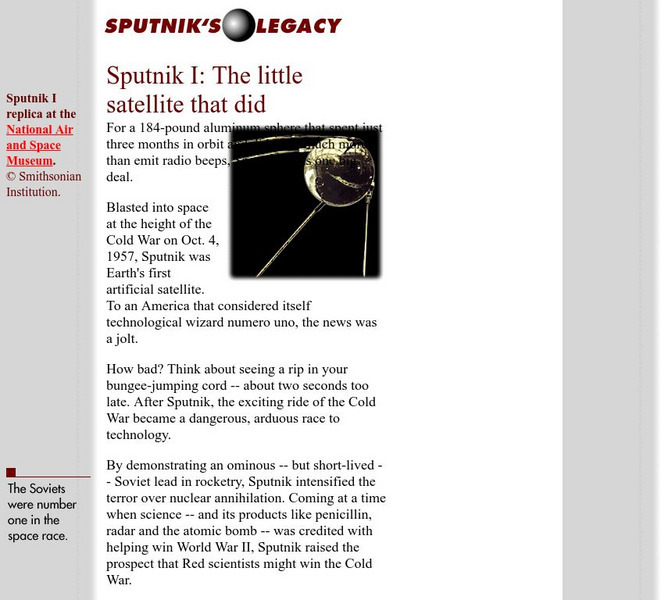
Easy-to-read history of the Soviet satellite launch that began the race for space between the Soviet Union and United States. Click on "next" at the bottom to advance to the next page.
Smithsonian Institution
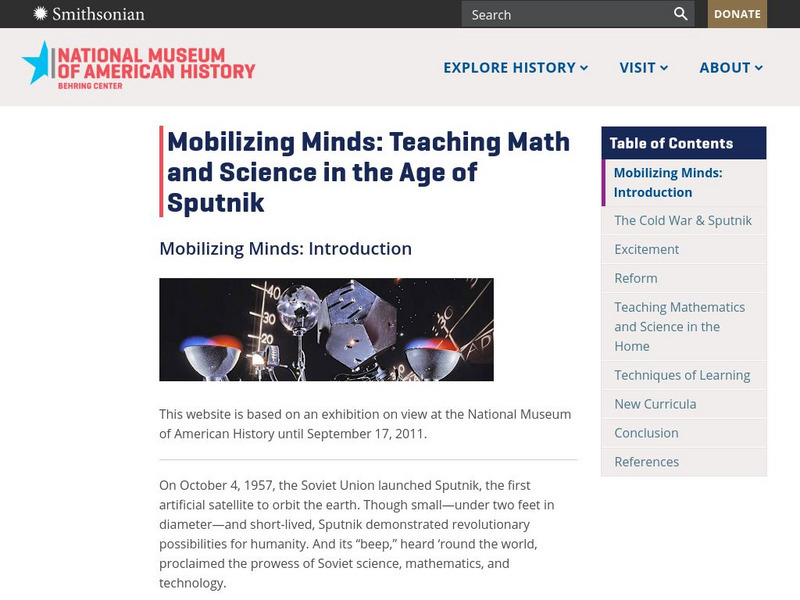
National Museum of American History: Teaching Math & Science in Age of Sputnik
Why did the Soviet Union's launch of Sputnik throw the fields of mathematics and science into tremendous demand in the United States? Find the many ways this revolutionary event impacted children from the 1950s to become the...
Siteseen
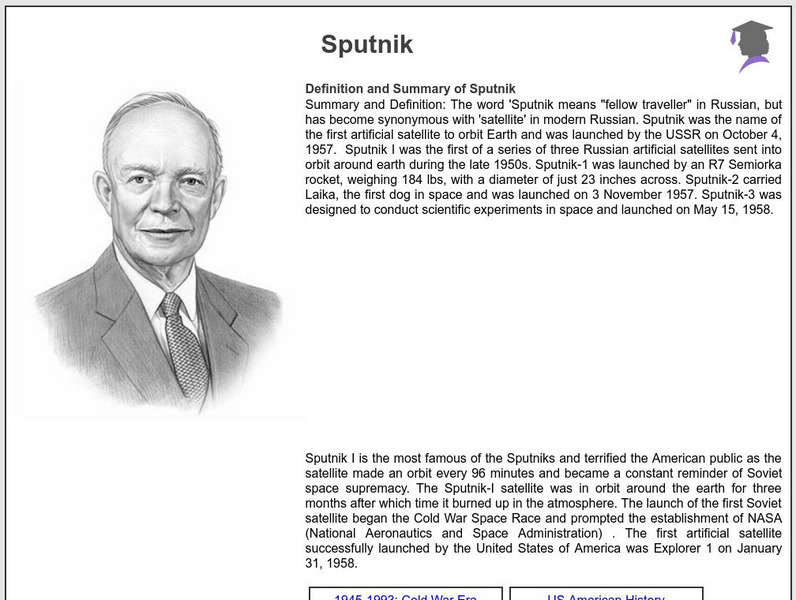
Siteseen: American Historama: Sputnik
Detailed information on Sputnik, the first artificial satellite to orbit Earth, launched by the USSR on October 4, 1957.
TeachEngineering
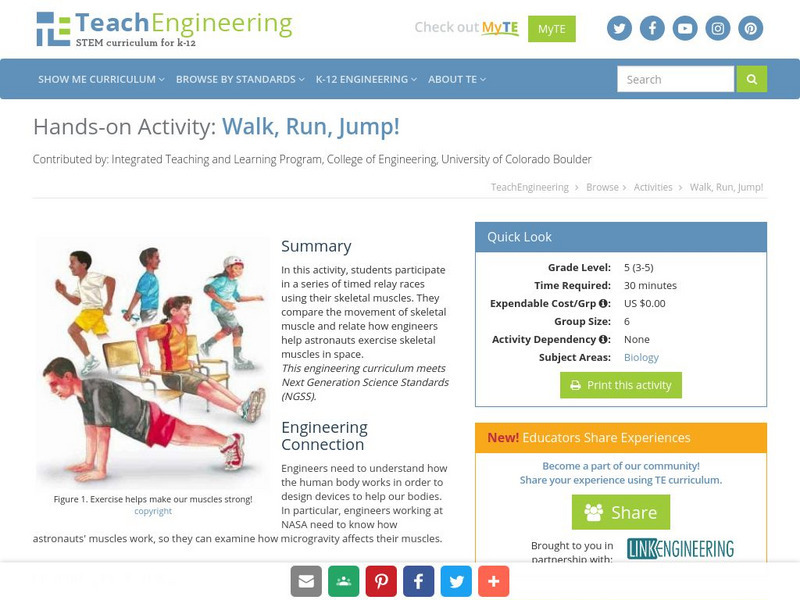
Teach Engineering: Walk, Run, Jump!
In this activity, students participate in a series of timed relay races using their skeletal muscles. The compare the movement of skeletal muscle and relate how engineers help astronauts exercise skeletal muscles in space.