Hi, what do you want to do?






Enchanted Learning
Enchanted Learning: Zoom Astronomy: All About Space
A fantastic collection of information about the solar system. Includes information on all of the planets, the moon, the sun, asteroids, comets, meteoroids, and stars. Also find puzzles, a dictionary, quizzes, classroom activities, and...
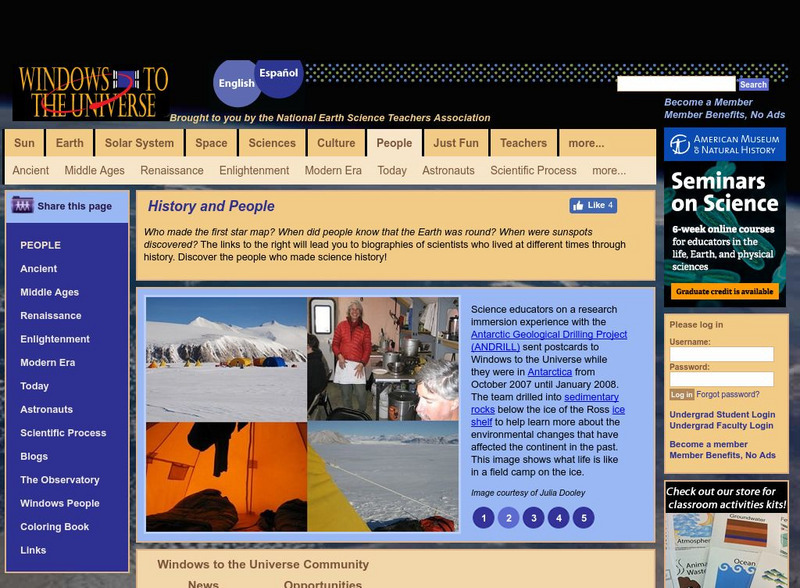
National Earth Science Teachers Association
Windows to the Universe: History & People
Biographies of people throughout history who looked at the sky and wondered what was there. Links to a detailed description of the planets and interactive activities.
NASA
Nasa: Image Science Center: Ask the Space Scientist
A NASA scientist, Dr. Sten Odenwald, answers many students' questions. Topics include planets, galaxies, black holes, the origin of the universe, and common misconceptions about space.
Nine Planets
The Nine Planets: Meteors, Meteorites and Impacts
Very informative and in-depth site about meteors, meteorites and their impacts. This site provides lots of text to inform about meteors, lots of pictures of the different types of meteorites, tables and statistics about meteors and...
Nine Planets
The Nine Planets: Venus
In-depth information site on Venus, complete with a thorough glossary, links to a wide array of related sites, thumbnail picture files linked to larger images, and even a short audio file from a classic symphony.
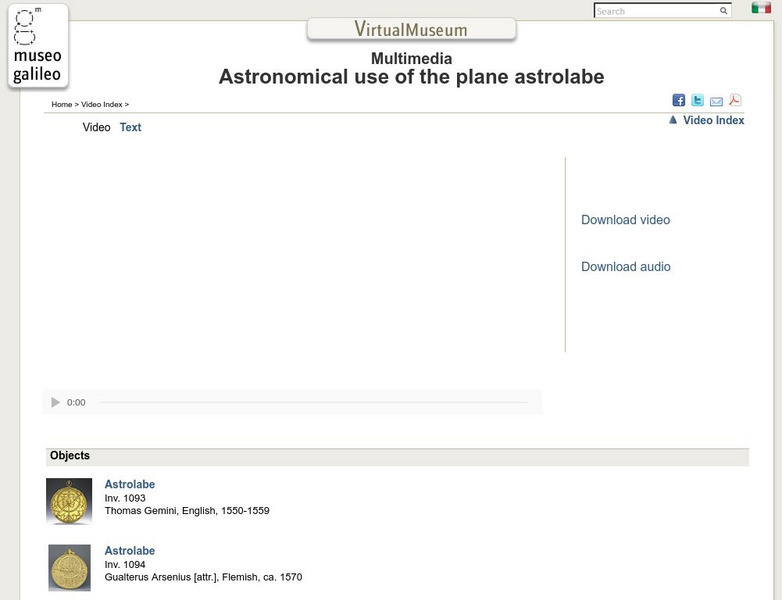
Institute and Museum of the History of Science
Museo Galileo: Multimedia: Video: Astronomical Use of the Plane Astrolabe
Invented in ancient Egypt, the plane astrolabe is a tool used by astronomers and navigators to determine time and identifying positions of the Sun, Moon, stars, and planets. Read text or view the video to understand the details of its...
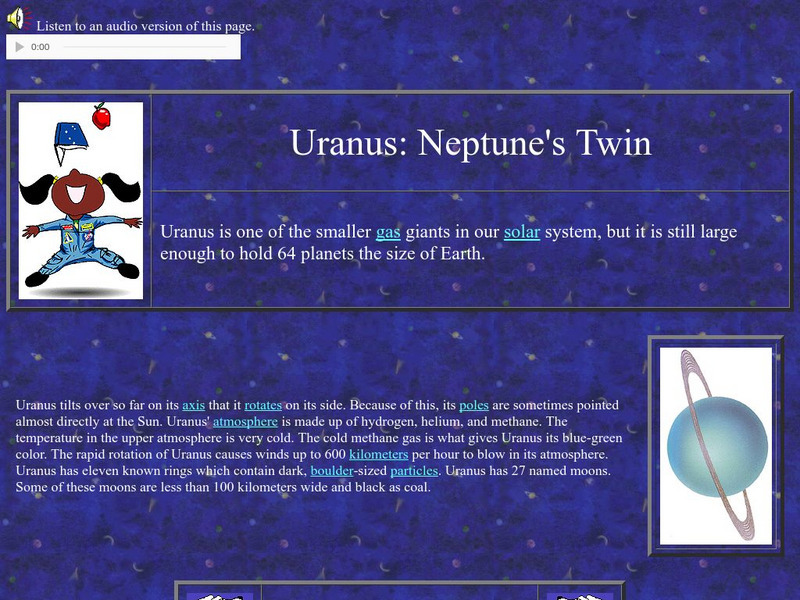
NASA
Nasa Star Child: Uranus, Neptune's Twin (Level 1)
Get to know the twin of Neptune with this introduction to Uranus. Listen to the information in an audio file. Features include a printable version of the page, and vocabulary words are linked to a glossary of terms.
Georgia Department of Education
Ga Virtual Learning: A Brief History of Astronomy
In this interactive module students will explore what different ancient cultures believe was an explanation of the stars and planets. They will look at how the work of Nicolas Copernicus revolutionize the world of astronomy and learn how...

Unite for Literacy
Unite for Literacy: Earth and Sky: The Night Sky
Read about the sights you can see in a clear night sky. Book includes audio narration in 16 additional languages with text in English.

Other
Astromador: Astronomia Para Amadores
This resources focuses exclusively on astronomy. It's packed with historical facts about space exploration, famous people who pioneered the study of stars and planets. It features chronological list of space exploration, current news,...
Kidport
Kidport: Space Science
This complete resource will help students to improve their understand of space exploration. Includes images of the universe, galaxies, stars and planets.
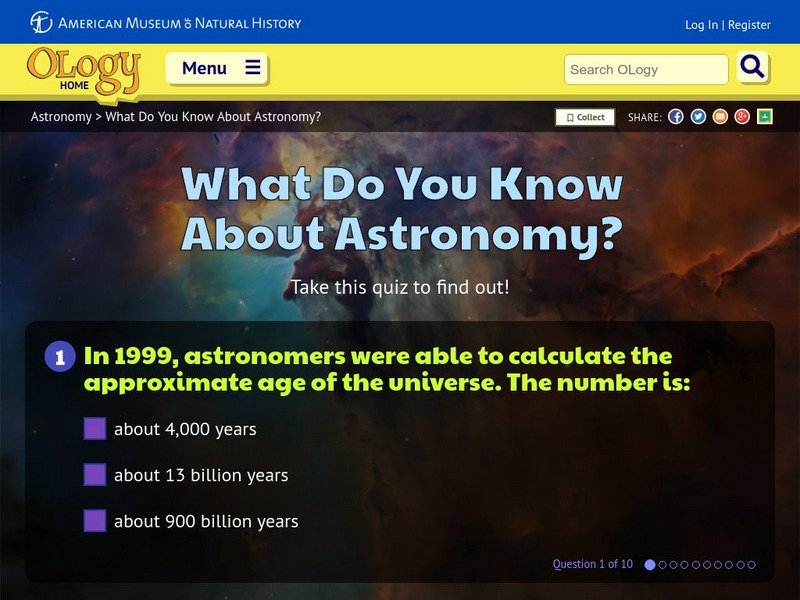
American Museum of Natural History
American Museum of Natural History: O Logy: What Do You Know? Astronomy
Take this ten-question self-scoring quiz to test your knowledge of astronomy facts: age of the universe, why stars and planets are spheres, where other life might exist in the outer space, the Milky Way, and more.
Space Telescope Science Institute
Space Telescope Science Institute: Amazing Space
Amazing Space promotes the "science and majestic beauty of the universe for use in the classroom." Here you can find learning activities, lesson plans, teaching guides, and helpful tips for students eager to learn about space and space...
US Environmental Protection Agency
Epa: Planet Protectors Club for Kids
This site has activities, games and stories starring the Planet Protector's Club. Find out how kids can help our environment. (Several activities include a Spanish version.)
Other
Energy Star: Un Mundo Bellow Comienza Contigo [Pdf]
The Government sponsored resource helps individuals protect the environment through superior energy efficiency. The activities teach students about the environment and what they can do to save the planet.
Other
Energy Star: A Beautiful World Starts With You [Pdf]
The Government sponsored resource helps individuals protect the environment through superior energy efficiency. The activities teach students about the environment and what they can do to save the planet.
NASA
Nasa: The Space Place
This site is geared towards elementary learners, but most lessons can be modified for older learners. Space-related classroom activities, printable images of Earth and space, thought-provoking Space Place Musing podcasts and math-related...
Scholastic
Scholastic: Study Jams! Science: Our Solar System: The Universe
A video and a short multiple-choice quiz on the Universe and what it is made up of.
NASA
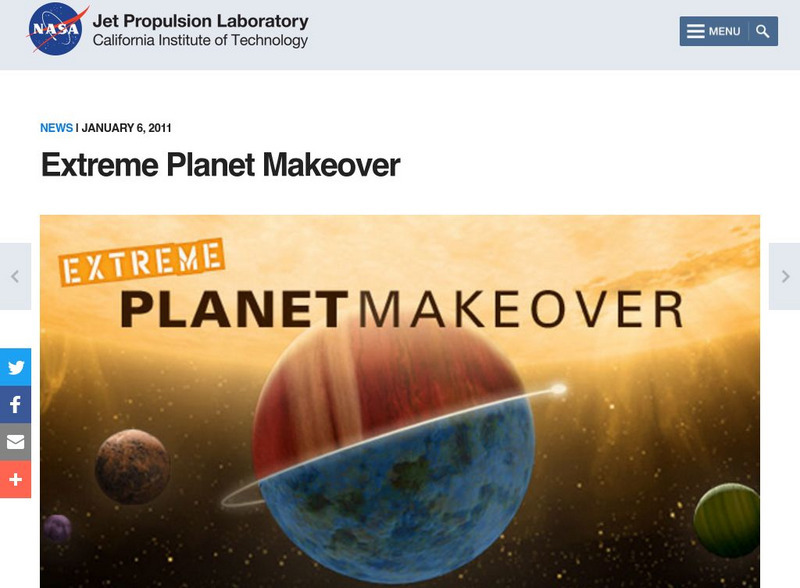
Nasa: Planet Quest: Extreme Planet Makeover
Activity in which students create a planet based on distance from a star, age, size, and star type. The created planet is evaluated to determine if it can support life.
E-learning for Kids
E Learning for Kids: Science: Antarctica/ What Are the Different Parts of the Universe?
In this lesson, students learn about objects in the universe, including constellations, planets, meteors, asteroids, and comets.
Nine Planets
The Nine Planets: Sun Picture List
Various pictures and movies of the sun. Download some of these files and then give a presentation to your class explaining the solar phenomena.
Ministerio de Educación (Spain)
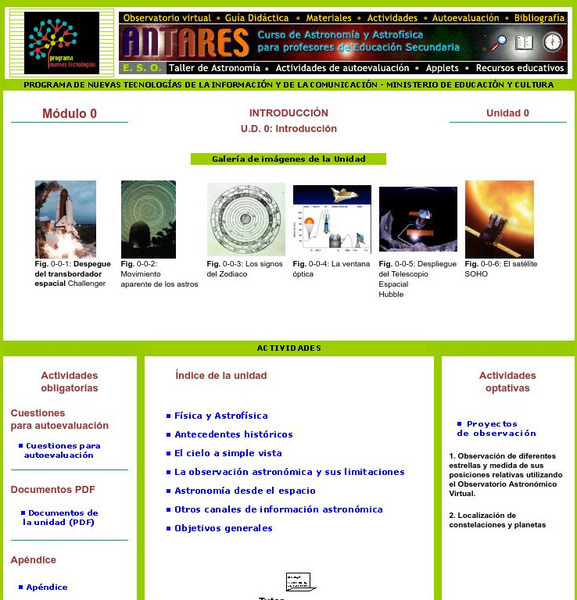
Ministerio De Educacion: Introduccion Modulo 0
Observe different stars and measure its relative position utilizing the Virtual Astronomical Observatory.

Other
University of Cambridge: Astro Adventure
Imagine a time when you can travel through space, planet to planet, cheaply and in comfort, when you can take a trip to the stars as your next holiday. Well, imagine no more. Learn more about the solar system as you take this trip of a...
TED Talks
Ted: Ted Ed: Can You Solve the Unstoppable Blob Riddle?
A shooting star crashes onto Earth. It's unstoppable: no matter what you throw at it, it just re-grows and continues its rampage. The only way to save the planet is to cut the entire blob into precise acute triangles, rendering it inert....