Smithsonian Institution
Smithsonian Learning Lab: The Universe, an Introduction
Start with the questions all students ask: How big is the universe, how far away are the planets and stars, how did they form and when, how do they move and why? Build on their natural curiosity. The Smithsonian, in cooperation with...
Other
University of Cambridge: Astro Adventure
Imagine a time when you can travel through space, planet to planet, cheaply and in comfort, when you can take a trip to the stars as your next holiday. Well, imagine no more. Learn more about the solar system as you take this trip of a...

TED Talks
Ted: Ted Ed: Can You Solve the Unstoppable Blob Riddle?
A shooting star crashes onto Earth. It's unstoppable: no matter what you throw at it, it just re-grows and continues its rampage. The only way to save the planet is to cut the entire blob into precise acute triangles, rendering it inert....
NASA
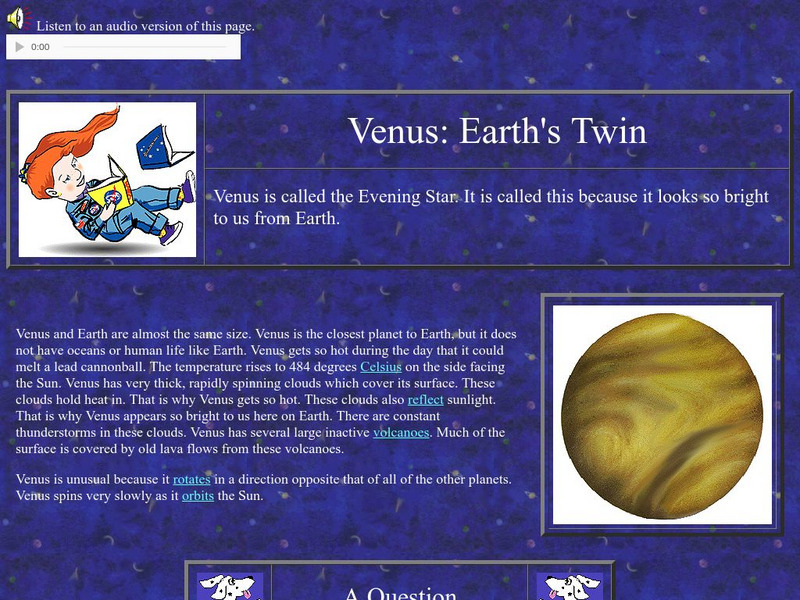
Nasa Star Child: The Planet Venus
Basic facts about the planet Venus including its temperature, its atmosphere, and its volcanoes. Includes a discussion question on temperature, with facts, and the answer. A linked page covers similar material in a "Level 2" version, and...

Other
Paper Plate Education: Serving the Universe on a Paper Plate
Excellent resource for "paper-plate" activities that help simplify various astronomy topics. Learn how to build a "Moon Finder" and "Planet Pointer," and create a paper-plate model that explains the Transit of Venus.
Mocomi & Anibrain Digital Technologies
Mocomi: How Big Is the Universe?
Provides facts about the Universe, Jupiter, the Milky Way Galaxy, and Superclusters.
NASA
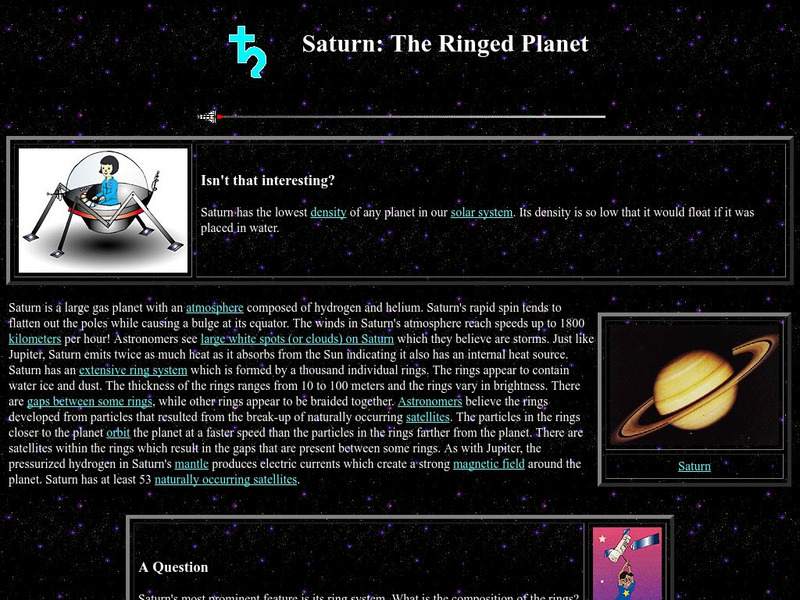
Nasa Star Child: Saturn, the Ringed Planet (Level 2)
An introductory site with information about planet Saturn, with a good glossary, a brief quiz, and links for more information. Printable version also available.
Other
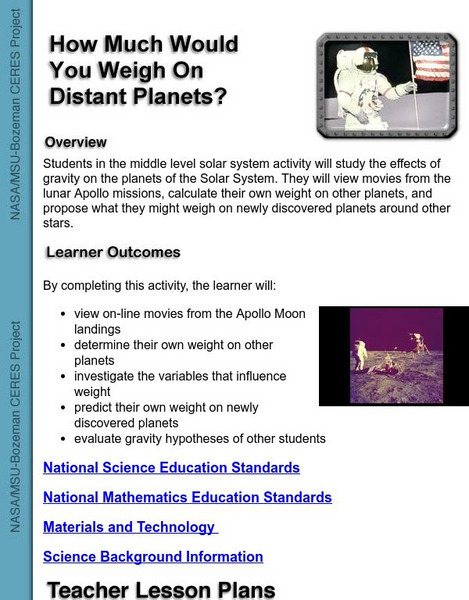
Montana State University: How Much Would You Weigh on Distant Planets?
This resource contains a lesson plan in which students study the effects of gravity on the planets of the Solar System. They will view movies from the lunar Apollo missions, calculate their own weight on other planets, and propose what...

NASA
Nasa Star Child: Mars, the Red Planet (Level 2)
A general introduction to Mars. Includes a glossary of terms and two images of Mars. Many interspersed links to more graphics and more detailed information about the planet Mars. Also includes a printable version and links to other...
Annenberg Foundation
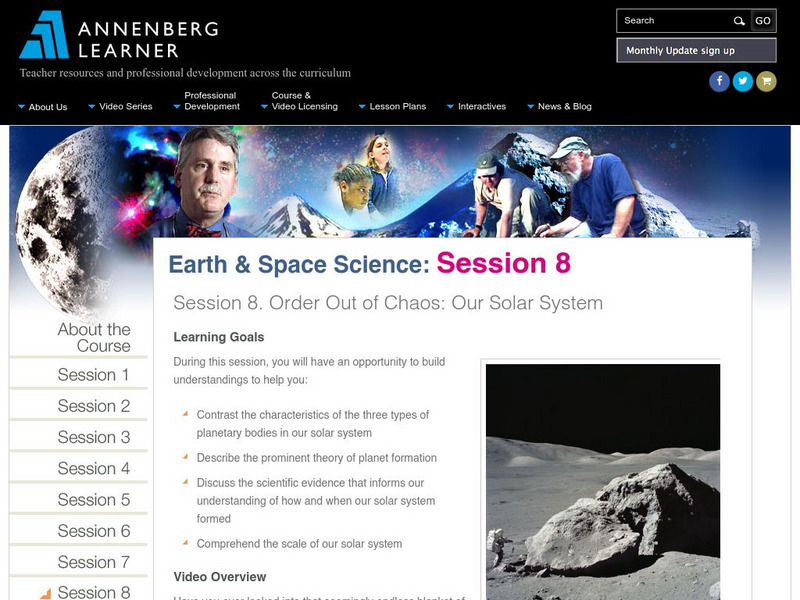
Annenberg Learner: Earth and Space Science: Order Out of Chaos: Solar System
Material to begin an exploration of the Solar System: the characteristics of the planets, theories about planet formation, and more. An hour-long video is accompanied by learning goals, an outline and overview, details on star formation,...

NASA
Nasa: Students K 4
NASA-sponsored coverage and research on a range of topics related to space exploration -- flying weather stations, comets, first steps on the Moon, and other space-related topics -- are presented in age-appropriate activities, lesson...

ClassFlow
Class Flow: Planets and Stars
[Free Registration/Login Required] In this flipchart students will learn about the planets and stars.
NASA
Nasa: The Space Place
This site from NASA's Space Place is geared towards early elementary learners. It offers detailed instructions for crafts and activities related to space, games and a teacher resource area. Students can also ask an expert at this site.
NASA
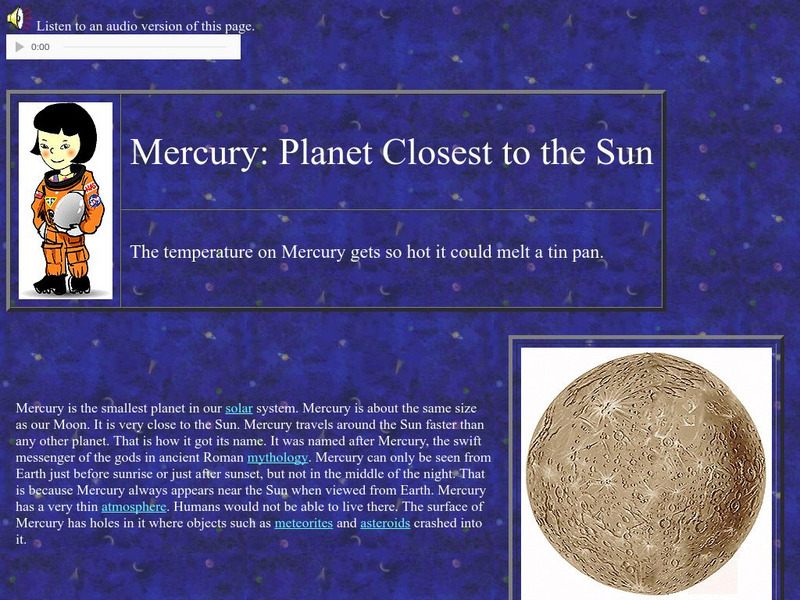
Nasa Star Child: Mercury
Provides good information about Mercury and is a good starting point for information about the planet along with pictures and audio. Links to a simple fact table, puzzle, glossary, and more detailed information.

Cornell University
Cornell University: Astronomy: Orbital Motion and Kepler's Laws
At this site from the Astronomy Department of Cornell University, Kepler's three laws of planetary motion are stated. There are brief explanations of each, along with links to additional information on related subjects.
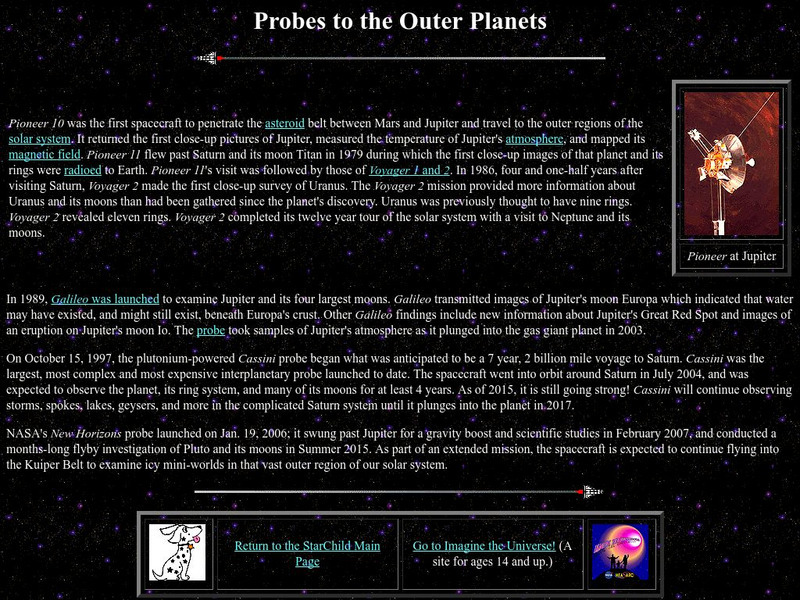
NASA
Nasa Star Child: Probes to the Outer Planets (Level 2)
This site has a description of the many probes sent to the outer planets, including pictures and vocabulary words linked to a glossary of terms. Other links on interesting facts and more detailed information are also included.
Other
Hong Kong Space Museum
Besides an introduction to exhibitions and events at the museum, the site provides a guide to stargazing, an astronomy FAQ, space news, virtual tours (see site map) and research resources (including Chinese-English star and constellation...

ClassFlow
Class Flow: Space Solar System
[Free Registration/Login Required] In this lesson students will compare and contrast the attributes of star, star patterns and planets. Students will also have the opportunity to review facts about each planet and then complete various...
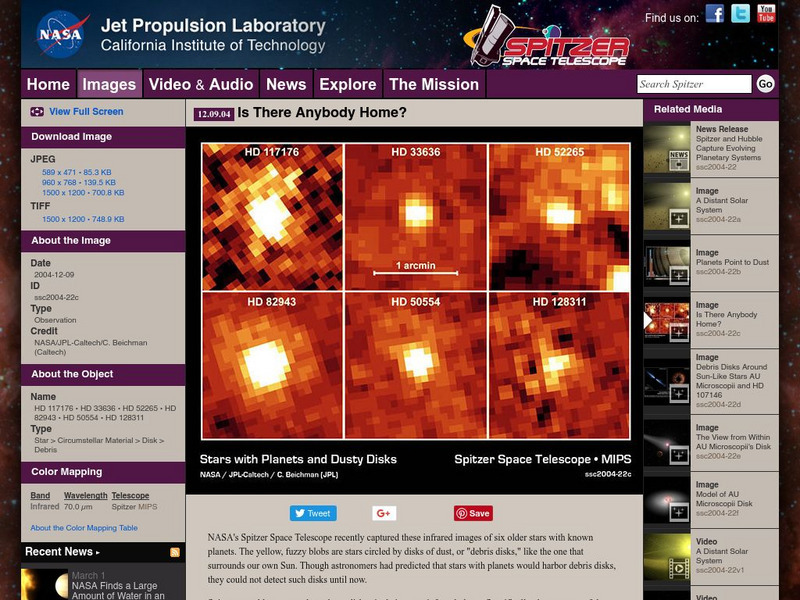
California Institute of Technology
Spitzer Science Center: Is There Anybody Home?
This image, titled "Is There Anybody Home?" features six fuzzy pictures depicting six stars associated with known planets. The text under the image details various specifics about the picture and the planetary system associated with the...

ClassFlow
Class Flow: We Are Part of a Larger Universe
[Free Registration/Login Required] The flipchart was made a culminating activity for a unit of study on mapping. It starts with a video on the sky, stars and then a brief look at the universe to earth with images then addresses are...
Other
Christopher Crockett: The Astronomy Word of the Week Is "Barycenter"
While astronomers and philosophers have long mused on the possibility of other solar systems, the first planets confirmed to orbit a star other than our Sun weren't found until 1992. The reason it took so long is that it's really hard!...
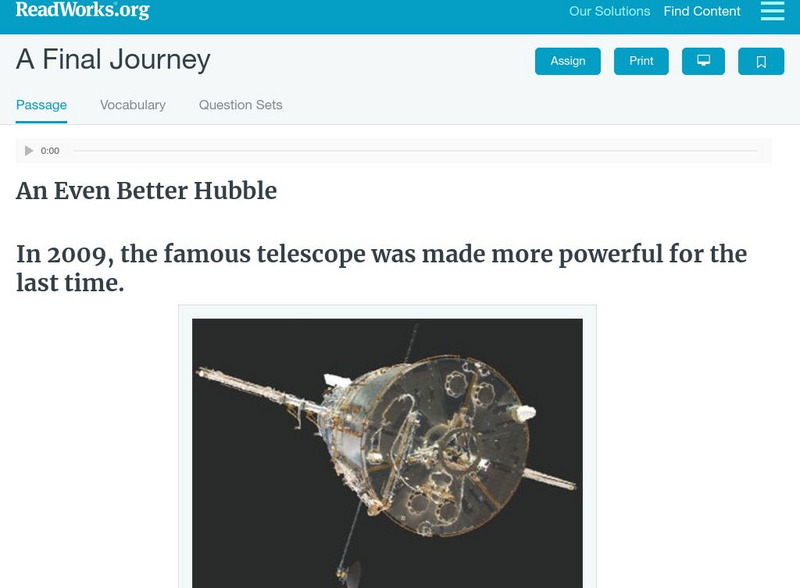
Read Works
Read Works: A Final Journey
[Free Registration/Login Required] An informational text about improvements made to the Hubble telescope. A question sheet is available to help students build skills in reading comprehension.

ClassFlow
Class Flow: Stars 1 5
[Free Registration/Login Required] Making sets of stars to match the numbers 1-5.
NASA
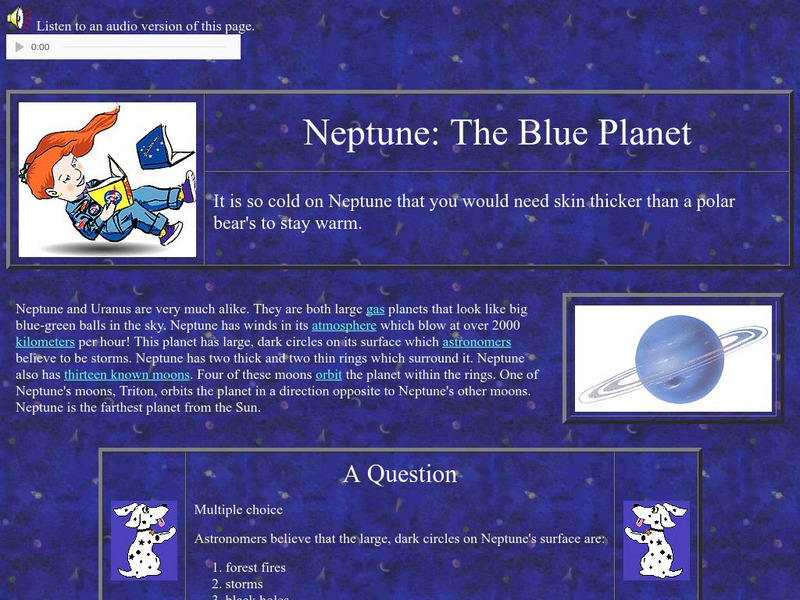
Nasa Star Child: Neptune, the Blue Planet (Level 1)
An introduction to Neptune for young students. Audio content, a glossary, graphics, and a printable version are all included.