Hi, what do you want to do?






PBS
Pbs Learning Media: The Sun and the Water Cycle
Learn about the water cycle through the adventures of two sisters. They will explain how the sun powers the water cycle and describe the different states of water. A glossary and labeled illustrations accompany the video. For the...
Science Buddies
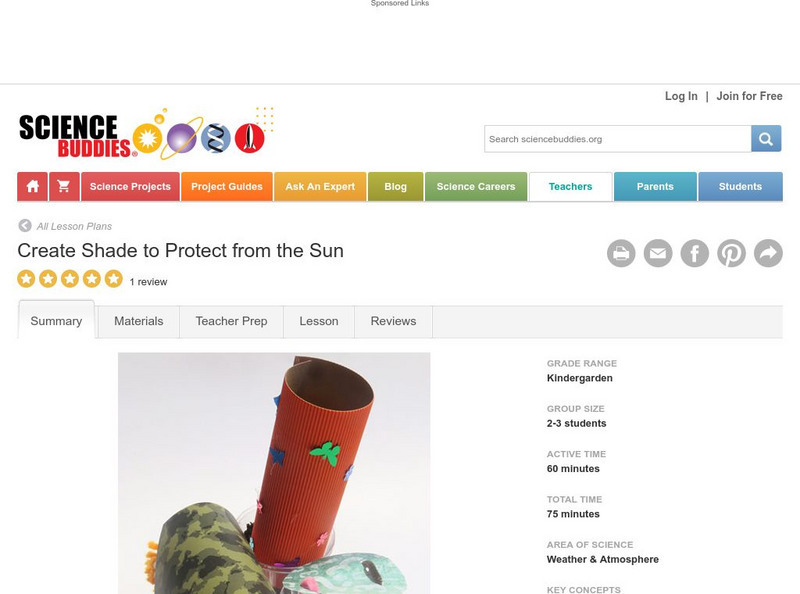
Science Buddies: Create Shade to Protect From the Sun
In this fun activity, students will get creative with craft materials. They will figure out how to protect an "animal" and its territory from getting too hot in the sun. What will they build to keep their animals cool?
Utah Education Network
Uen: Fun in the Sun & Shade
Compare temperatures of soil and water in and out of the sun.
TED Talks
Ted: Ted Ed: The Sun's Surprising Movement Across the Sky
Suppose you placed a camera at a fixed position, took a picture of the sky at the same time every day for an entire year, and overlaid all of the photos on top of each other. What would the sun look like in that combined image? A...
University Corporation for Atmospheric Research
Ucar: "Parts" of the Sun
Learn about the sun's three main regions: the Sun's interior, the solar atmosphere, and the visible "surface" of the Sun.
National Endowment for the Humanities
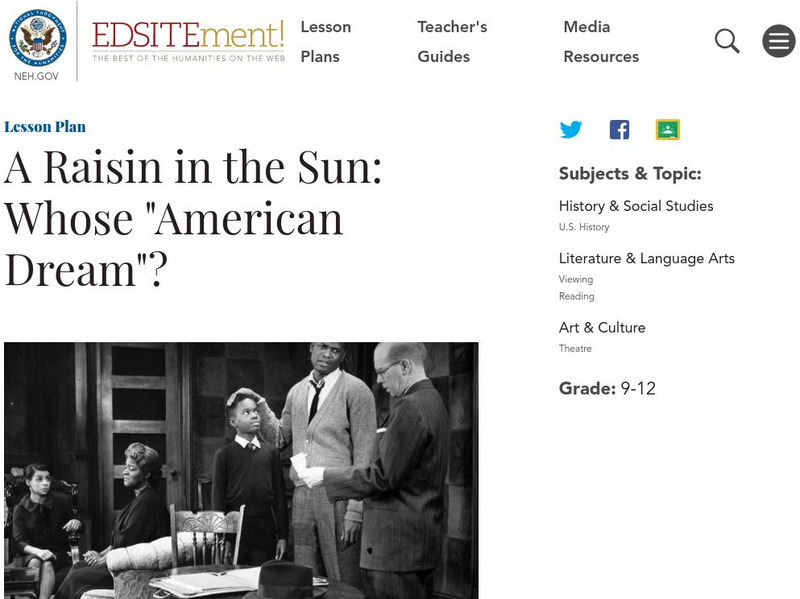
Neh: Edsit Ement: Quest for the American Dream in "Raisin"
This unique online lesson plan explores the term "The American Dream," and applies it to Hansberry's play "A Raisin in the Sun." Students define what they believe is "The American Dream," and then modify that belief based on a thorough...
Shmoop University
Shmoop: Learning Guides: A Raisin in the Sun
In addition to offering a summary of A Raisin in the Sun by Lorraine Hansberry, this guide contains notes on themes, a collection of quotes, character profiles, interactive quizzes, and a list of study questions suitable for reviewing...
NASA
Nasa: Imagine the Universe: The Sun
Site discusses the regions of the Sun's atmosphere such as the Photosphere, Chromosphere, and Corona. Provides sources for educators as well as additional links for students.
NASA
Nasa: Space Place: What's the Sun's Mood Today?
Find out about characteristics of our solar system's main source of energy, the sun.

Geography 4 kids
Geography4 Kids: Radiant Energy From the Sun
An introduction to radiant energy that offers a look at the different types of radiation from the sun, the radiation that actually hits Earth, and how the Sun's age will affect the radiation absorbed by Earth. Also, view NASA videos...
The Wonder of Science
The Wonder of Science: 5 Ps3 1: Food Energy From the Sun
Work samples, phenomena, assessment templates, and videos that directly address standard 5-PS3-1: food energy from the sun.
American Geosciences Institute
American Geosciences Institute: Earth Science Week: Third From the Sun
Students learn about the history of Earth imaging, the Landsat satellite program. They develop interpretation skills as they play a game that involves inferring the subjects of various Landsat images.
NASA
Nasa: Space Place: Venus Crosses the Sun
Animations, videos, and informational text illustrating the natural phenomena of different types of eclipses.
Utah Education Network
Uen: Here Comes the Sun
In this activity, 3rd graders predict, measure, and record temperatures.

Better Lesson
Better Lesson: A Place in the Shade an Engineering Challenge
Kindergarteners can participate in the engineering and design process in this challenge in which they try to keep an ice cube from melting. Included in this instructional activity are samples of student's structures, a video of a...
Utah Education Network
Uen: How Big Are Earth, Sun, and Moon?
Understand where the sun is in the solar system and how big the earth, moon, and sun are.
Utah Education Network
Uen: The Night Sky
Learn about the rotation of the earth, the movement of the moon, and the position of the sun.
NASA
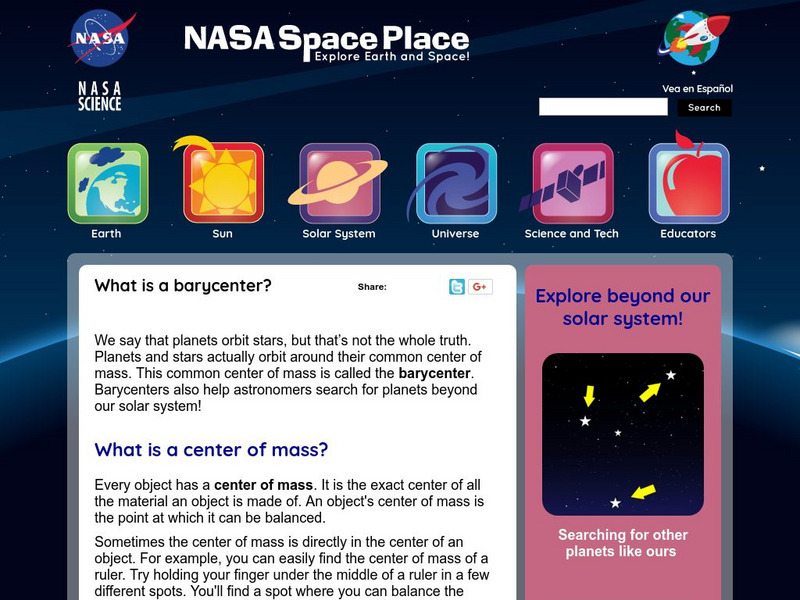
Nasa: The Space Place: What's a Barycenter?
This site from NASA helps in explaining a barycenter. "In the case of the Earth and the Sun, both bodies actually revolve, or spin, around the center of the mass between them. This point is called the barycenter."
The Wonder of Science
The Wonder of Science: Ms Ess1 1: Earth Sun Moon System
Develop and use a model of the earth-sun-moon system to describe the cyclic patterns of lunar phases, eclipses of the sun and moon, and seasons.
The Wonder of Science
The Wonder of Science: 1 Ess1 1: Sun, Moon, and Star Patterns
The NSTA vetted source includes resources to help students describe patterns of the sun, moon, and stars using observation. Included are assessment ideas, videos, examples, lesson plans, and photos of student work.
Utah Education Network
Uen: Bouncing Sunlight
The light we see from the moon at night is light that the moon reflects from the sun.
University of Chicago
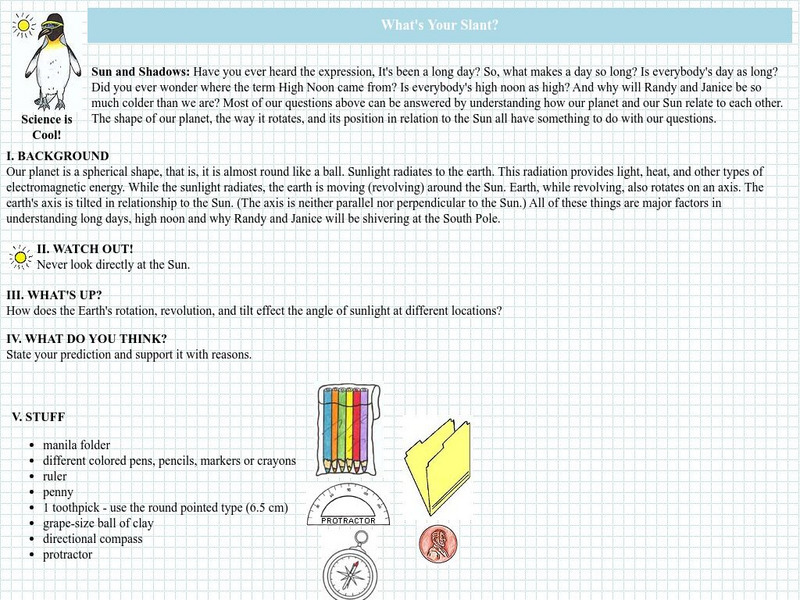
University of Chicago: What's Your Slant? Sun and Shadows
This fun activity helps you to understand the movement of the sun by studying shadows.
Other
Making a Scale Model of the Solar System
In this lesson plan site, students are asked to construct a scale model of the planets to help visualize the relative size of planets and their relative distance from the Sun. Links are provided to the Sun and the planets which contain...
University of Texas at Austin
The University of Texas Mc Donald Observatory: Mercury
Discover interesting facts about the tiny planet Mercury, the closest planet to the Sun.
Other popular searches
- A Raisin in the Sun
- Myths of the Sun
- Raisin in the Sun
- Camille and the Sunflowers
- Characteristics of the Sun
- Orbit the Sun
- Layers of the Sun
- Arrow to the Sun
- Earth and the Sun
- Energy From the Sun
- Movement of the Sun
- "A Raisin in the Sun" Movie