Hi, what do you want to do?






American Museum of Natural History
One-on-One With The Sun
Follow along as Stella Stardust interviews the sun. A fun and informative interview provides scholars with information about the sun.

American Museum of Natural History
Journey to the Stars
Fifteen detailed pictures and informative captions delve deep into the exploration of stars—their life cycle and importance in the universe.

American Museum of Natural History
Planetary Mysteries
A website all about planetary mysteries—it's a one-stop-shop for all things, stars, planets, and space travel. Scholars read an astronomy overview to discover the page's big ideas, then choose from the plethora of resources, including...

American Museum of Natural History
What is Marine Biology?
A marine environment covers the majority of the earth but is arguably the least understood. Teach young scientists about the characteristics of oceans and ocean species using an interactive online lesson. The in-person or remote learning...

American Museum of Natural History
A Closer Look at Mars
A website looks at how we know so much about Mars—telescopes, robots, and spacecraft—and the search for martian life. Following the informational text are three questions that quiz pupils about possible life on Mars.

American Museum of Natural History
What is Astronomy?
Go study the universe. Pupils learn seven aspects about astronomy and astronomers. They begin to learn about constellations; distance and motion between objects; gravity; the electromagnetic spectrum; dark matter and energy; and teams of...
Nine Planets
The Eight Planets: The Sun Solar Wind
This Eight Planets site briefly describes solar wind, a low density stream of charged particles emitted by the Sun. It also provides the basics on the sun's composition and additional sun links.
American Geosciences Institute
American Geosciences Institute: Astronomy
Eight hands-on lessons module in which students explore the characteristics of planet Earth, its moons, the sun, the solar system, planets, and the difference between science fact and science fiction.

Ducksters
Ducksters: Astronomy for Kids: The Planet Saturn
Kids learn about the planet Saturn of the Solar System including its rings, mass, day, year, and distance from the Sun. Astronomy for kids and teachers.
NASA
Nasa Star Child: The Planet Venus
Basic facts about the planet Venus including its temperature, its atmosphere, and its volcanoes. Includes a discussion question on temperature, with facts, and the answer. A linked page covers similar material in a "Level 2" version, and...
Other
The Telson Spur: The Solar System
This is a list of links to online resources related to the study of the planets. It has a literary theme associated with the Lewis Carrol poem "The Hunting of the Snark" with many quotes from literature and science. Navigation tools...
Johns Hopkins University
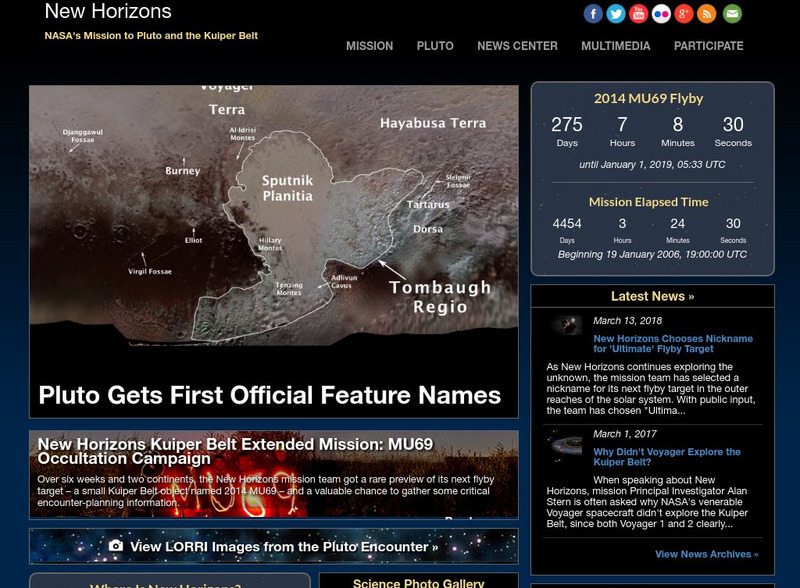
New Horizons Website
This site from the Solar System Exploration section of NASA provides an overview of the space mission to Pluto, Charon, and the fringes of our Solar System. It describes the Kuiper Belt, and the objects involved with it, provided links...