Hi, what do you want to do?






Weber State University
The Sun and the Seasons
Why is there more daylight in June than in December if you live above the equator? How does the angle of sunlight shift throughout the year? Answer these questions and more with an interactive article about the sun, its path through the...

American Museum of Natural History
One-on-One With The Sun
Follow along as Stella Stardust interviews the sun. A fun and informative interview provides scholars with information about the sun.

American Museum of Natural History
Journey to the Stars
Fifteen detailed pictures and informative captions delve deep into the exploration of stars—their life cycle and importance in the universe.

American Museum of Natural History
The Milky Way Galaxy
Just how big is the galaxy? Learners read information about the size of the Milky Way galaxy to better comprehend its size. Pupils develop an understanding of the number of stars in the galaxy by finding just how big a billion is and...

American Museum of Natural History
Planetary Mysteries
A website all about planetary mysteries—it's a one-stop-shop for all things, stars, planets, and space travel. Scholars read an astronomy overview to discover the page's big ideas, then choose from the plethora of resources, including...

American Museum of Natural History
What is Astronomy?
Go study the universe. Pupils learn seven aspects about astronomy and astronomers. They begin to learn about constellations; distance and motion between objects; gravity; the electromagnetic spectrum; dark matter and energy; and teams of...

American Museum of Natural History
A Closer Look at Mars
A website looks at how we know so much about Mars—telescopes, robots, and spacecraft—and the search for martian life. Following the informational text are three questions that quiz pupils about possible life on Mars.

NASA
Nasa: The Sun
An introduction to the Sun including its size and distance from the Earth, sunspots, flares and coronal mass ejections.
NASA
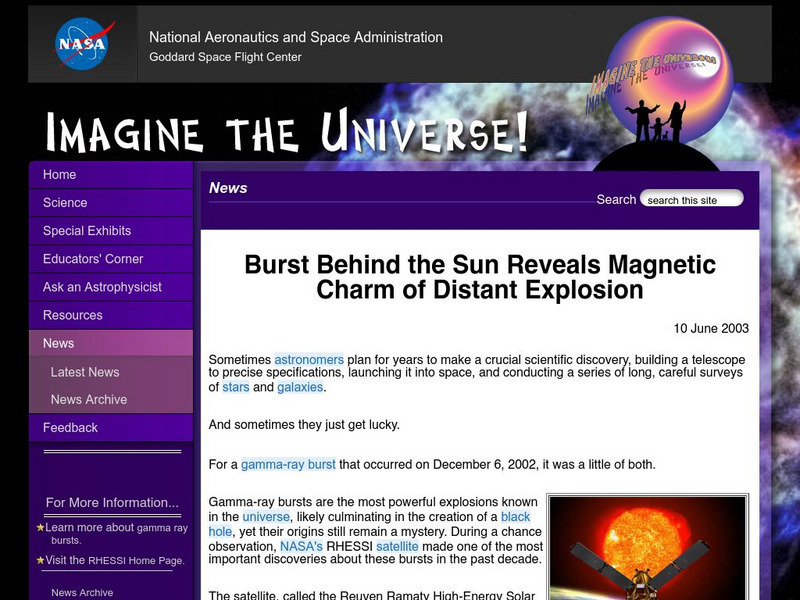
Nasa: Imagine the Universe: "Burst Behind the Sun"
Site provides the article, "Burst Behind the Sun Reveals Magnetic Charm of Distant Explosion," that details on a gamma-ray burst that occurred on December 6, 2002. Provides graphics and links to learn more about gamma-ray bursts.
Nine Planets
The Eight Planets: The Sun Solar Wind
This Eight Planets site briefly describes solar wind, a low density stream of charged particles emitted by the Sun. It also provides the basics on the sun's composition and additional sun links.
Institute for Dynamic Educational Advancement
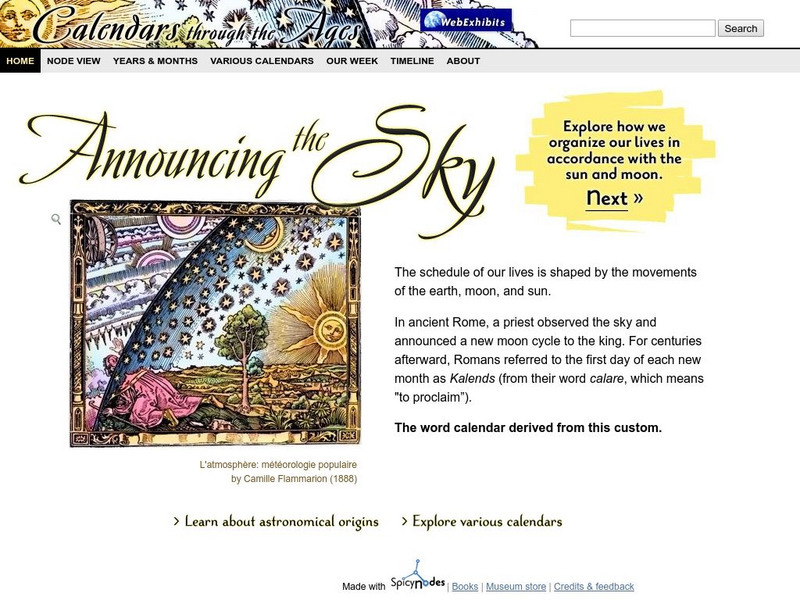
Web Exhibits: Calendars Through the Ages: Announcing the Sky
Well-organized website depicts the "Fascinating history of the human endeavor to organize our lives in accordance with the sun and stars." Gives an overview and specifics of the basis of calendars through the ages.
The Wonder of Science
The Wonder of Science: 1 Ess1 1: Sun, Moon, and Star Patterns
The NSTA vetted source includes resources to help students describe patterns of the sun, moon, and stars using observation. Included are assessment ideas, videos, examples, lesson plans, and photos of student work.
University Corporation for Atmospheric Research
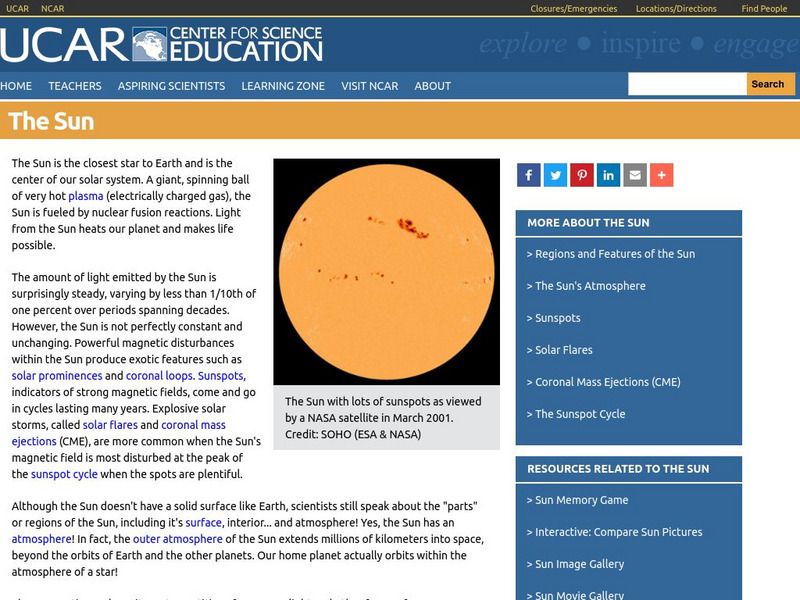
Ucar: The Sun
Learn about the sun, the center of our solar system and the closest star to Earth.
NASA
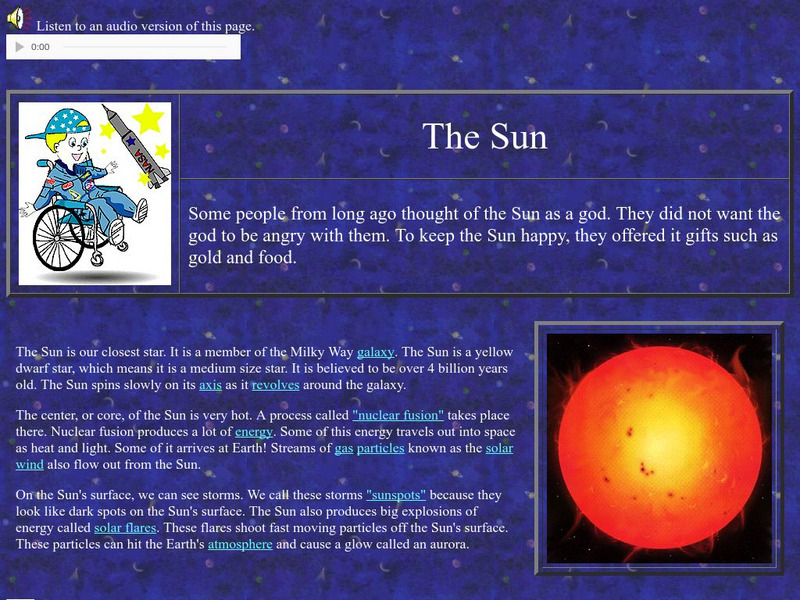
Nasa Star Child: The Sun
Get to know our nearest star with this introduction to the sun. Listen to the information in an audio file. Vocabulary words are linked to a glossary of terms. Features include links to other interesting facts and a printable version of...
NASA
Nasa: Imagine the Universe: The Sun
Site discusses the regions of the Sun's atmosphere such as the Photosphere, Chromosphere, and Corona. Provides sources for educators as well as additional links for students.

Enchanted Learning
Enchanted Learning: Zoom Astronomy: All About Space
A fantastic collection of information about the solar system. Includes information on all of the planets, the moon, the sun, asteroids, comets, meteoroids, and stars. Also find puzzles, a dictionary, quizzes, classroom activities, and...
NASA
Nasa: Image Science Center: Ask the Space Scientist
A NASA space scientist provides 98 questions and answers about the sun, the center of our solar system.

Other
An Atlas of the Universe
What does the universe look like? This website offers visitors a collection of images that serve as an "atlas" of our universe. See multiple charts showing the Earth's distance from the Sun and other stars, find helpful terms in a...
National Earth Science Teachers Association
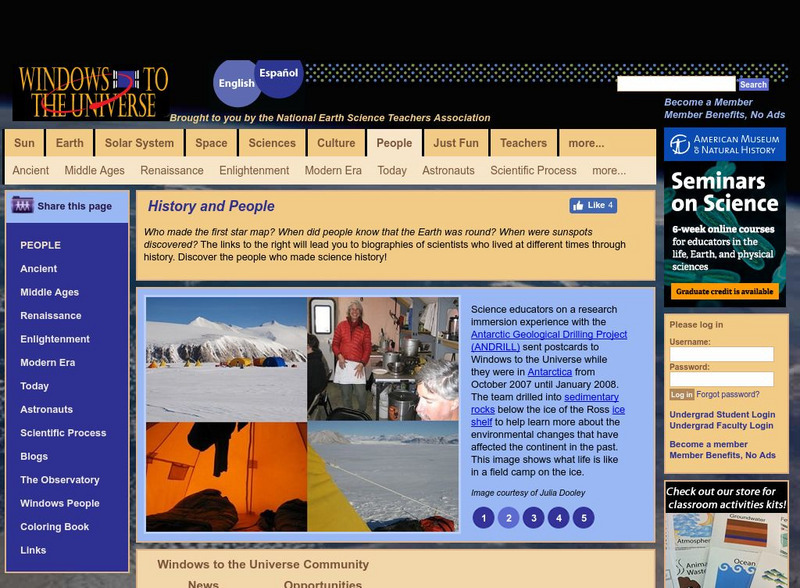
Windows to the Universe: History & People
Biographies of people throughout history who looked at the sky and wondered what was there. Links to a detailed description of the planets and interactive activities.
PBS
Pbs News Hour Extra: Satellites Orbit the Sun to Better Predict Solar Storms
For the first time, NASA scientists have generated a full image of the sun, front and back, using twin orbiting satellites. The new view of Earth's star will allow for the study of solar weather events like coronal mass ejections that...
Other
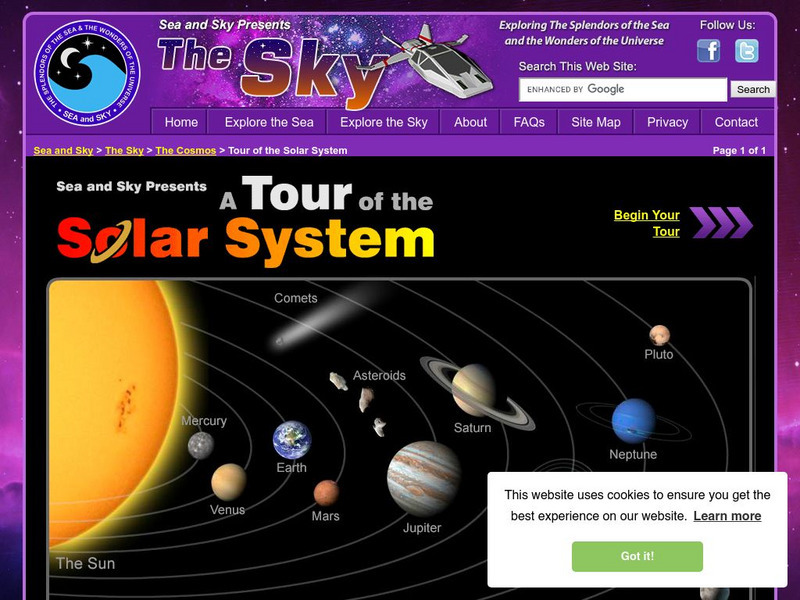
Sea and Sky: A Tour of the Solar System
Take a virtual tour of the solar system starting with detailed information about the sun.
NASA
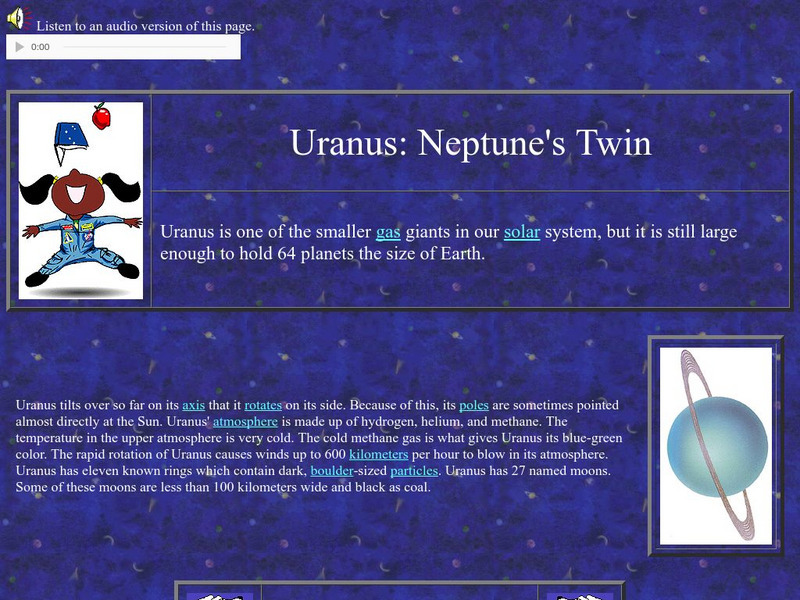
Nasa Star Child: Uranus, Neptune's Twin (Level 1)
Get to know the twin of Neptune with this introduction to Uranus. Listen to the information in an audio file. Features include a printable version of the page, and vocabulary words are linked to a glossary of terms.
Extreme Science
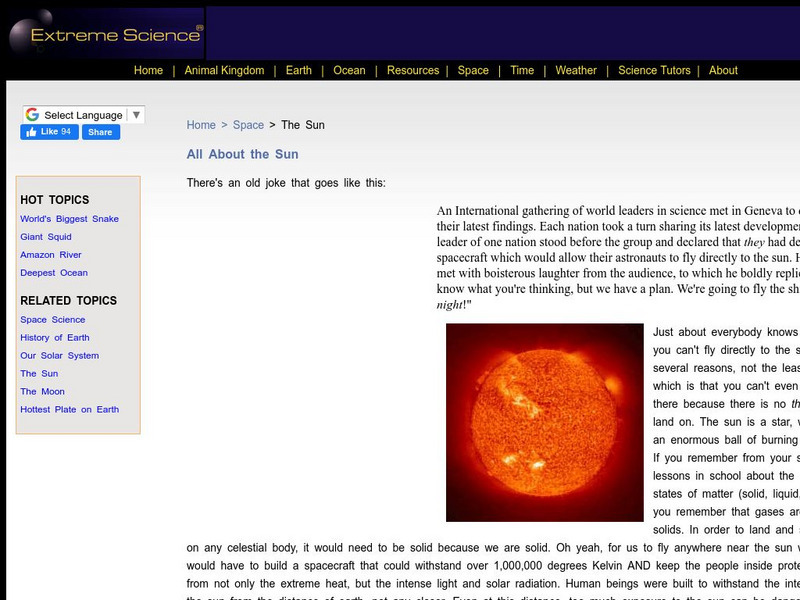
Extreme Science: All About the Sun
Read about the sun, the source of its energy, solar activity, sunrise/sunset times, solar flares, and other interesting facts.
NASA
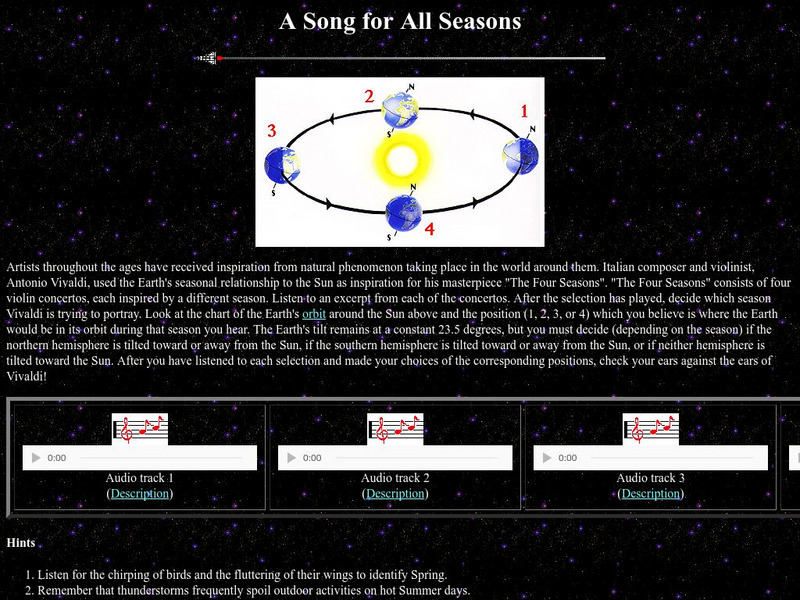
Nasa Star Child: A Song for All Seasons
After listening to excerpts from four of the violin concertos from "The Four Seasons" by Italian composer and violinist, Antonio Vivaldi, decide which excerpt was meant to go with which season, and also decide where the earth would be in...