Hi, what do you want to do?





Library of Congress
Loc: Creating the United States
This resource examines the creativity and inspiration that went into the creation and writing of the Declaration of Independence, the U.S. Constitution, and the Bill of Rights.
Library of Congress
Loc: Creating the United States: Creating the Bill of Rights
As part of this 'Creating the United States' interactive resource, this section deals with creating The Bill of Rights. Connect particular phrases and ideas set down in The Bill of Rights with texts that preceded it.
US Senate
United States Senate: Constitution of the United States
The complete text of the Constitution can be read here. Each section is accompanied by an explanation of what it means in lay language.

Yale University
Avalon Project: Constitution of the United States: Article Ii
Read the text of Article II of the Constitution, the four sections of which lay out the powers and duties of the executive branch of the federal government.

Siteseen
Siteseen: Government and Constitution: The United States Constitution
Article covers the history and origins of the US Constitution.
US National Archives
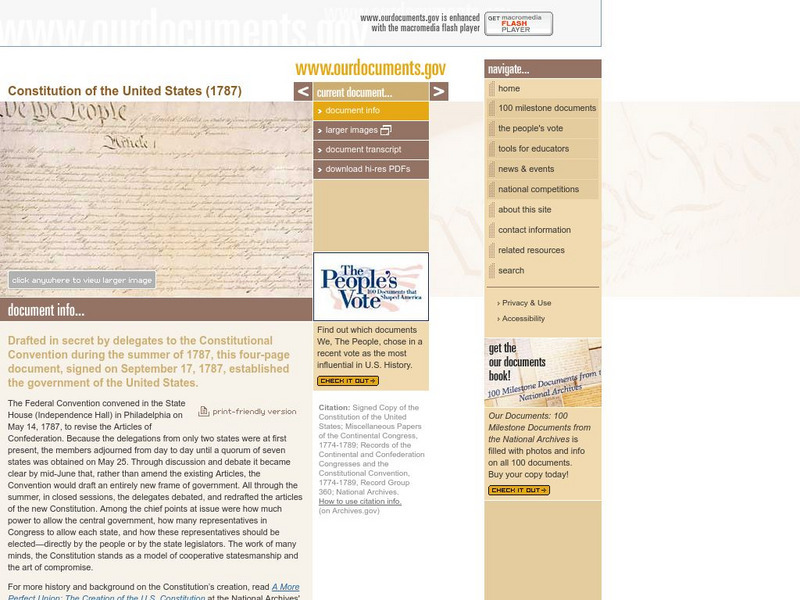
Our Documents: The Us Constitution (1787)
See the original copy of the United States Constitution! This interactive page lets you point to the part you would like to see. Along with background information, you can also link to larger images, a typed transcript, and downloadable....

Siteseen
Siteseen: Government and Constitution: Federalist Papers
The Federalist Papers were a series of 85 essays that promoted the ratification of the United States Constitution and the nature of a Republican government.
CK-12 Foundation
Ck 12: United States Government
El Paso Independent School District in El Paso, Texas created this US Government text for its high school course using OER, CC, and public domain content from a variety of sources curated by educators in the district. The course is...
Thomson Reuters
Find Law: u.s. Supreme Court: Escobedo v. Illinois (1964)
A detailed description of the United States Supreme Court decision on the appeal of the case Escobedo v. Illinois, which ruled on the right to have counsel under the 6th and 14th Amendments to the Constitution.
PBS
Pbs Learning Media: The Powers of Government
Students learn how the three branches of the United States government work together and the powers that the Constitution assigns to each branch-legislative, executive, and judicial.

The White House
The White House: The Judicial Branch
Learn about the judicial branch of the federal government, how the organization of the federal judiciary is determined, the functions and responsibilities of the Supreme Court, and features of the judicial process.
National Endowment for the Humanities
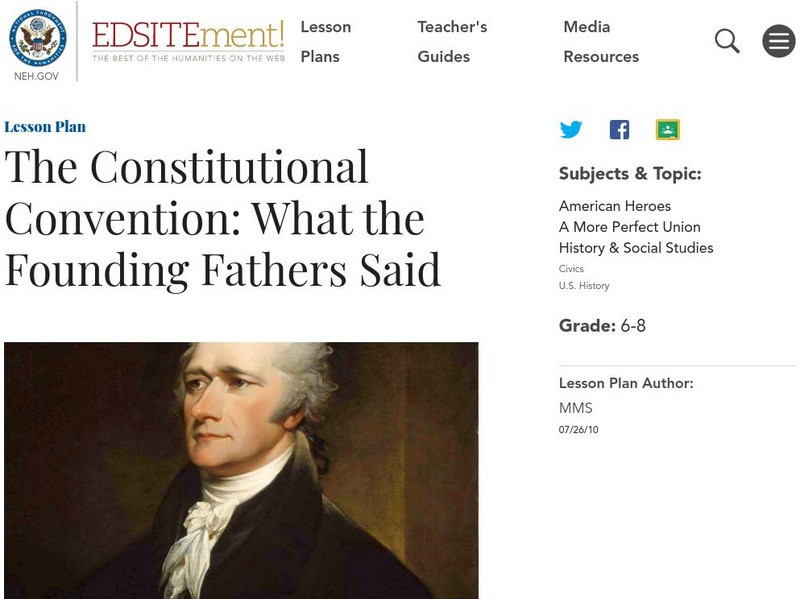
Neh: Edsit Ement: The Constitutional Convention: What the Founding Fathers Said
For this lesson plan, students will consider "The Constitutional Convention: What the Founding Fathers Said." The plan includes worksheets and other student materials that can be found under the resource tab.
A&E Television
History.com: Continental Congress
From 1774 to 1789, the Continental Congress served as the government of the 13 American colonies and later the United States. The First Continental Congress, which was comprised of delegates from the colonies, met in 1774 in reaction to...
University of Virginia Library
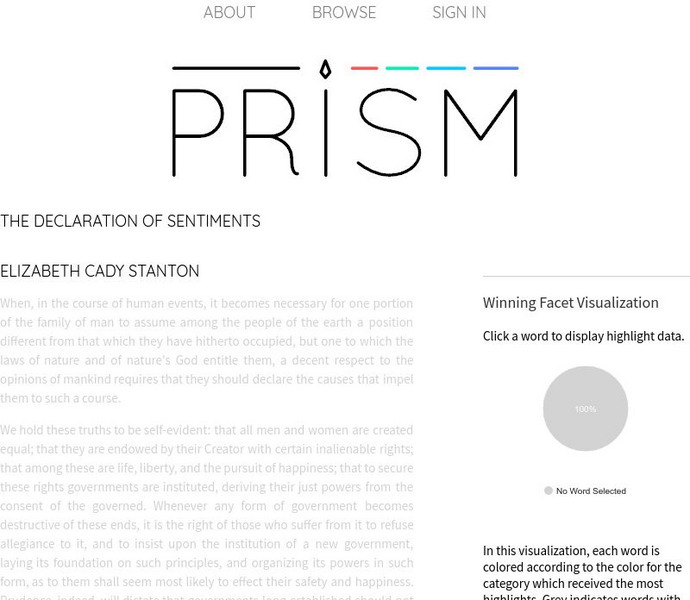
Prism: "The Declaration of Sentiments" Visualization
[Free Registration/Login Required] See the results of how users have highlighted Elizabeth Cady Stanton's "The Declaration of Sentiments." Details that show unjust treatment are blue while details that show feminism are red, and details...
Ohio State University
Osu History Teaching Institute: The Alien and Sedition Acts
Objective of this lesson plan is to understand the provisions of the Alien and Sedition Acts within their political and constitutional contexts.
Siteseen
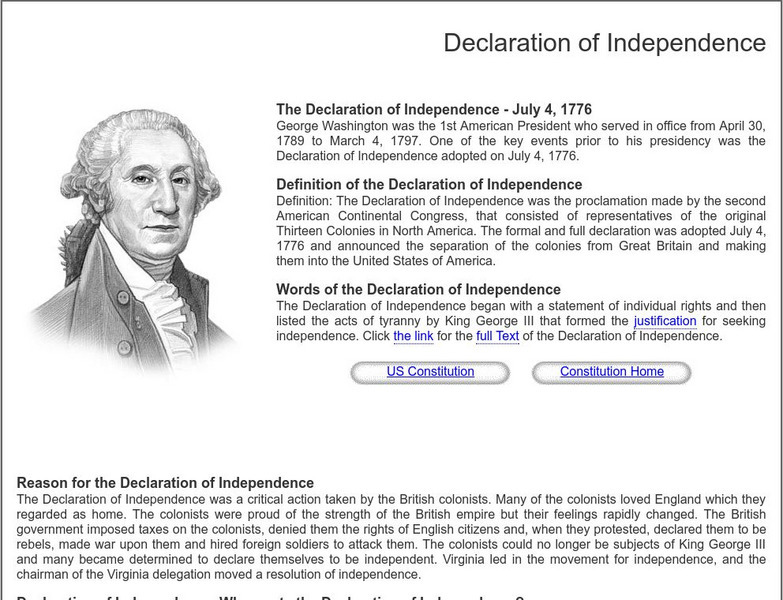
Siteseen: Government and Constitution: Declaration of Independence
The Declaration of Independence, made by the second American Continental Congress and adopted July 4, 1776, announced the separation of the original thirteen North American British colonies from Great Britain making them into the United...
iCivics
I Civics: Sources of Law
This lesson teaches students about the sources, types, and unique systems of law that exist in the United States. They learn about sources of law from the Constitution to local ordinances and also compare and contrast civil and criminal...

Khan Academy
Khan Academy: Japanese Internment
Discusses the internment of Japanese Americans during World War II, an action that resulted from Franklin D. Roosevelt's Executive Order 9066. The constitutionality of the order was challenged all the way to the Supreme Court by Fred...
Center For Civic Education
Center for Civic Education: Ronald Reagan and Executive Power [Pdf]
"Ronald Reagan and Executive Power" examines the use of presidential powers by Ronald Reagan, the fortieth president of the United States. It explores Article II of the Constitution, which grants the president executive powers.
Other
Potus: James Madison
Comprehensive facts about James Madison and his presidency. Includes biography, election results, cabinet members, odd facts, and notable events.
Siteseen
Siteseen: Government and Constitution: Judiciary Branch
Article covers the Judiciary Branch of Government, the branch that interprets the law, and its connection to the US Constitution.
Siteseen
Siteseen: Government and Constitution: Legislative Branch
Article covers the Legislative Branch of Government, the branch that makes the laws, and its connection to the US Constitution.

Siteseen
Siteseen: Government and Constitution: Executive Branch
Article provides a guide to the Executive Branch of Government, its connection to the US Constitution, and its role as the branch that enforces the law and is responsible for the daily administration of the government.
Other
Federal Indian Policy: Bureaucrats or Bullets?
The making of federal Indian policy in the United States during the 19th century was marked by disagreement among all parties. The areas of disagreement that stood out most were (1) What is the legal/constitutional status of Indians and...