Hi, what do you want to do?






Curated OER
Rock Art Stories
Students examine different types of rock art. They analyze them to try to figure out the meaning of the art. They create their own rock art that tells a story. They share their creation with the class.

Curated OER
Nevada Postcard Project
Students, as a class, design a postcard of their school or city with a specific picture and blurb on the back. They work in groups to design a postcard of Nevada. They follow specific directions for their postcards and then their...

Curated OER
Great Questions for Tic Tac Toe
Fourth graders plan their own activities to reinforce the concepts being taught in school. The tic-tac-toe grid is used to help students create innovative learning activities to generate ideas.

Curated OER
Immigration in Massachusetts, 1880-1920
Students, in groups, research immigration in America at the turn of the century. They put together a series of original written essays, letters, newspaper columns, etc. that show what it was like to live as an American citizen and as an...

Curated OER
Effects Of Natural Disasters On Environment
Pupils investigate the concept of how natural disasters effect the environment. They conduct research using a variety of resources. They are given a scenario that needs a defensive speech. Students take a position and defend it by...

Curated OER
Science Trail
Fourth graders explore the concept of ecosystems. In groups, they examine clues to find mystery objects. Once they find the mystery objects, they discuss what ecosystem each comes from. They also look at pond water samples under a...

Curated OER
The Walking Purchase of 1737
Students review the main points of the Walking Purchase of 1737. In groups, they describe how the Iroquois, Minisink, and Delaware Indians felt about the purchase and compare and contrast the different views. They write and perform a...

Curated OER
Jeannette
Students develop hypothesis about what might happen when salt water is frozen. In groups, they freeze ice samples with different salt concentrations. They use the internet to research the situation of the Jeannette to discover their...
Other
Reading Quest: Making Sense of Social Studies
Teaching students to read well in areas other than language arts requires teaching and reinforcing the kinds of reading strategies taught here. There are 27 strategies, ranging from brainstorming to word mapping. The site includes PDF...
ReadWriteThink
Read Write Think: Scaffolding Summarization With Fishbone Mapping
Lesson that teaches middle schoolers how to find important and significant information while reading text. After locating information through strategies, students learn how to summarize content-area text. A downloadable fishbone template...

Stanford University
Sheg: Document Based History: Reading Like a Historian: Mapping the New World
[Free Registration/Login Required] Students read primary source documents to solve a problem surrounding a historical question. This document-based inquiry lesson allows students study two 17th-century maps of Virginia and think...

Other
Edte.ch: Maths Maps
Maths Maps is a collaborative project where participants use Google maps to choose a location within one of the cities highlighted, then create a Math problem about the site. The problems are marked on the map with various colors...
ReadWriteThink
Read Write Think: Mapping Characters Across Book Series
This lesson plan examines the changes and developments in characters which appear in a series. Included in the lesson plan is an overview, practice, objectives, resources, preparation, and more.

ReadWriteThink
Read Write Think: Creating a Persuasive Podcast
This lesson unit has students research a local, state, national, or international issue of personal interest and create and share a two-minute persuasive podcast presenting their research-based opinions on the topic. It includes tools...
ReadWriteThink
Read Write Think: Critical and Analytical Thinking About Literary Characters
Contains plans for four lessons that use the short story "After Twenty Years" by O. Henry to teach about characterization using word maps. In addition to objectives and standards, this instructional plan contains links to sites used in...
ReadWriteThink
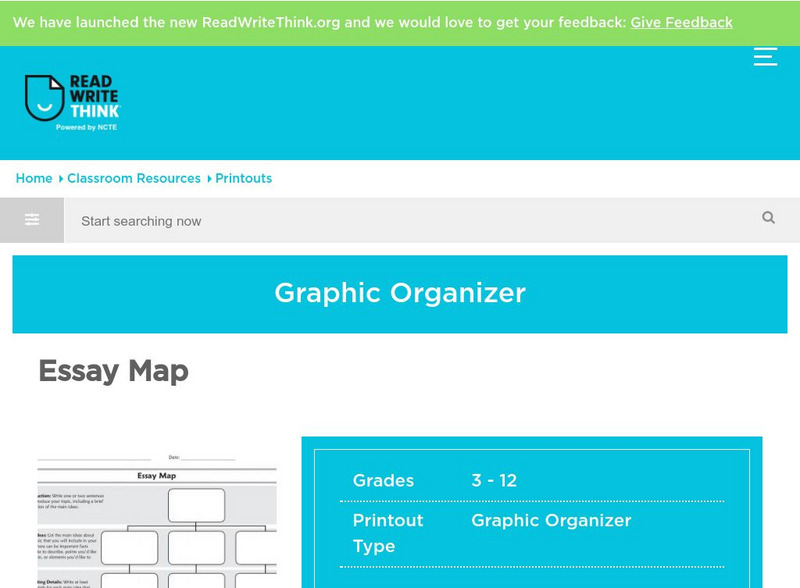
Read Write Think: Essay Map
A fillable essay map in PDF format with boxes for an introduction, main ideas, supporting details, and a conclusion. Directions on how to use this type of graphic organizer as well as lists of teaching ideas and related resources are...
ReadWriteThink
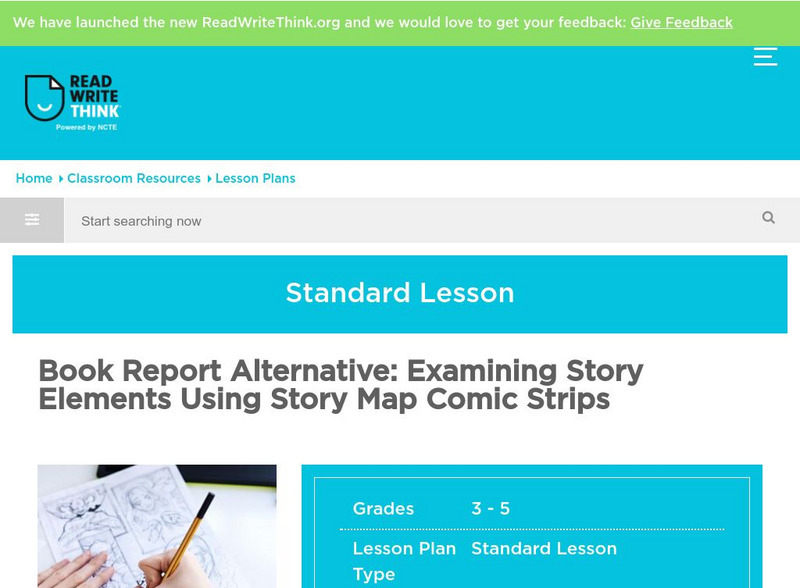
Read Write Think: Book Report Alternative: Examine Story Elements Using Comic Stri
Comic frames are traditionally used to illustrate a story in a short, concise format. In this lesson, students use a six-paneled comic strip frame to create a story map, summarizing a book or story that they have read. Each panel retells...

ReadWriteThink
Read Write Think: Conflict Map
This graphic organizer focuses on conflict: identifying the conflict, listing possible resolutions, and determining the cause of the conflict. It can be used as a reading tool, a writing organizer, or solving a real-life conflict.
Code.org
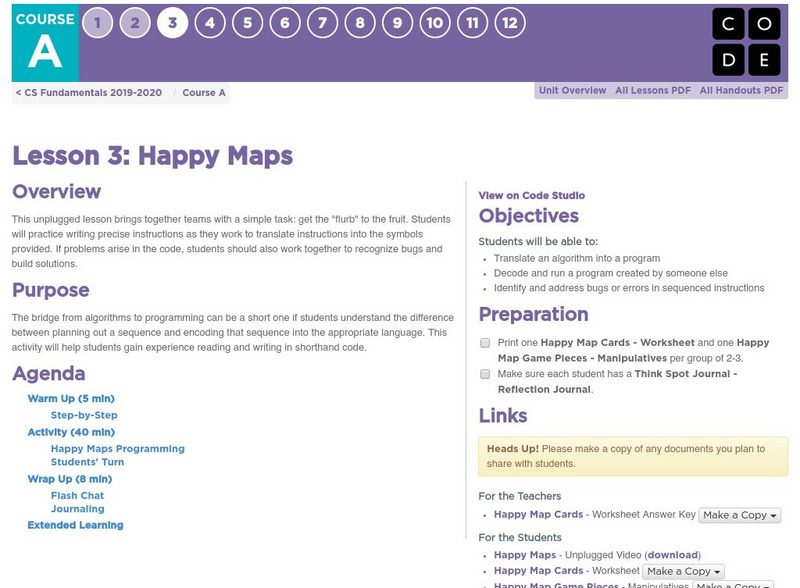
Code.org: Cs Fundamentals: Happy Maps
The bridge from algorithms to programming can be a short one if students understand the difference between planning out a sequence and encoding that sequence into the appropriate language. This activity will help students gain experience...

ReadWriteThink
Read Write Think: Lights, Camera, Action: Interviewing a Book Character
Students get the inside scoop on a story when they create interview questions and answers for characters in the books they read.
ReadWriteThink
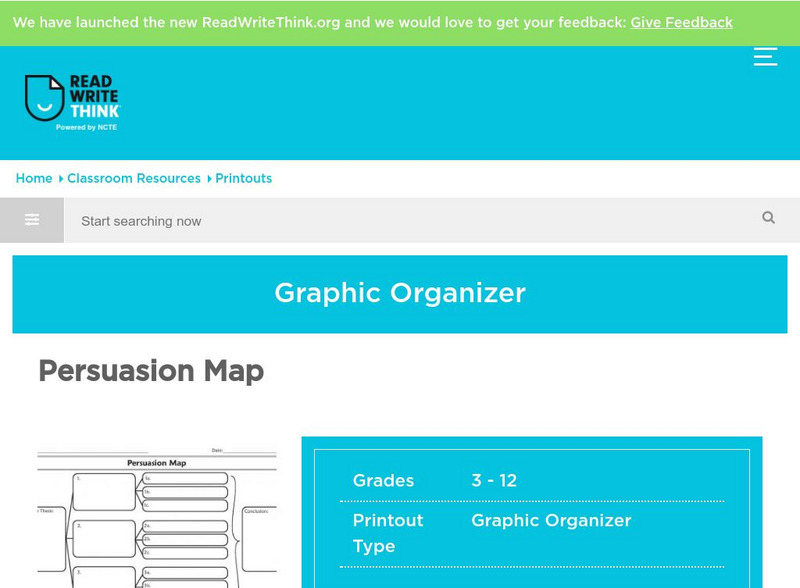
Read Write Think: Persuasion Map
A printable graphic organizer for students to use when writing on opinion or persuasive essay. Directions on how to use this type of graphic organizer as well as lists of teaching ideas, lesson plans, and other resources are also...
ReadWriteThink
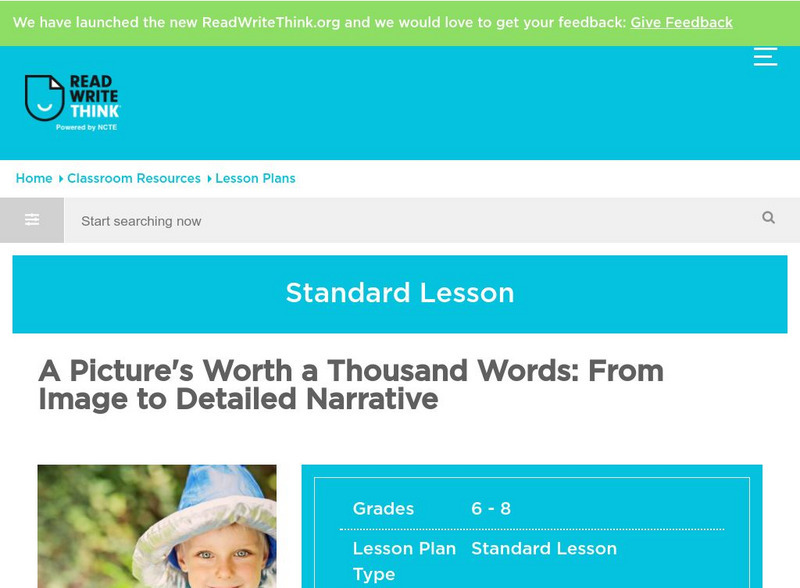
Read Write Think: A Picture's Worth a Thousand Words: Image to Narrative
This activity, which can be adapted to fit with any picture you choose, works for students of all levels.
ReadWriteThink
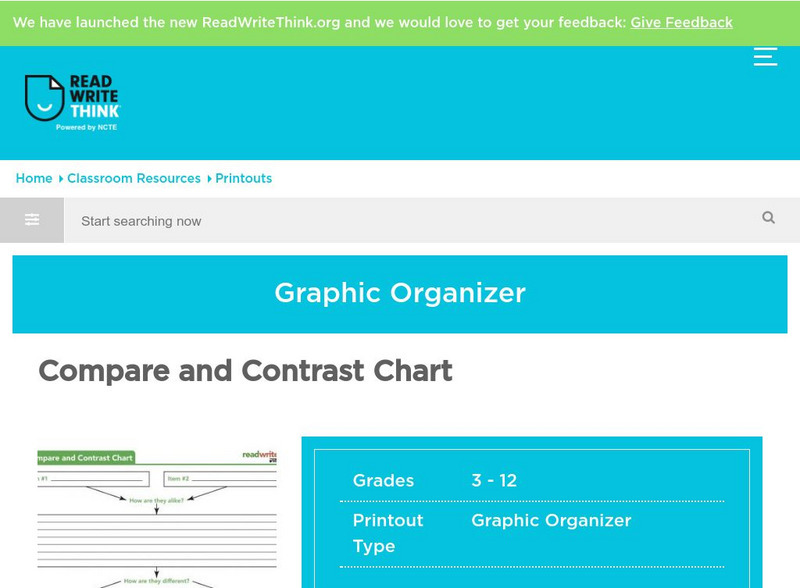
Read Write Think: Compare and Contrast Map
Use this graphic organizer to compare or contrast ideas, things, or texts. This is a great cross-curricular tool to use for both reading strategies and prewriting.
ReadWriteThink
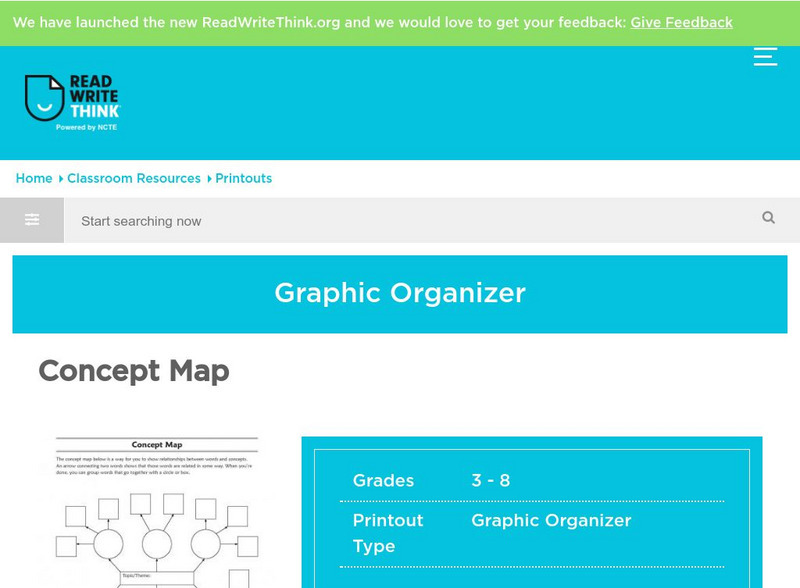
Read Write Think: Concept Map
This concept map is a way for you to show relationships between words and concepts. An arrow connecting two words shows that those words are related in some way. When you're finished, you can group words that go together with a circle or...