Hi, what do you want to do?





Texas Instruments
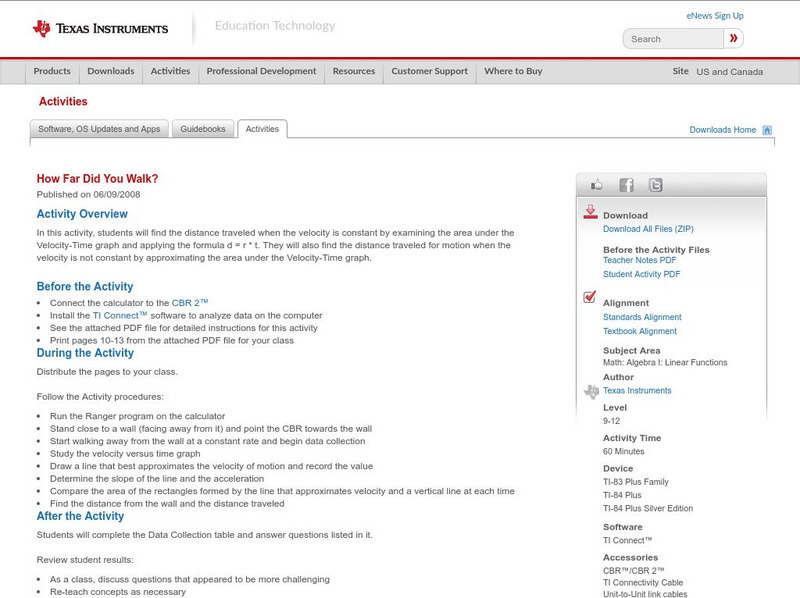
Texas Instruments: How Far Did You Walk?
In this activity, students will find the distance traveled when the velocity is constant by examining the area under the Velocity-Time graph and applying the formula d = r * t. They will also find the distance traveled for motion when...
Texas Instruments
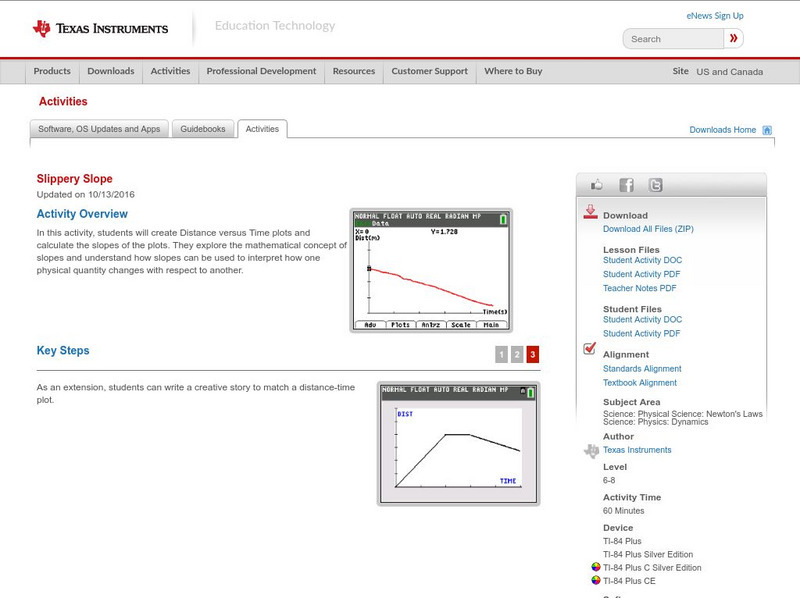
Texas Instruments: Slippery Slope
In this activity, students will create Distance versus Time plots and calculate the slopes of the plots. They explore the mathematical concept of slopes and understand how slopes can be used to interpret how one physical quantity changes...
Science Education Resource Center at Carleton College
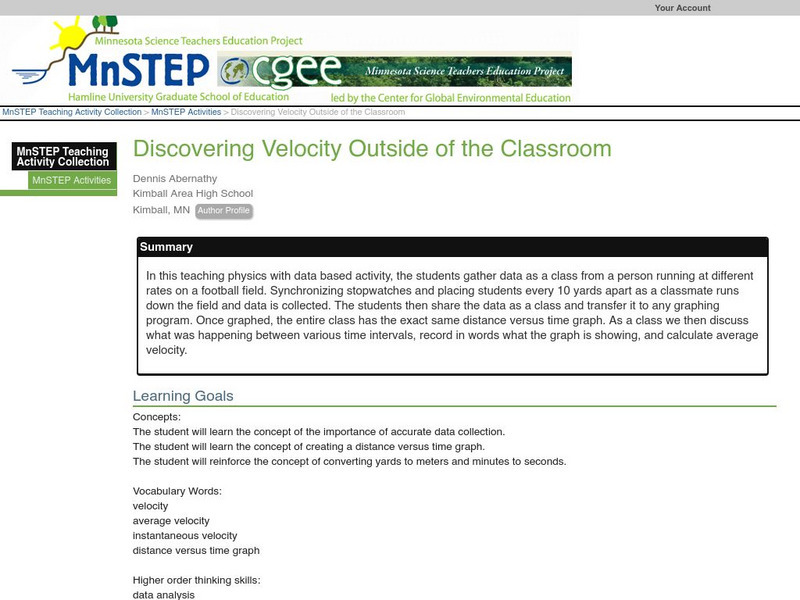
Serc: Discovering Velocity Outside of the Classroom
A physics lab activity where students gather data from classmates running at different rates on a football field. They then share their gathered data and transfer it to a graphing program to ultimately calculate average velocity.

BBC
Bbc: Gcse Bitesize: Motion
This lesson focuses on motion including definitions, how to calculate the change in velocity and the average acceleration, and a link to an assessment.
Purdue University
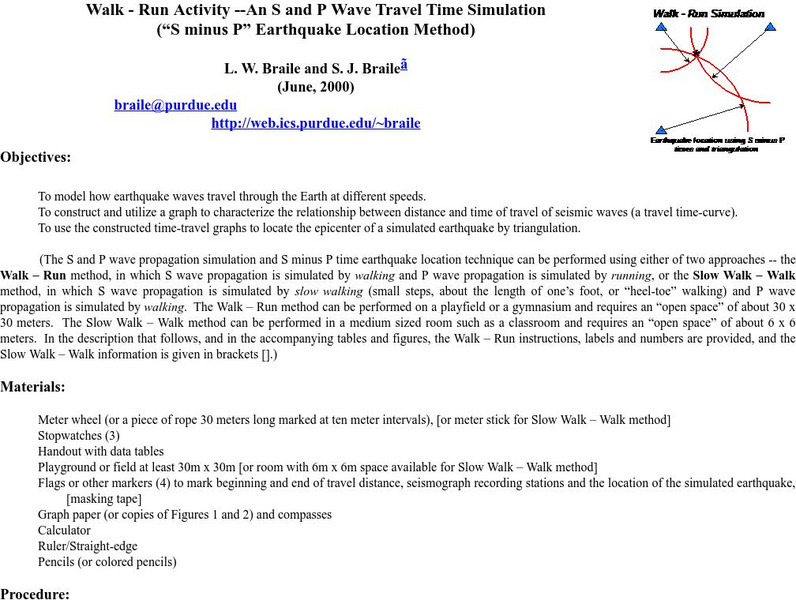
Purdue University: An S and P Wave Travel Time Simulation
A classroom simulation modeling how earthquake waves travel through Earth at different speeds. A graph is constructed to demonstrate the relationship between the distance and time of travel of seismic waves, and then used to locate the...
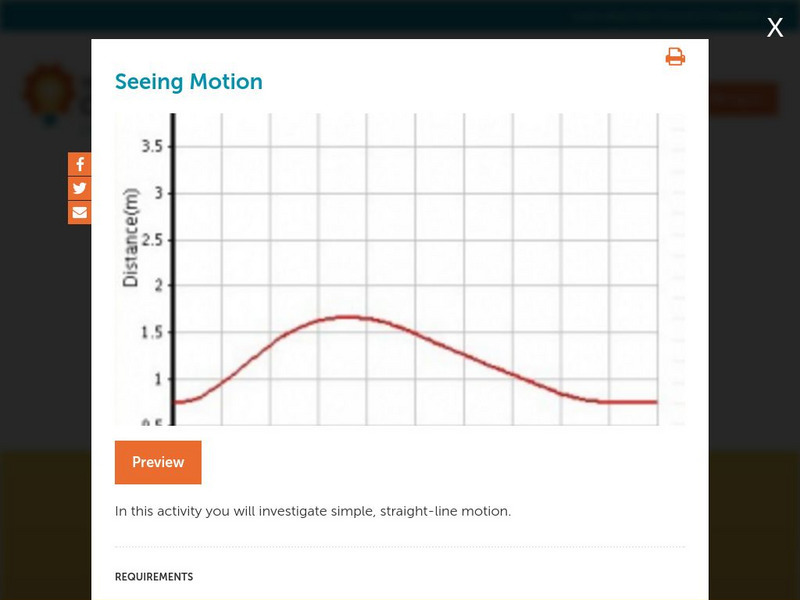
Concord Consortium
Concord Consortium: Stem Resources: Seeing Motion
With this interactive tool and the use of a motion sensor, students will track their own motion and, as they collect data in several experiments, they will plot it on a distance-time graph. After completing the three experiments, they...
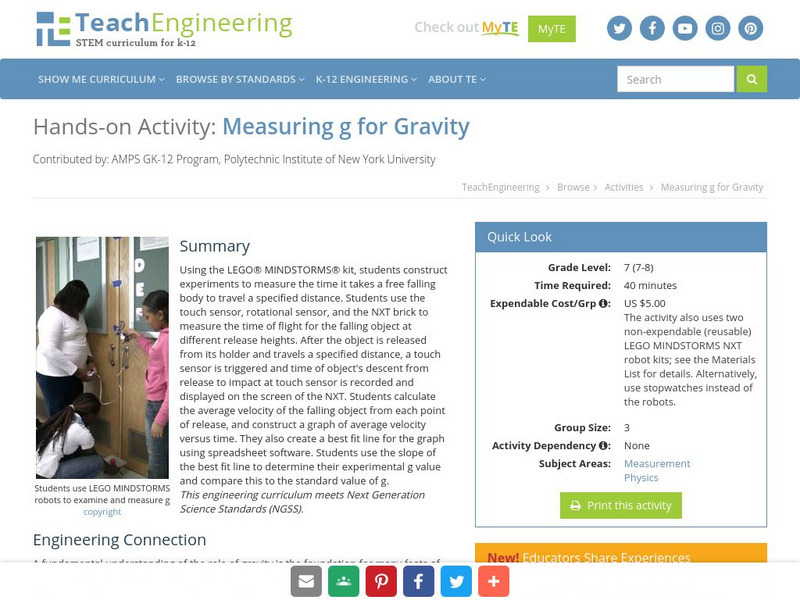
TeachEngineering
Teach Engineering: Measuring G
Using the LEGO MINDSTORMS NXT kit, students construct experiments to measure the time it takes a free falling body to travel a specified distance. Students use the touch sensor, rotational sensor, and the NXT brick to measure the time of...
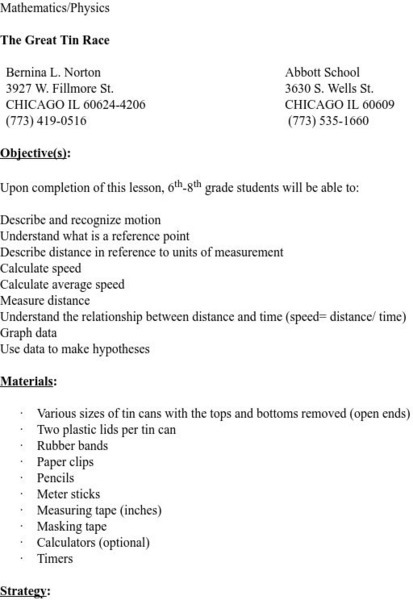
Science and Mathematics Initiative for Learning Enhancement (SMILE)
Smile: The Great Tin Race
This activity is a great way to show distance and time relationships while incorporating charts and graphing. Different sized tins are raced against each other, and data is collected.

Physics Aviary
Physics Aviary: Speed of Sound Lab
This lab is designed to have students investigate the relationship between the distance from an explosion and the time it takes the sound of the explosion to reach the observer. The temperature of the air can be changed by changing the...

Other
Stat Soft: Statistics Glossary
Dozens of statistical terms are defined and illustrated in this glossary.
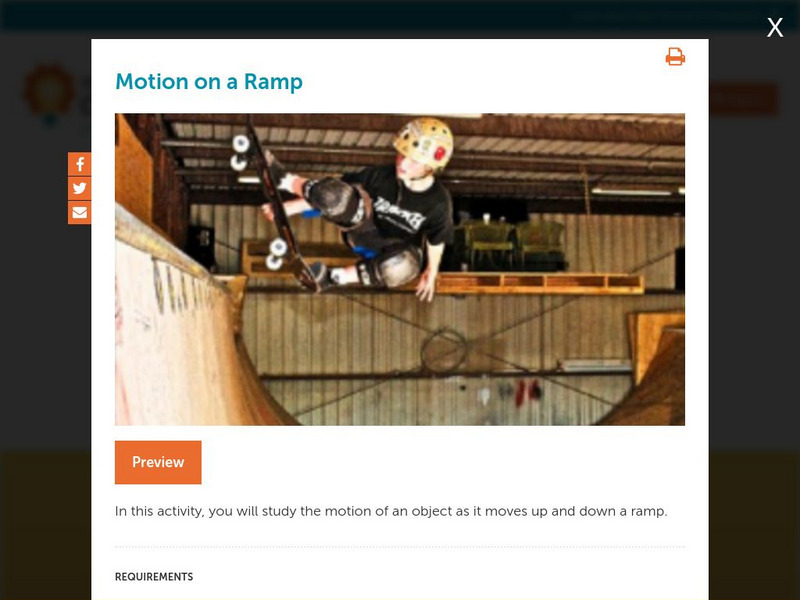
Concord Consortium
Concord Consortium: Stem Resources: Motion on a Ramp
Using a motion detector, students produce graphs that show the motion of a toy car as it moves on a ramp. Students collect distance versus time graphs and velocity versus time graphs as well as predict what the motion will look like on...
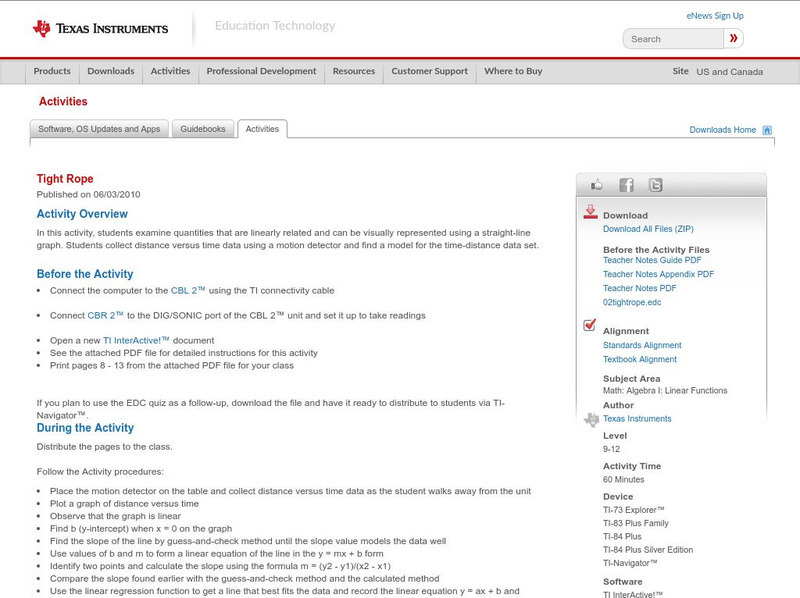
Texas Instruments
Texas Instruments: Tight Rope
In this activity, students examine quantities that are linearly related and can be visually represented using a straight-line graph. Students collect distance versus time data using a motion detector and find a model for the...
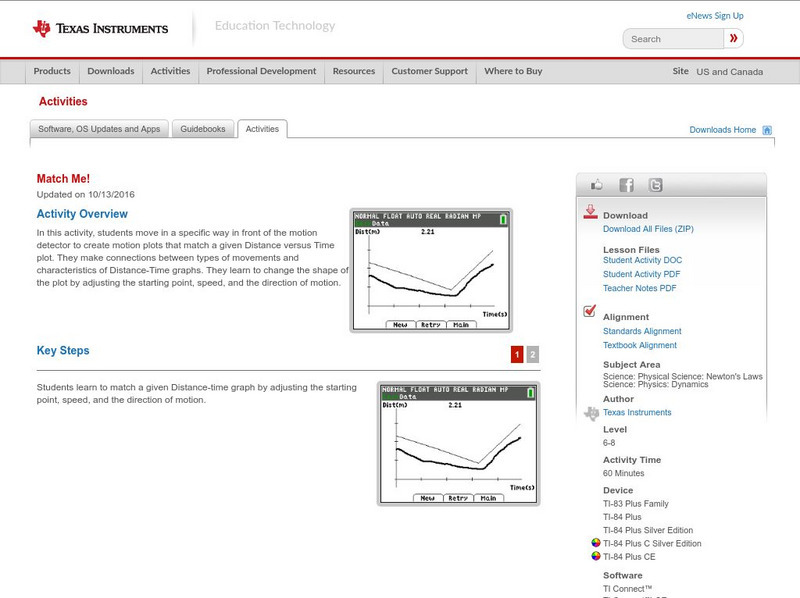
Texas Instruments
Texas Instruments: Match Me!
In this activity, students move in a specific way in front of the motion detector to create motion plots that match a given Distance versus Time plot. They make connections between types of movements and characteristics of Distance-Time...
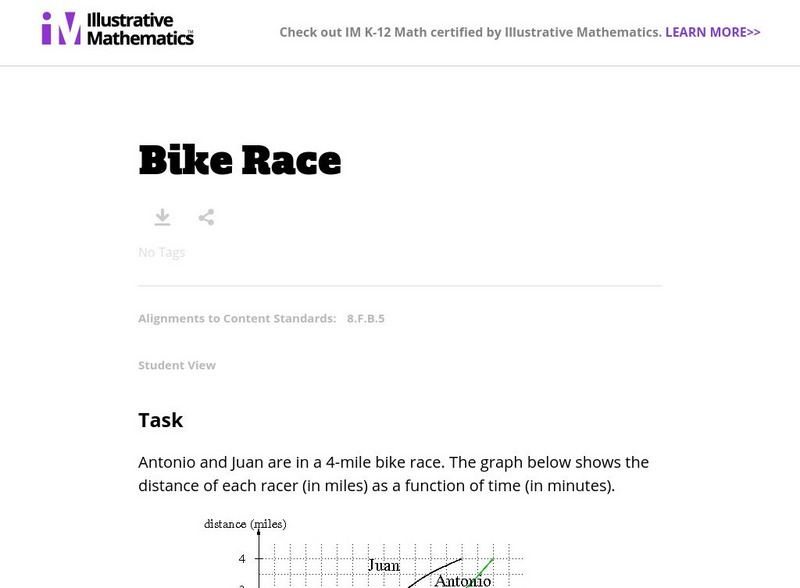
Illustrative Mathematics
Illustrative Mathematics: 8.f Bike Race
Eighth graders are presented with the distance-time graphs of two bike riders in a race. They are to identify the winner and write a story describing what is happening during the race based on the shapes of the graphs. Aligns with 8.F.B.5.
Texas Instruments
Texas Instruments: Slippery Slope Activity: Math & Science in Motion
This activity serves as a follow-up to Activity 6 in the Explorations book, Math and Science in Motion: Activities for Middle School by Chris Brueningsen, Elisa Brueningsen, and Bill Bower (Texas Instruments Incorporated, 1997). Students...
Science and Mathematics Initiative for Learning Enhancement (SMILE)
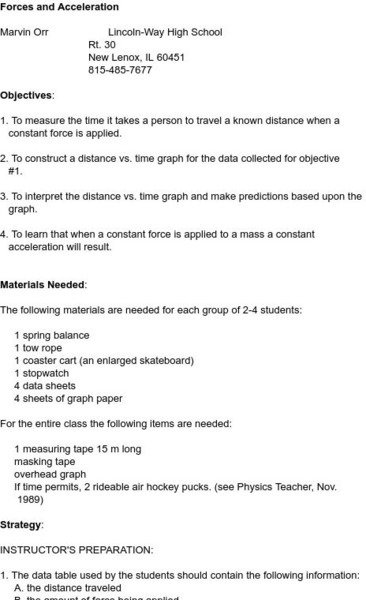
Smile: Lab Work Forces & Acceleration
The Illinois Institute of Technology provides this site. The site contains a graphing activity which illustrates that a constant force exerted upon an object results in constant acceleration. Rolling carts and stopwatches are used to...

CK-12 Foundation
Ck 12: Plix: Motion: Changing Speeds
[Free Registration/Login Required] Drag the red dot to draw a position-time graph for a sprinter with changing speeds.
CK-12 Foundation
Ck 12 Exploration Series: Simulations: Physics: Archery
[Free Registration/Login Required] Watch this animation as an archer shoots at a target on an angle, and its horizontal and vertical paths and its velocity are explained. An interactive follows where you can manipulate the archer's...
Texas Instruments
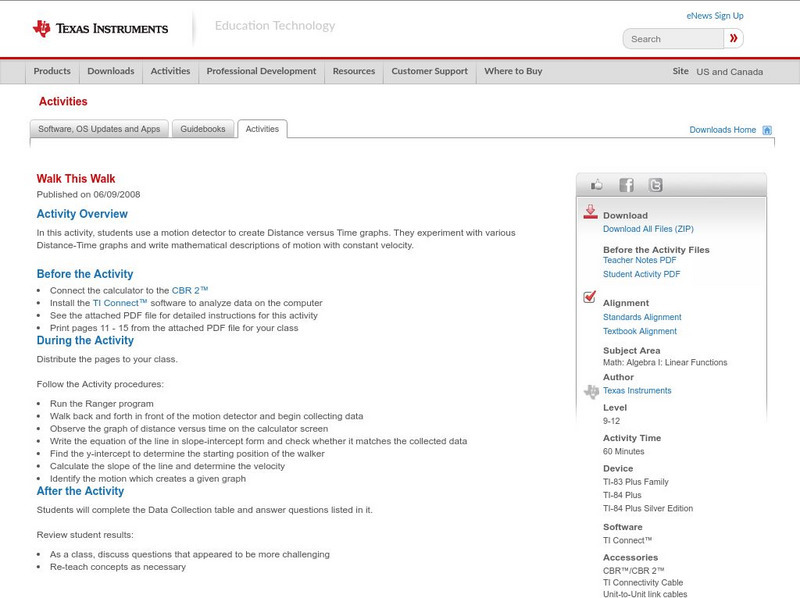
Texas Instruments: Walk This Walk
In this activity, students use a motion detector to create Distance versus Time graphs. They experiment with various Distance-Time graphs and write mathematical descriptions of motion with constant velocity.

Texas Instruments
Texas Instruments: Walk This Way: Definition of Rate
In this activity, students' will use a motion detector to record distance and velocity versus time information for a walker. They find the area under the velocity versus time graph and compare it to the actual distance traveled by the...
Science Education Resource Center at Carleton College
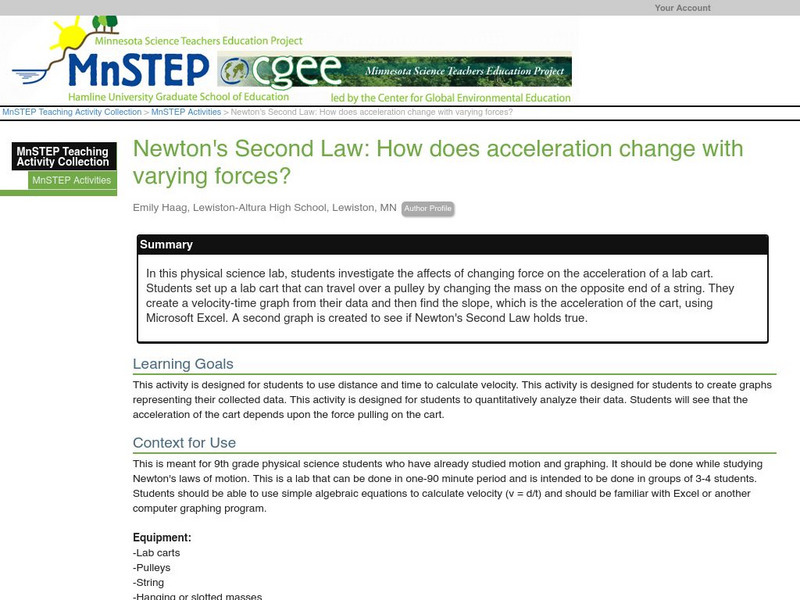
Serc: Newton's Second Law: How Does Acceleration Change With Varying Forces?
In this lab activity, students investigate the effects of changing force on the acceleration of a lab cart testing Newton's Second Law of Motion. They will use distance and time to calculate velocity and create a graph representing their...
Physics Aviary
Physics Aviary: Projectile Lab
This lab is designed to have students find the relationships that affect the horizontal distance travelled by a projectile. Students will be able to modify the starting height, initial speed and angle at which the projectile is fired....