Hi, what do you want to do?






PBS
Pbs: Real Life Math: Physical Trainer
The general manager of a fitness center explains how numerical calculations, percentages, and ratios are critical to his job in this video from KAET. In the accompanying classroom activity, students explore percentages, fractions, and...

Illustrative Mathematics
Illustrative Mathematics: F Le in the Billions and Linear Modeling
In this task, learners are shown a table of world population data and asked to explore whether linear functions would be appropriate to model relationships within the data. Aligns with F-LE.A.1.b.

TeachEngineering
Teach Engineering: Timing a Speedbot!
Students strengthen their communication skills by first learning the meaning of base units and derived units. Then, working in groups, students measure the time for LEGO MINDSTORMS NXT robots and calculate the robots' average speeds at...

Khan Academy
Khan Academy: Constant of Proportionality From Equations
Practice finding the constant of proportionality in equations.
Illustrative Mathematics
Illustrative Mathematics: 6.rp Hippos Love Pumpkins
Students use ratios to answer four questions about rates in situations involving unusual units in this performance task.

McGraw Hill
Glencoe: Self Check Quizzes Ratios
The randomly generated questions explore ratio applications. Students answer the multiple choice questions which include hints and solutions.
Illustrative Mathematics
Illustrative Mathematics: F Le in the Billions and Exponential Modeling
For this task, students examine world population data from 1804 to 2012 and investigate whether an exponential function is appropriate for modeling the relationship between the world population and the year. Aligns with F-LE.A.1.c.
University of Nottingham
Mathematics Assessment Project: Modeling Population Growth: Having Kittens
This lesson unit guides students in developing strategies for modeling problems. The task focuses on investigating a cat shelter's claims about the rate of cat population growth. The unit includes a full lesson plan, examples of student...
Education Place
Houghton Mifflin: Eduplace: Extra Practice Quiz Distance, Speed, & Time
Using these rate of speed problems practice figuring out either the distance, time or speed. Read the interactive quiz rules and then click on the "Begin" ticket. If you answer incorrectly you get one more chance to try again then you...
PBS
Pbs Learning Media: The Lowdown: Life Expectancy: Finding Ratio Relationships
In this interactive map, learn how life expectancy, obesity, hypertension, and physical activity rates have changed dramatically throughout the United States over the last three decades. The accompanying classroom activity supports...
National Council of Teachers of Mathematics
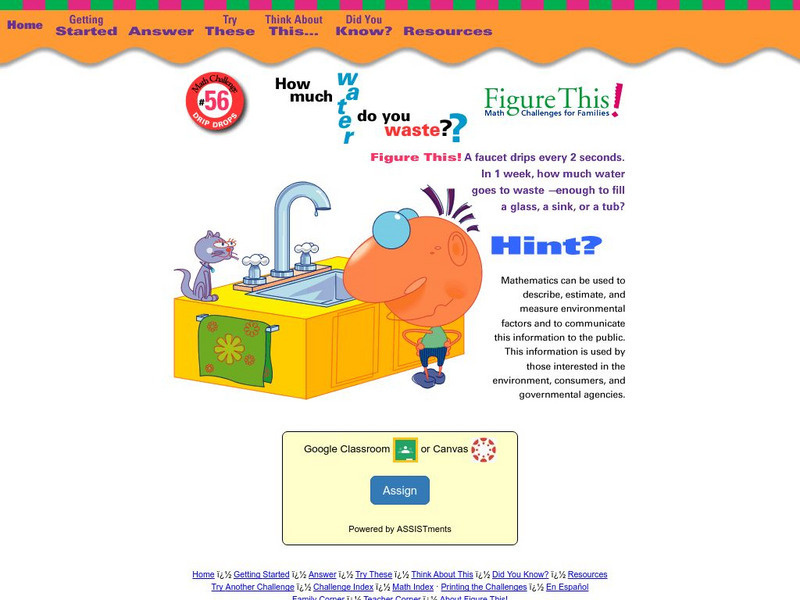
Nctm: Figure This: Drip Drops
Figure out how much water you waste in a week in this exploration using your problem solving, measurement, and estimation skills. This activity is from the NCTM Math Challenges for Families series.

Illustrative Mathematics
Illustrative Mathematics: F Le Identifying Functions
In this task, young scholars are shown a table with linear, quadratic, and exponential functions at various values of x and are asked to match the function type to each data set and explain their reasoning. Aligns with F-LE.A.1.b and...
Illustrative Mathematics
Illustrative Mathematics: F Le Basketball Rebounds
The purpose of this task is to introduce students to an exponential decay function in the form f(x) = abx, with a concrete interpretation of the decay factor b. A table shows the rebound height of a basketball for each successive bounce....

Illustrative Mathematics
Illustrative Mathematics: F Le Us Population 1982 1988
In this task, students are shown a table of U.S. population data between 1982 and 1988 and are asked to explore whether linear functions would be appropriate to model relationships within the data. Aligns with F-LE.B.5 and F-LE.A.1.b.
Illustrative Mathematics
Illustrative Mathematics: F Le Us Population 1790 1860
In this task, students are shown a table of U.S. population data between 1790 and 1860 and are asked to explore whether exponential functions would be appropriate to model relationships within the data. The purpose of the task is to help...
Illustrative Mathematics
Illustrative Mathematics: F Le Carbon 14 Dating, Variation 2
In this task on exponential decay, students calculate what the amount of Carbon 14 left in a preserved plant will be as time passes and when one microgram will be all that is left. Aligns with F-LE.A.1.c.
Illustrative Mathematics
Illustrative Mathematics: F Le Linear Functions
In this problem, students are presented with the equations of two linear functions and their intersecting graphs. They are asked to label the graphs and compute values for several points on the graphs. Aligns with F-LE.A.1.b.
Other
Ask Numbers: Measurement Conversion Calculators and Charts
What kind of unit conversion would you like to do? This site will allow you to do a multitude of conversions. Just click on the specific measurement you are needing to convert. It also provides a history of measurements and a chart of...
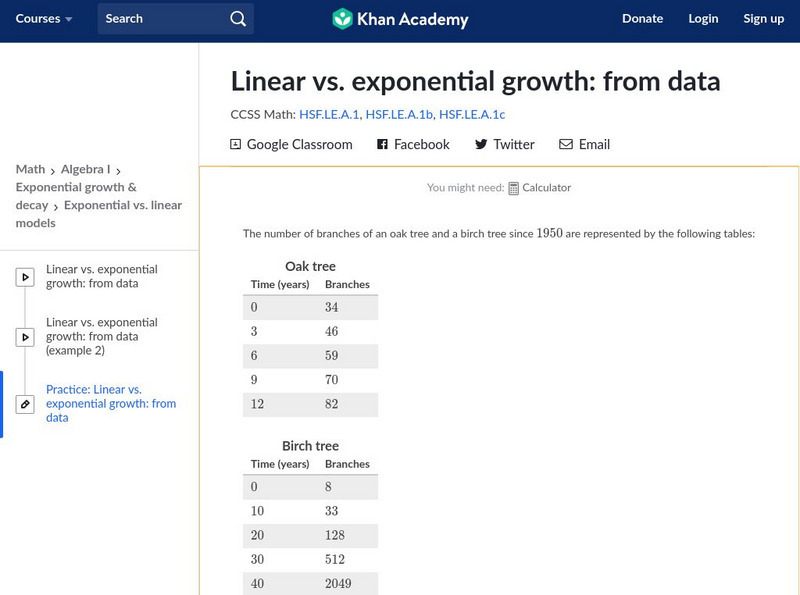
Khan Academy
Khan Academy: Algebra I: Linear vs. Exponential Growth: From Data
Given a table with values of two quantities over time, determine whether the quantities grow linearly or exponentially. Students receive immediate feedback and have the opportunity to try questions repeatedly, watch a video or receive...

Khan Academy
Khan Academy: Algebra I: Sequences Word Problems
Given a verbal description of a real-world relationship, determine the sequence that models that relationship. Students receive immediate feedback and have the opportunity to try questions repeatedly, watch a video or receive hints.

Khan Academy
Khan Academy: Algebra I: Exponential vs. Linear Models
Given a description of a real-world relationship, determine whether that relationship is linear or exponential. Students receive immediate feedback and have the opportunity to try questions repeatedly, watch a video or receive hints.