Hi, what do you want to do?





Scholastic
Scholastic: Study Jams! Science: Our Solar System: The Universe
A video and a short multiple-choice quiz on the Universe and what it is made up of.
NASA
Nasa Star Child: The Universe (Level 1)
This site provides an introduction to the origin of the universe for the young child and the Big Bang theory. There is also a song about the Doppler Shift. Vocabulary glossary and printable version available.
PBS
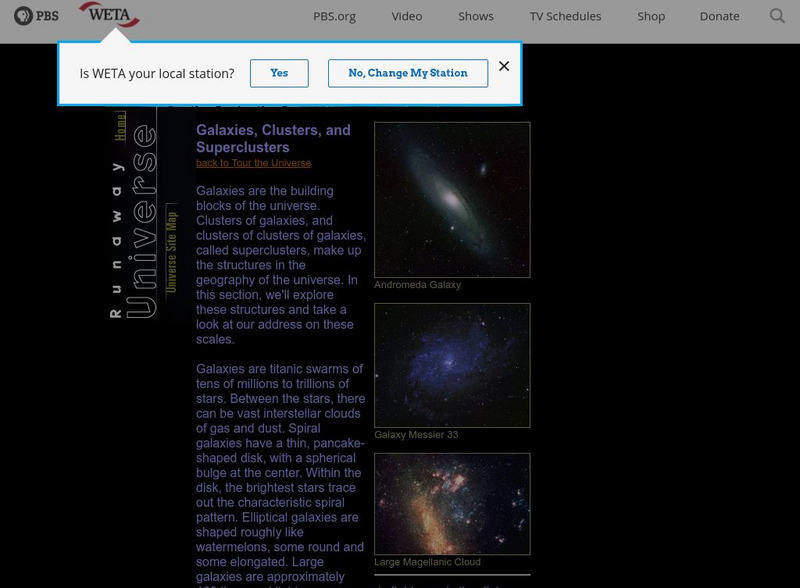
Pbs: Nova Online: Galaxies, Clusters, and Superclusters
PBS site explores these building blocks of the universe as well as their various types and clusters.
PBS
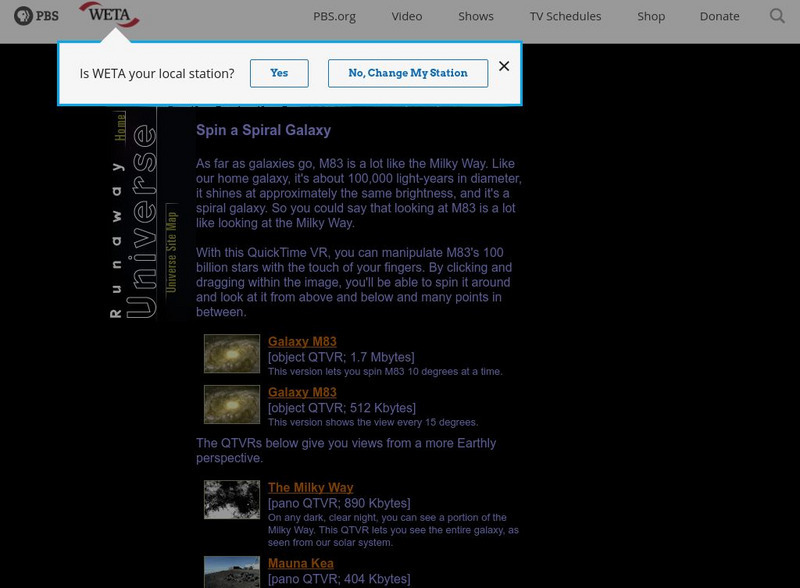
Pbs Nova Online: Spin a Spiral Galaxy
PBS site provides various views of spiral galaxies. (Quick Time required) With this technology, you can manipulate the image to spin it around and look at it from various angles.

TED Talks
Ted: Ted Ed: How Small Are We in the Scale of the Universe?
In 1995, scientists pointed the Hubble Telescope at an area of the sky near the Big Dipper. The location was apparently empty, and the whole endeavor was risky- what, if anything, was going to show up? But what came back was nothing...
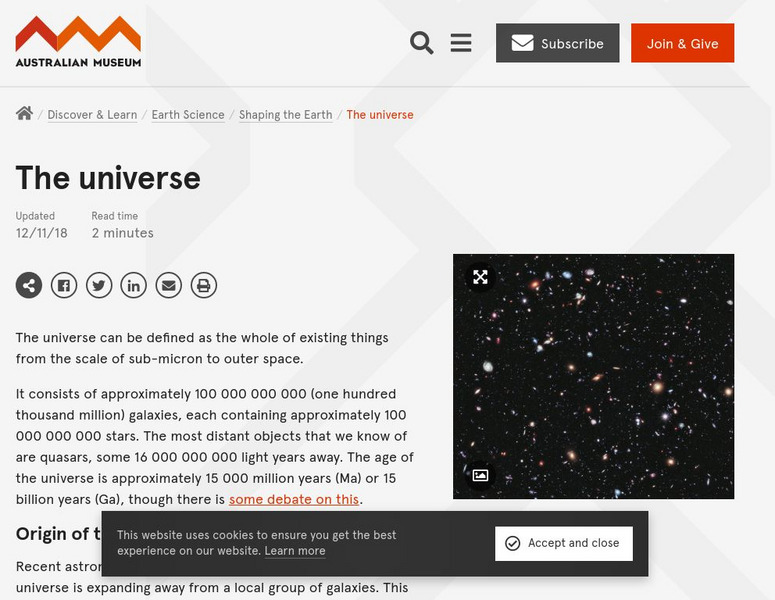
Australian Museum
Australian Museum: The Earth: The Universe
Basic information about the universe, its origin and composition. Also includes information about galaxies, stars, and the sun.

Space Telescope Science Institute
Nasa: Hubble Space Telescope: Galaxies
At this site from HubbleSite you can learn all about galaxies and black holes. Click on the movie link and discover how old the universe is or study about what happens when two galaxies collide!
Other
University of Cambridge Cosmology: Galaxies
This site from the University of Cambridge allows you to view information on spiral, elliptical, and Milky Way galaxies, as well as galaxy clusters. Provides basic facts about each one.
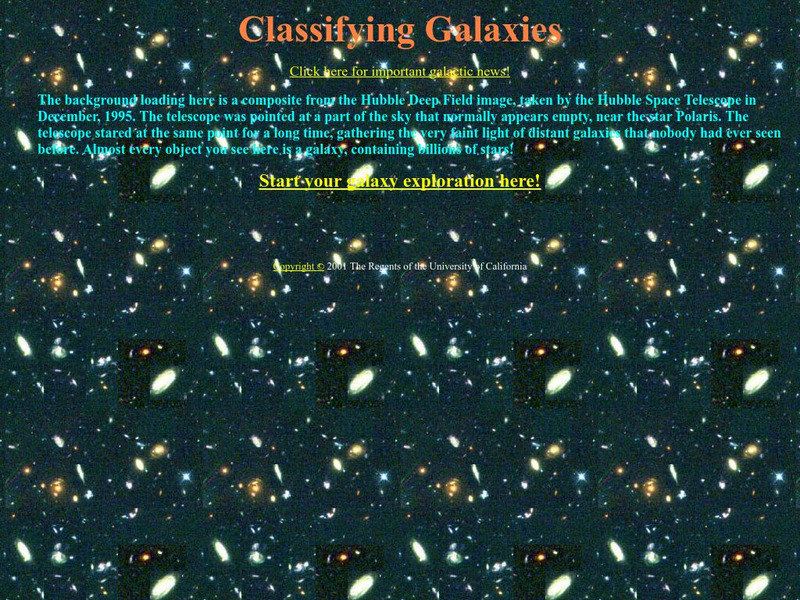
University of California
University of California Berkeley: Classifying Galaxies
Find out how galaxies are classified and then see if you can apply that knowledge to identify the different types of galaxies. In addition to explaining Hubble's galaxy classification system, the site has links to Hubble Space Telescope...
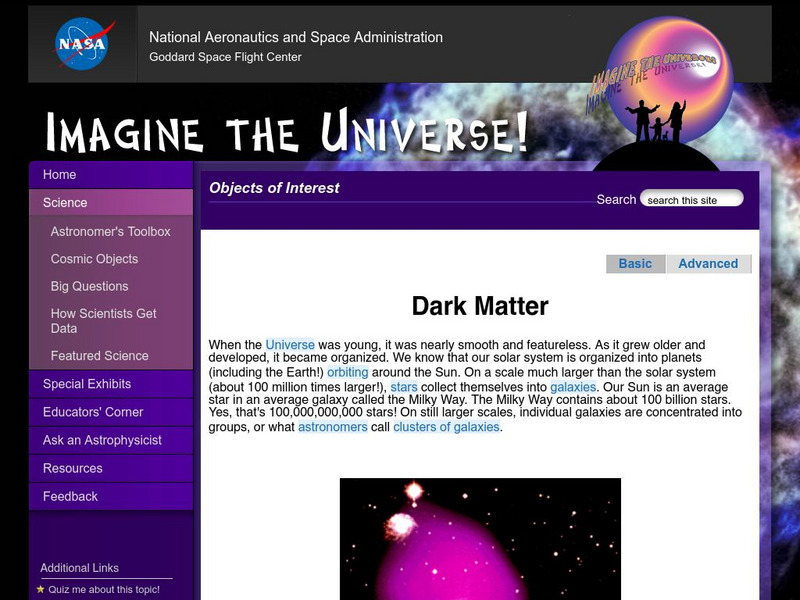
NASA
Nasa: Imagine the Universe: Dark Matter
Site provides an introduction to dark matter and what it really is. Provides links to a quiz as well as facts about dark matter. Offers links to additional resources as well as related topics.

University of Texas at Austin
The University of Texas Mc Donald Observatory: The Milky Way
Students will work in groups to make up a story and picture that explains how someone living thousands of years ago in their location might have explained the Milky Way.
NASA
Nasa: Imagine the Universe: Welcome to the World of Multiwavelength Astronomy!
This Imagine the Universe site provides an introduction into the multiwavelength universe and astronomy. Site provides graphics, links to a quiz, facts on this topic as well as teacher resources.
Other
University of Leicester: Irregular Galaxies
Provides a general overview of irregular galaxies, including a specific look at type I and type II irregulars.
Other
University of Leicester: Spiral Galaxies
Provides a general overview of spiral galaxies, including descriptions of the different classes of spiral galaxy.
Harvard University
Chandra X Ray Observatory: Video Podcasts: The Incredible Two Inch Universe
A set of podcasts outlining a four-step process for understanding the vastness of our universe, from the vicinity of the Earth and Moon, out into distant galaxies. Downloadable instructions and a handout are included, as well as...
NASA
Nasa: Imagine the Universe: Fa Qs on Quasars
A list of answers to many questions related to quasars and active galaxies.
Space Telescope Science Institute
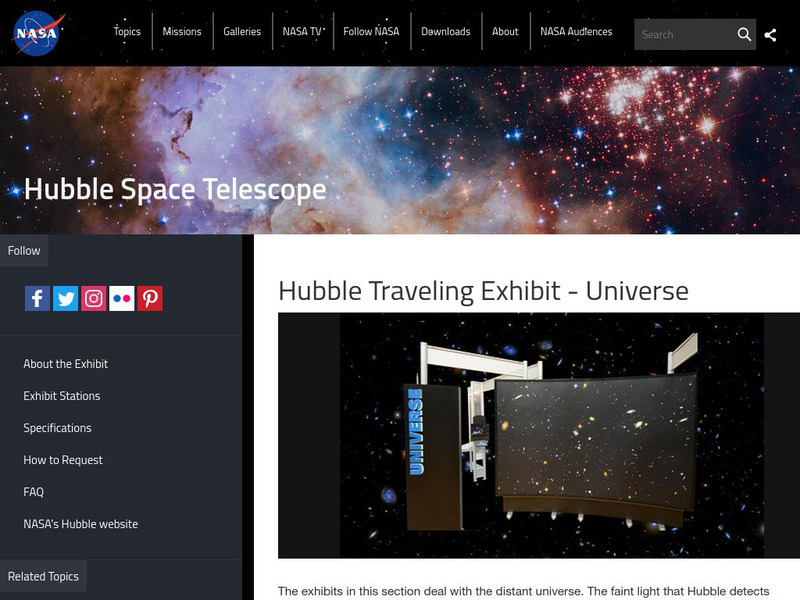
Nasa: Hubble Space Telescope: Universe
At this site from HubbleSite you can discover the universe by taking a look back toward the beginning of time. Site contains links to information on planets, stars, galaxies, and much more.
American Museum of Natural History
American Museum of Natural History: O Logy: How Did the Universe Begin?
Bite-size introduction to two scientists-Hubble and Lemaitre-who played key roles in formulating the theory of the origin of the universe known as the big bang. Includes an interactive timeline on which you can plot out the approximate...
Smithsonian Institution
Smithsonian Learning Lab: The Universe, an Introduction
Start with the questions all learners ask: How big is the universe, how far away are the planets and stars, how did they form and when, how do they move and why? Build on their natural curiosity. The Smithsonian, in cooperation with...

Khan Academy
Khan Academy: Gallery: Structure in the Universe
The Universe is very diverse and contains many unique elements that can be observed in this gallery of pictures.
NASA
Nasa: Image Science Center: Ask the Space Scientist
A NASA scientist, Dr. Sten Odenwald, answers many students' questions. Topics include planets, galaxies, black holes, the origin of the universe, and common misconceptions about space.
European Space Agency
European Space Agency: Esa Kids: Our Universe: Supernovas
A basic overview of supernovas. Links to more information about starts, planets and other objects in our solar system and galaxy are included.
PBS
Pbs Learning Media: Spin a Spiral Galaxy
This interactive activity from NOVA Online lets you spin a spiral galaxy, including our own Milky Way. It demonstrates that what you can learn from visible light observations of a galaxy is largely determined by the angle from which you...
Mocomi & Anibrain Digital Technologies
Mocomi: How Big Is the Universe?
Provides facts about the Universe, Jupiter, the Milky Way Galaxy, and Superclusters.