Hi, what do you want to do?






American Museum of Natural History
How Did the Universe Begin?
The Big Bang Theory is more than a television show. Pupils read how Edwin Hubble observed other galaxies and noticed that the galaxies are moving away from each other. Scholars learn about the idea of the big bang and what happened next...

American Museum of Natural History
Journey to the Stars
Fifteen detailed pictures and informative captions delve deep into the exploration of stars—their life cycle and importance in the universe.

American Museum of Natural History
Planetary Mysteries
A website all about planetary mysteries—it's a one-stop-shop for all things, stars, planets, and space travel. Scholars read an astronomy overview to discover the page's big ideas, then choose from the plethora of resources, including...

American Museum of Natural History
What is Astronomy?
Go study the universe. Pupils learn seven aspects about astronomy and astronomers. They begin to learn about constellations; distance and motion between objects; gravity; the electromagnetic spectrum; dark matter and energy; and teams of...

American Museum of Natural History
Being an Astronomer: Neil deGrasse Tyson
An interview delves deep into the life of famous astronomer Neil deGrasse Tyson.
Other
Physics.org: A Grain of Sand Covers 10,000 Galaxies
A fascinating look at how big our solar system really is. Shows how we can only see a tiny bit of our vast universe.
University of Wisconsin
University of Wisconsin: The Constellations and Their Stars
An excellent site dedicated to the constellations and information about the objects which make them up. Contains a great deal of information about various stars, galaxies and other objects, as well as details on how best to observe them.
Kidport
Kidport: Space Science
This complete resource will help students to improve their understand of space exploration. Includes images of the universe, galaxies, stars and planets.

Other
University of Leicester: Spiral Galaxies
Provides a general overview of spiral galaxies, including descriptions of the different classes of spiral galaxy.
NASA
Nasa Star Child: The Universe (Level 1)
This site provides an introduction to the origin of the universe for the young child and the Big Bang theory. There is also a song about the Doppler Shift. Vocabulary glossary and printable version available.
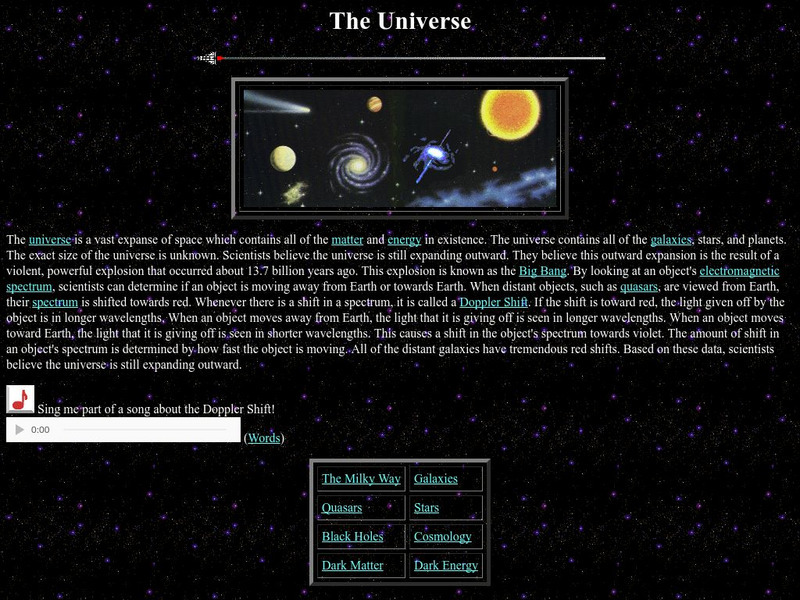
NASA
Nasa Star Child: The Universe (Level 2)
This site provides a description of the universe and what it contains. Includes links to definitions, activities, and an audio song. Printable version available.
NASA
Nasa: Imagine the Universe: Got Calcium?
This site has an article on, "The Milky Way galaxy doesn't contain any milk, but it sure does have a lot of calcium. There's enough calcium floating between the stars to fortify trillions about trillions of stars."
National Earth Science Teachers Association
Windows to the Universe: History & People
Biographies of people throughout history who looked at the sky and wondered what was there. Links to a detailed description of the planets and interactive activities.
Other
University of Leicester: Elliptical Galaxies
Provides a general overview of elliptical galaxies, including a look at what defines an elliptical galaxy, what determines its shape, and it's physical nature.
Space Telescope Science Institute
Nasa: Hubble Space Telescope: Universe
At this site from HubbleSite you can discover the universe by taking a look back toward the beginning of time. Site contains links to information on planets, stars, galaxies, and much more.
European Space Agency
European Space Agency: Esa Kids: Our Universe: Supernovas
A basic overview of supernovas. Links to more information about starts, planets and other objects in our solar system and galaxy are included.
NASA
Nasa Star Child: Quasars (Level 1)
Learn why quasars are the brightest things in the universe. Vocabulary words linked to a glossary of terms and a printable version are available.

Other
An Atlas of the Universe
What does the universe look like? This website offers visitors a collection of images that serve as an "atlas" of our universe. See multiple charts showing the Earth's distance from the Sun and other stars, find helpful terms in a...

NASA
Nasa: Imagine the Universe: X Ray Binary Stars
Site provides a brief introduction to binary stars. Additional resources for students and teachers on this topic are offered as well as related topics.
NASA
Nasa: Imagine the Universe: Welcome to the World of Multiwavelength Astronomy!
This Imagine the Universe site provides an introduction into the multiwavelength universe and astronomy. Site provides graphics, links to a quiz, facts on this topic as well as teacher resources.

NASA
Nasa Star Child: Star Child
StarChild from NASA defines and describes the Solar System in a simple and easy-to-understand manner. The website is broken down into two versions for the student, grade school and junior high.
NASA
Nasa: Imagine the Universe: "Burst Behind the Sun"
Site provides the article, "Burst Behind the Sun Reveals Magnetic Charm of Distant Explosion," that details on a gamma-ray burst that occurred on December 6, 2002. Provides graphics and links to learn more about gamma-ray bursts.

NASA
Nasa: Imagine the Universe: The History of Gamma Ray Astronomy
This NASA article discusses the history of gamma-ray astronomy. Related resources.
NASA
Nasa Star Child: What Is a Light Year and How Is It Used?
This is a definition and example of how distance is measured in astronomy, such as the distance between our earth and the stars.