Hi, what do you want to do?





Calculator Soup
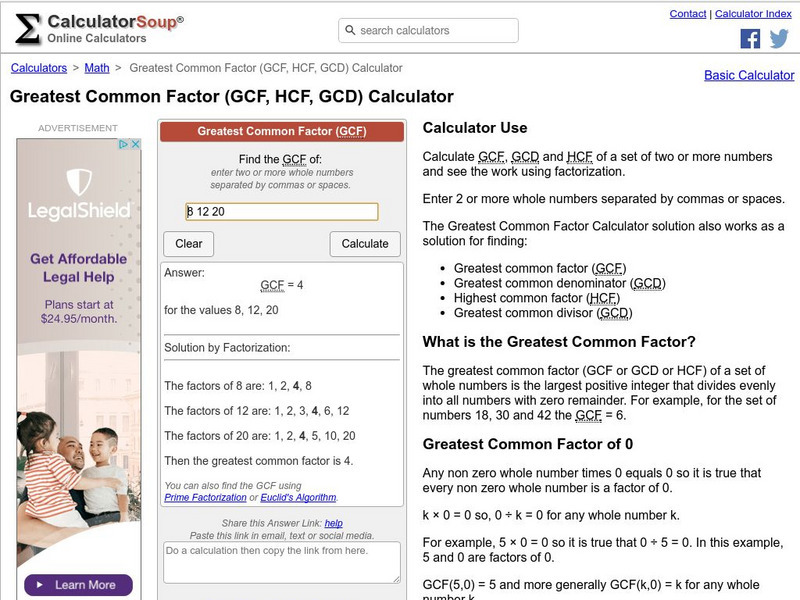
Calculator Soup: Greatest Common Factor Gcf Calculator
Calculate GCF, GCD, and HCF of a set of two or more numbers and see the work using factorization. An interactive calculator, explanations, and examples are included.

University of Nebraska
Univ. Of Nebraska Lincoln: Titration of a Diprotic Acid
An experiment to identify an unknown diprotic acid using a CBL system. A brief discussion of diprotic acids is given.
Math Planet
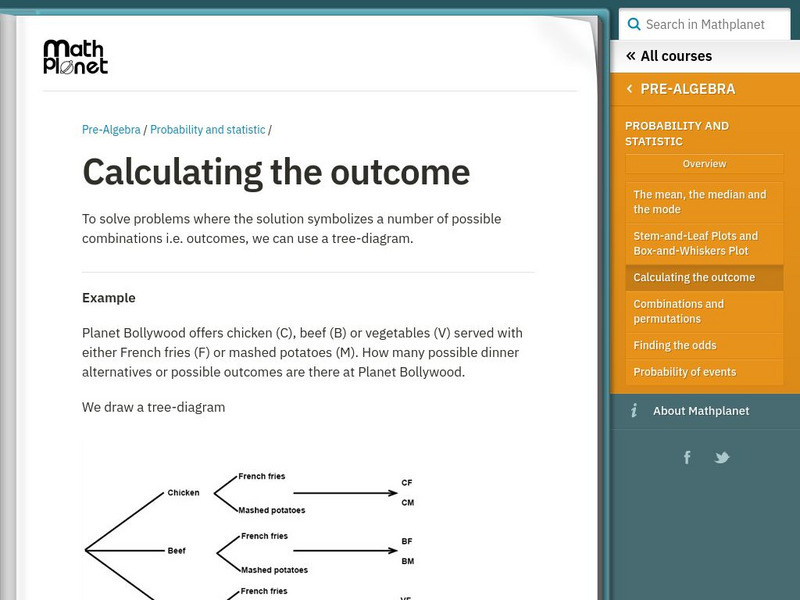
Math Planet: Calculating the Outcome
Gain an understanding of how to calculate the outcome using a tree-diagram by viewing an example and a video lesson.
Oswego City School District
Regents Exam Prep Center: Graphically Represent the Inverse of a Function
Investigates how to graph the inverse of a function. There is also an explanation that involves the use of a graphing calculator.
TeachEngineering
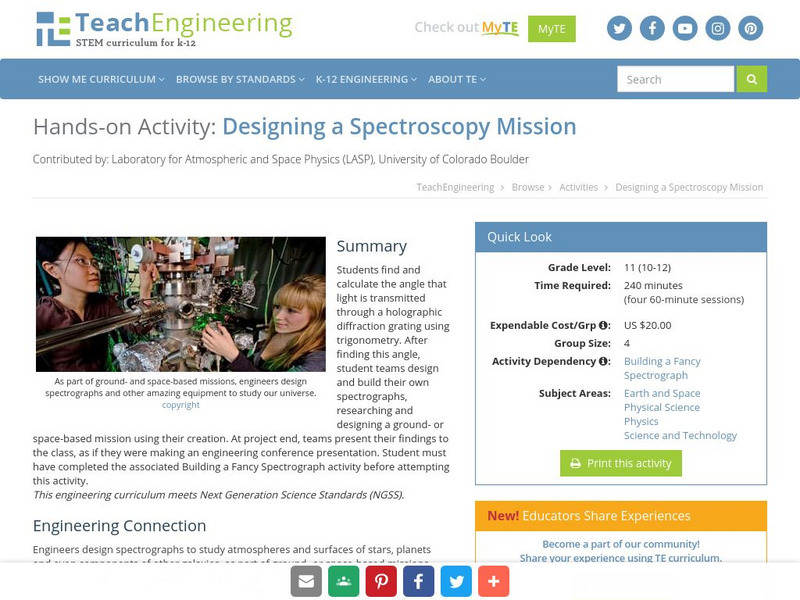
Teach Engineering: Designing a Spectroscopy Mission
Students find and calculate the angle that light is transmitted through a holographic diffraction grating using trigonometry. After finding this angle, student teams design and build their own spectrographs, researching and designing a...

Oswego City School District
Regents Exam Prep Center: Multiple Choice Practice: Equations and Inequalities
Check your understanding of equations and inequalities by completing this multiple-choice practice test. You may use a graphing calculator to solve the problems and check your answers at any given time.
Calculator Soup
Calculator Soup: Rule of 72 Calculator
Use the Rule of 72 to estimate how long it will take to double an investment at a given interest rate. Divide 72 by the interest rate to see how long it will take to double your money on an investment.
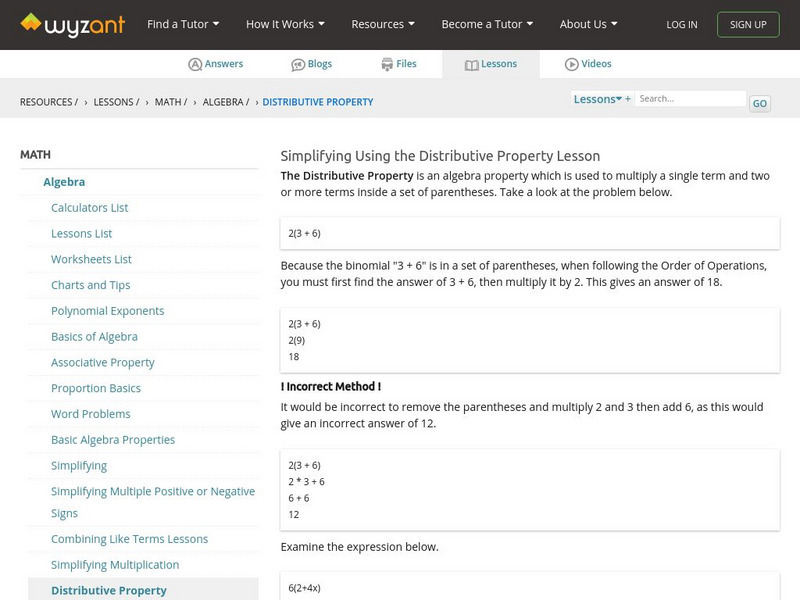
Wyzant
Wyzant: Simplifying Using the Distributive Property
Students investigate how to simplify using the distributive property. The resource consists of lessons with examples, an expression simplifying calculator, and a worksheet to check for comprehension.
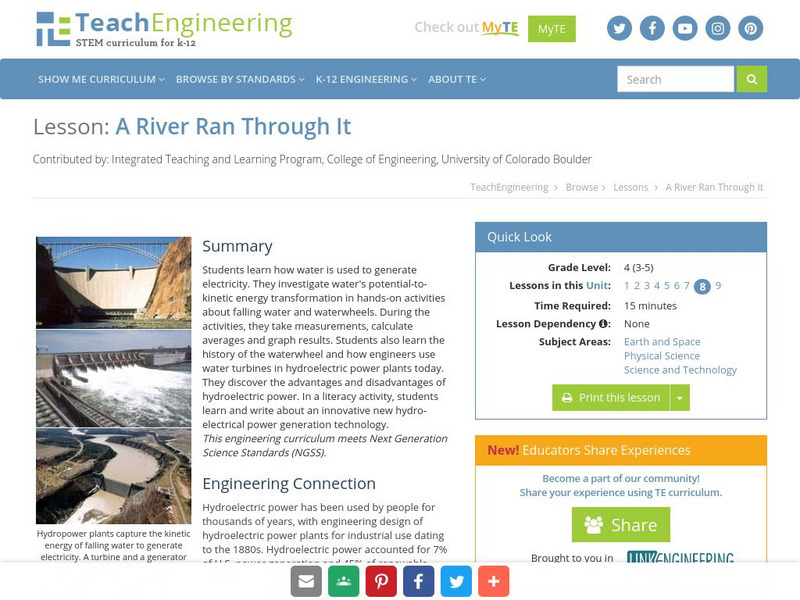
TeachEngineering
Teach Engineering: A River Ran Through It
Students learn how water is used to generate electricity. They investigate water's potential-to-kinetic energy transformation in hands-on activities about falling water and waterwheels. During the activities, they take measurements,...
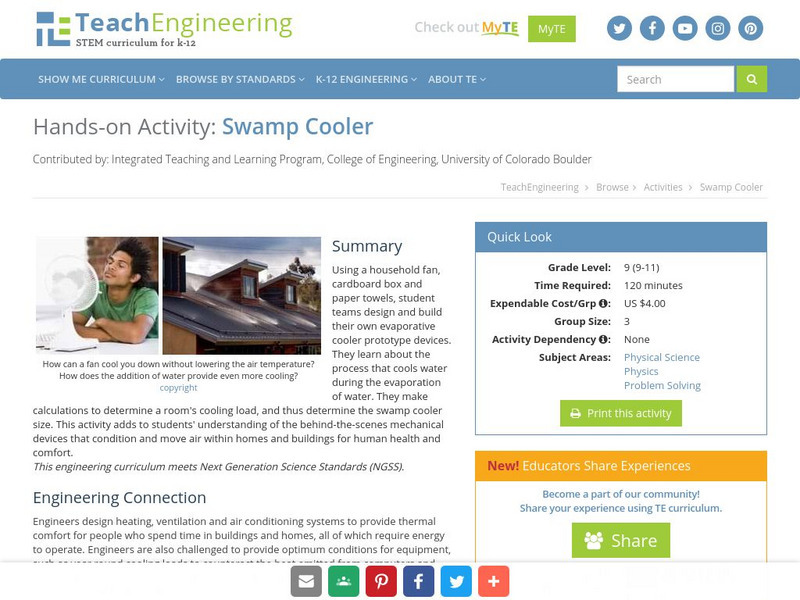
TeachEngineering
Teach Engineering: Swamp Cooler
Using a household fan, cardboard box and paper towels, student teams design and build an evaporative cooler (swamp cooler). They learn about the process that cools water during the evaporation of water. They make calculations to...

Khan Academy
Khan Academy: Lesson Summary: Fiscal Policy
In this lesson summary review and remind yourself of the key terms, calculations, and graphs related to fiscal policy. Topics include how taxes and spending can be used to close an output gap, how to model the effect of a change in taxes...
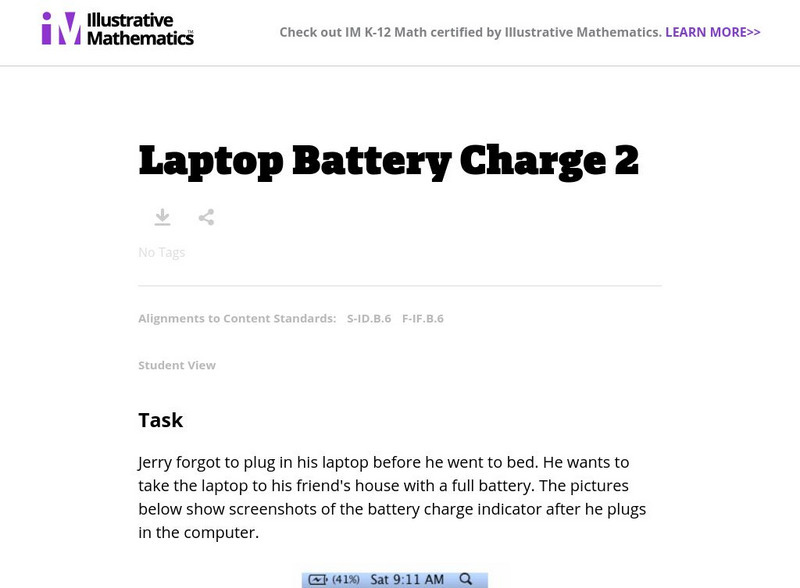
Illustrative Mathematics
Illustrative Mathematics: S Id, F if Laptop Battery Charge
This task uses a situation that is familiar to students to solve a problem they probably have all encountered before: How long will it take until an electronic device has a fully charged battery? Given data, students perform a variety of...
Illustrative Mathematics
Illustrative Mathematics: 6.g Computing Volume Progression 4
The purpose of this fourth task in a series of four is to find the volume of an irregular 3D solid by using Archimedes' Principle. Students must calculate the volume of the displaced water in a rectangular prism tank in order to solve...

Khan Academy
Khan Academy: Lesson Summary: The Circular Flow and Gdp
In this lesson summary review and remind yourself of the key terms and calculations used in describing the output of an economy. Key topics include the expenditures approach, income approach, and value added approach to calculating GDP...
TeachEngineering
Teach Engineering: Does Weight Matter?
Using the same method for measuring friction that was used in the previous lesson (Discovering Friction), students design and conduct an experiment to determine if weight added incrementally to an object affects the amount of friction...
Other
University of Cambridge: Inclusive Design Toolkit
This site provides tons of information about inclusive design. It has an Exclusion Calculator that can be used to assess a product once you understand the principles of inclusive design, as well as the Sight Exclusion Estimator -...
Science Struck
Science Struck: Horsepower Formula
Explains what is meant by horsepower, where the term originated, and demonstrates how to use the formulas for calculating the horsepower of a car and an electric motor. Conversion formulas are also provided. Includes interactive...

Alabama Learning Exchange
Alex: Land Surveying Project
This project resulted from of the collaboration of a computer aided drafting teacher, Chris Bond, and a math teacher, Lee Cable, (Hewitt-Trussville High School) to provide higher math expectations in CT and real life application in...
CK-12 Foundation
Ck 12: Fundamental Counting Principle: Don't Make Eyes at Me!
[Free Registration/Login may be required to access all resource tools.] An explanation with examples of using the Counting Principle as a method for calculating the total number of possible outcomes. This lesson includes a video [6 mins,...

Alabama Learning Exchange
Alex: Wildlife Math
This integrated lesson is the result of collaboration between Chip Blanton, a wildlife management teacher, and Greg Pendergrass, a math teacher (Ft. Payne High School). Learning to manage wildlife requires an understanding of planting...
Illustrative Mathematics
Illustrative Mathematics: F If.6 Mathemafish Population
For this task, students are presented with a table and a graph and are asked to summarize the data and report the findings of a project by the Environmental Protection Agency to contain the effects of an invasive species on a fish...