Hi, what do you want to do?






Curated OER
Tree Study
Young scholars measure the lengths of provided leafs to the nearest millimeter. Students identify trends in the data as well as sourced of inaccuracy and formulate additional questions that could be investigated to enhance their...

Curated OER
Music History
In this music activity, learners answer 7 questions about music history. For example, "Describe the Bach influences upon Mahler in the second section of this extract."

Curated OER
Butterfly Round-Up
Students classify the characteristics of butterflies and moths moths. For this life cycle lesson, students identify butterflies and moths common in the state of Iowa as well as their characteristics. Students then learn the proper...

Curated OER
Black Hawk Island Hike
Students explore Wisconsin's natural and cultural history through hands-on exploration of Upham Woods. They are shown the basic paddling skills and they work in teams to paddle across the river on barge. Students describe cultural...

Curated OER
How Are Students Doing on the AP exams?
Students compile and analyze data pertaining to College Credit AP Exams. They pose questions - Which exam is the easiest? - determine answers from their data and display their results.

Curated OER
Weightlessness
Eighth graders study weight, force and mass as it pertains to the earths pull. For this weightlessness lesson students are divided into groups and complete an activity.

Science Struck
Science Struck: How Does a Spring Scale Work?
Explains how a spring scale works and what it is used for.
TryEngineering
Try Engineering: Spring Scale Engineering
Students learn about the engineering design process as they design, build, and test a spring scale using everyday items that can measure the weight of an apple. The objective of the activity is to explore how scales work and to learn...
Science Buddies
Science Buddies: Applying Hooke's Law: Make Your Own Spring Scale
Hooke's law says that the opposing force of a spring is directly proportional to the amount by which the spring is stretched. How accurately Hooke's law describe the behavior of real springs? Can springs be used to make accurate scales...
TeachEngineering
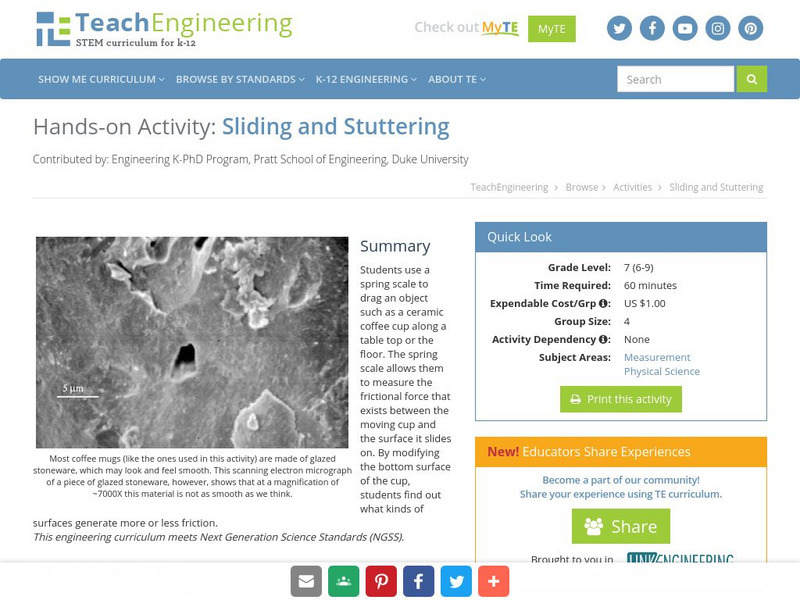
Teach Engineering: Sliding and Stuttering
Students use a spring scale to drag an object such as a ceramic coffee cup along a table top or the floor. The spring scale allows them to measure the frictional force that exists between the moving cup and the surface it slides on. By...
TeachEngineering
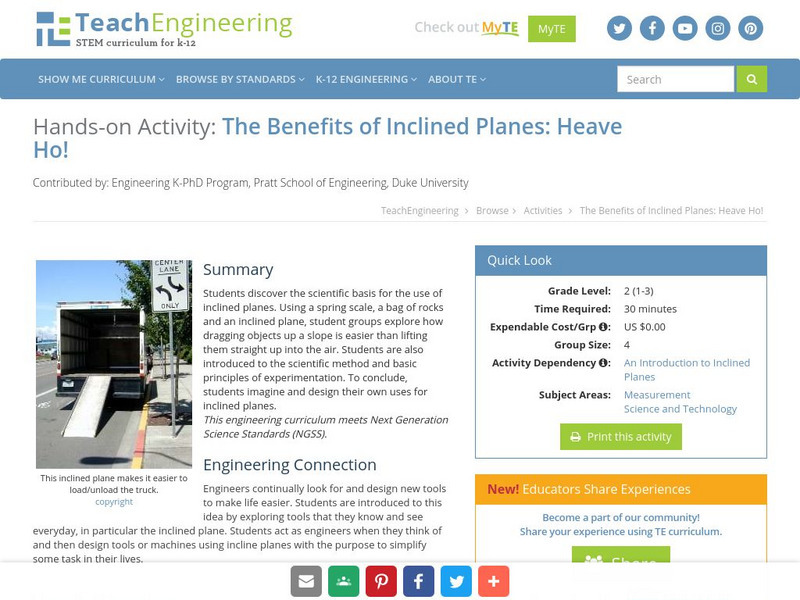
Teach Engineering: Heave Ho!
Students will discover the scientific basis for the use of inclined planes. They will explore, using a spring scale, a bag of rocks and an inclined plane, how dragging objects up a slope is easier than lifting them straight up into the...
TeachEngineering
Teach Engineering: Mechanics Mania
Through ten lessons and numerous activities, students explore the natural universal rules engineers and physicists use to understand how things move and stay still. Together, these rules are called "mechanics." The study of mechanics is...
TeachEngineering
Teach Engineering: Discovering Friction
With a simple demonstration activity, students are introduced to the concept of friction as a force that impedes motion when two surfaces are in contact. Then, in the Associated Activity (Sliding and Stuttering), they work in teams to...
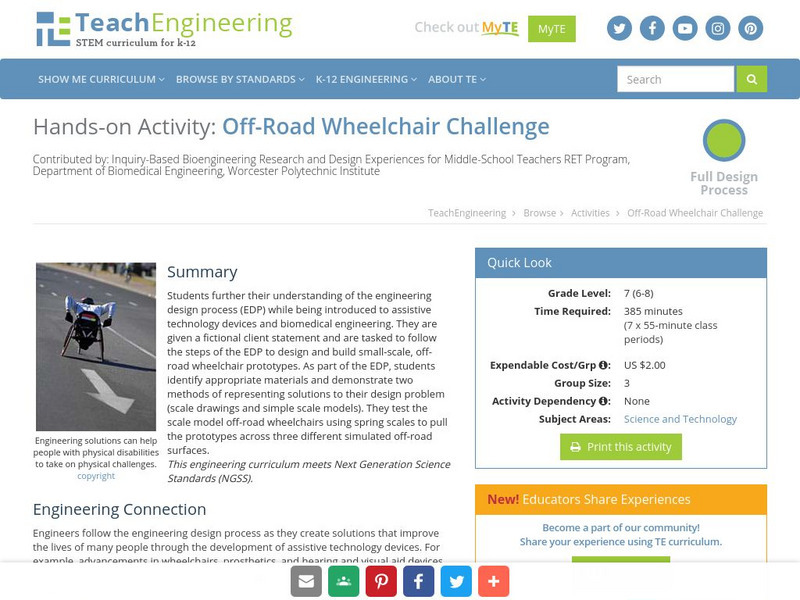
TeachEngineering
Teach Engineering: Off Road Wheelchair Challenge
Students further their understanding of the engineering design process (EDP) while being introduced to assistive technology devices and biomedical engineering. They are given a fictional client statement and are tasked to follow the...
TeachEngineering
Teach Engineering: The Force of Friction
In the first of two lessons of this curricular unit, students are introduced to the concept of friction as a force that impedes motion when two surfaces are in contact. Student teams use spring scales to drag objects, such as a ceramic...
Texas Instruments
Texas Instruments: Groucho's Sign Shop
Students' use force sensors to investigate forces and learn about force as a vector. Similar concept to the common "spring scale" force vector lab, but with a real-world twist.
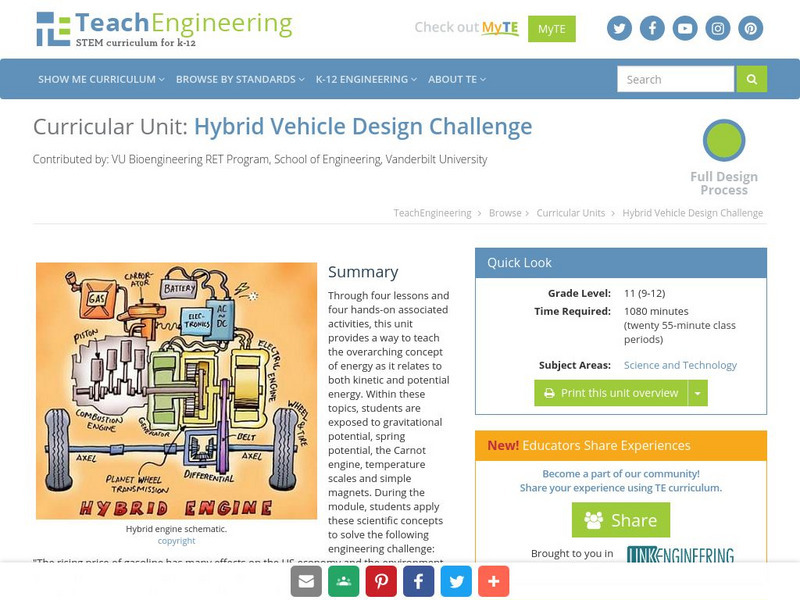
TeachEngineering
Teach Engineering: Hybrid Vehicle Design Challenge
This module is written for a first-year algebra-based physics class, though it could easily be modified for conceptual physics. It is intended to provide hands-on activities to teach the overarching concept of energy, as it relates to...