Hi, what do you want to do?






Better Lesson
Better Lesson: Go Figure With Figurative Language It Helps With Predicting!
In this lesson, learners will use figurative language, digital tools, and illustrations to write a story. The teacher will model how to use an app that has onomatopoeia to create a story with a good beginning, middle, and end. A video...
Texas Education Agency
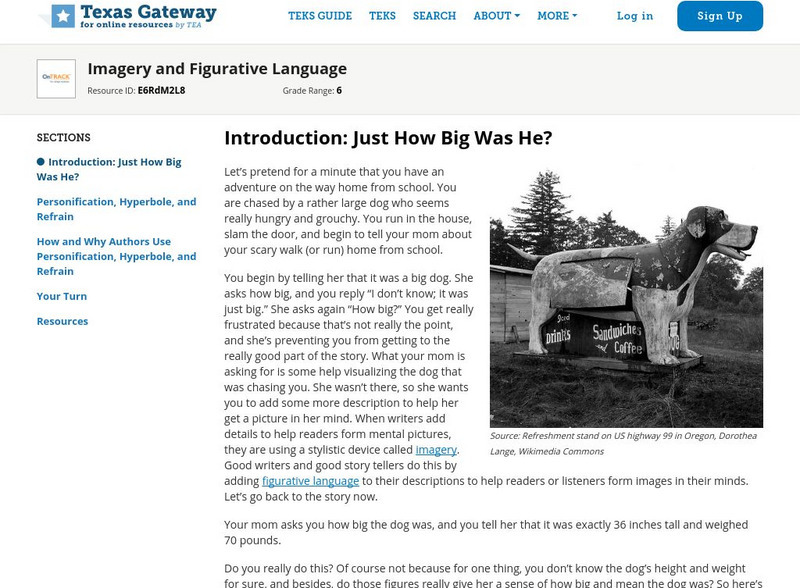
Texas Gateway: Imagery and Figurative Language (Grade 6)
This lesson focuses on the use of imagery and figurative language in writing to aid understanding and create images in the mind.

Alabama Learning Exchange
Alex: Plath, Personification, and Figurative Language
This project based activity will use Sylvia Plath's poem, "Mirror", to examine the use of personification and figurative language. The activity may also incorporate the use of technology to produce a multimedia project. This allows...
Read Works
Read Works: Fourth Grade: Three Lesson Unit: Figurative Language
[Free Registration/Login Required] A lesson plan, based on In a Pickle and Other Funny Idioms by Marvin Terba, in which young scholars learn how understand idioms and use them to explain the plot and to make predictions. With free login,...

Khan Academy
Khan Academy: The Sound of Language
Can you spot writers' use of alliteration, assonance, and onomatopoeia that add sound effects to their language?

PBS
Wnet: Thirteen: I Have a Metaphor
This lesson not only examines the message of Dr. King, but also the words themselves. This is a lesson in identifying the literary devices that he used in his "I Have a Dream" Speech. It will introduce the following literary devices:...

Alabama Learning Exchange
Alex: What Are Idioms?
After listening to More Parts by Tedd Arnold read aloud, intermediate school learners distinguish between literal and figurative meaning by using a graphic organizer, playing an online game, and incorporating an idiom into their writing.

Read Works
Read Works: 4th Grade Lesson: Similes and Metaphors
[Free Registration/Login Required] A lesson plan in which learners use the book Poetry for Young People: Langston Hughes edited by David Roessel and Arnold Rampersad to learn to identify and understand the use of simile and metaphor in...

Love To Know Media
Your Dictionary: Literary Terms Lesson Plan
This is a lesson plan for teaching the seven literary terms used in poetry: simile, metaphor, alliteration, imagery, hyperbole, personification, and onomatopoeia.
Other
E Tutor, Inc.: Headless Horseman, Heady Author
This lesson plan for Washington Irving's "The Legend of Sleepy Hollow" explores the author's use of figurative language and includes follow-up activities and additional resources.

Other
Polar Fle
Two French teachers created this game based on solving a murder mystery, much like the game Clue (Cluedo). In going from task to task, gather "evidence" to figure out who is guilty. Activities are divided into four levels: beginner,...