Hi, what do you want to do?






Curated OER
Web Gallery of Art: Still Life of Kitchen Utensils
An image of "Still-Life of Kitchen Utensils", created by Cornelis Jacobsz Delffz (Oil on panel, 66 x 100 cm).
Sophia Learning
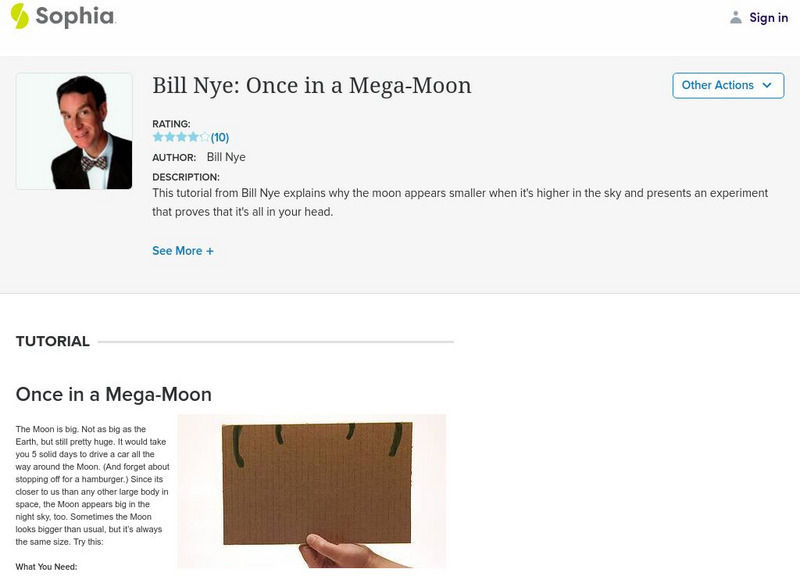
Sophia: Bill Nye: Once in a Mega Moon
Bill Nye explains why the moon appears smaller when it is higher in the sky, and he presents a Home Demo experiment that proves its an illusion. The experiment requires a bright moon on a clear night, a stiff piece of cardboard, and a...
Curated OER
Eternal Egypt: Mortar and Pestle
A kitchen utensil used to grind or mash hard food, such as pepper or chickpeas, and other types of foodstuff. It consists of two separate parts; the mortar, a cup-shaped receptacle and the pestle, a club-like instrument for pounding the...
Other
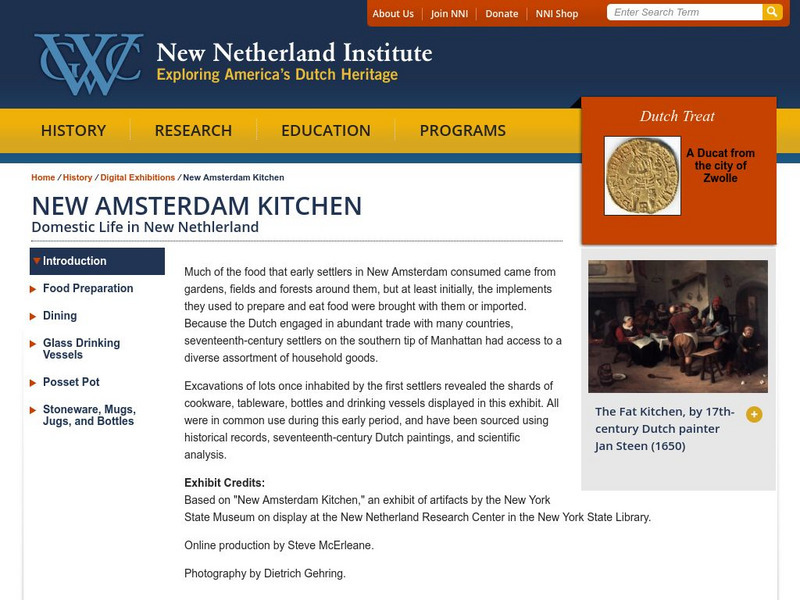
New Netherland Institute: New Amsterdam Kitchen: Domestic Life in New Netherland
Provides information about the foods eaten by settlers in New Amsterdam and how they prepared it. Describes the different utensils and dishes that were used for cooking and for food consumption.
Andre Dollinger
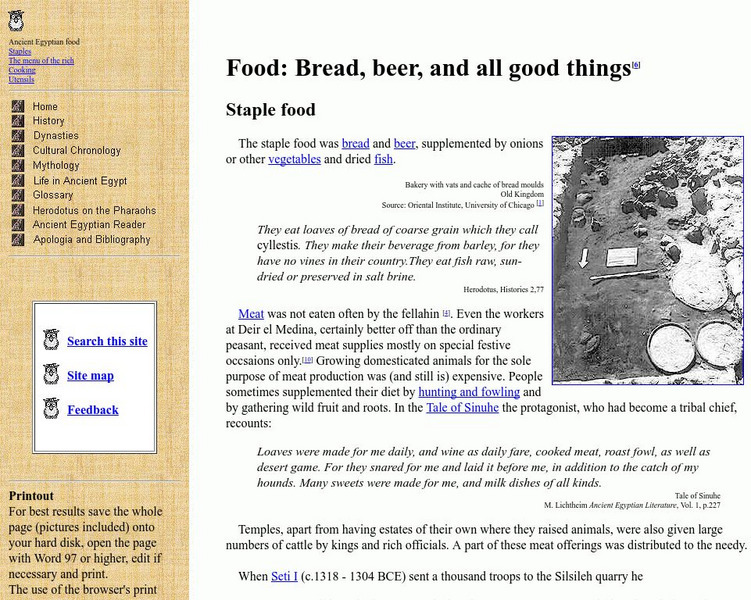
Reshafim: Food: Bread, Beer, and All Good Things
An interesting look at food, cooking, and cooking utensils in ancient Egypt. Take the opportunity to see pictures of banquets from tombs, and read quotes from ancient Egyptian records.
Countries and Their Cultures
Countries and Their Cultures: Alur
The Alur speak DhuAlur, a Western Nilotic language of the Lwo Group. They live in northwestern Uganda and in the neighboring parts of northeastern Zaire. Some two-fifths of the Alur live in Uganda and three-fifths in Zaire. The family is...
ibiblio
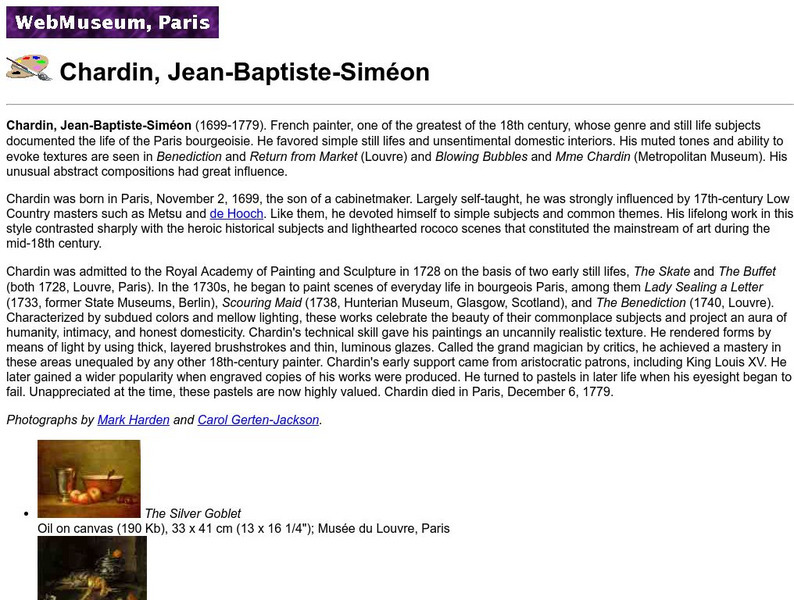
Ibiblio: Web Museum: Jean Baptiste Simeon Chardin
The WebMuseum gives you brief biographical information of Jean-Baptiste-Simeon Chardin and reproductions of Chardin's work, including "Back From the Market." There is also a link to de Hooch, an artistic influence of Chardin's.
Other
Romans in Sussex: The Roman Kitchen
Explores what one would find in a Roman kitchen, how the Romans cooked their food and what equipment a Roman kitchen would have.
Curated OER
Eternal Egypt: Iron Knife With a Gilded Handle
A household utensil long used in Egypt, this knife is made of iron. Its handle and blade have gilded oval-shaped decorations with interwoven and distorted black floral designs.
Curated OER
Educational Technology Clearinghouse: Clip Art Etc: Malleus
A hammer, a mallet. In the hands of the farmer the mallet of wood served to break down the clods and to pulverize them. The butcher used it in slaying cattle, by striking the head, and we often read of it as used by the smith upon the...
Curated OER
Eternal Egypt: Qur'an Stand
A Qur'an stand made of wood and inlaid with mother-of-pearl. The stand consists of the support for the Qur'an and a base. The main decoration on both sides of the support starts at the edges with indented designs of geometrical and...
Curated OER
Eternal Egypt: Basin of Qaitbay
This basin of Qaitbay has many straight sides with a flat bottom and a rather wide rim.
Curated OER
Eternal Egypt: Sword of Tutankhamun
The sword of King Tutankhamun is a single piece of bronze divided into three parts. The first part is the hilt, which is black. The second and third parts form the blade. It is considered to be ceremonial in purpose.
Curated OER
Eternal Egypt: Stirrer, a Kitchen Tool
A stirrer that consists of a square stick and 12 pegs on just three sides, the fourth face has none. Stirrers were used to grind seeds or to mix pastry for the cakes that were cooked for the king, as shown on the walls of the tomb of...
Curated OER
Eternal Egypt: Pestle of Massive Stone
A cylindrical device made of massive stone, which dates back to the Hellenistic period. This pestle has rounded edges and was used with a mortar to grind corn or other hard food. Wheat and corn were ground in this way to make flour.
Curated OER
Eternal Egypt: Glove of King Tutankhamun
The glove of King Tutankhamun is the same as a modern glove, in the shape of the hand and have five fingers. Most probably, gloves in ancient Egypt were not used to keep the hands warm, but were worn for horse riding, so were made of...
Curated OER
Eternal Egypt: Oven of Ramesses the Second
A bronze brazier, belonging to Ramesses the Second was taken to Tanis as a sacred artifact and as a token of veneration and respect for that great king.
Curated OER
Eternal Egypt: Al Mansur Mohammad's Pen Case
The rectangular copper inkwell is decorated with scriptures in both Kufic and Naskh calligraphy, (ornamental styles of writing). The inkwell is also decorated with plant, birds and animal ornamentation.
Curated OER
Eternal Egypt: Gold Sistrum With Head of Hathor
The sistrum or rattle was played to please the goddess Hathor. It is formed of three main parts.
Other popular searches
- Kitchen Utensils
- Measuring Utensils
- Esl Kitchen Utensils
- Eating Utensils
- Cooking Utensils
- Kitchen Utensils and Verbs
- Colonial Utensils
- Utensils for Baking
- Chinese Writing Utensils
- Tools and Utensils
- Utensils Safety
- Hmong, Eating Utensils