Hi, what do you want to do?





McMaster University
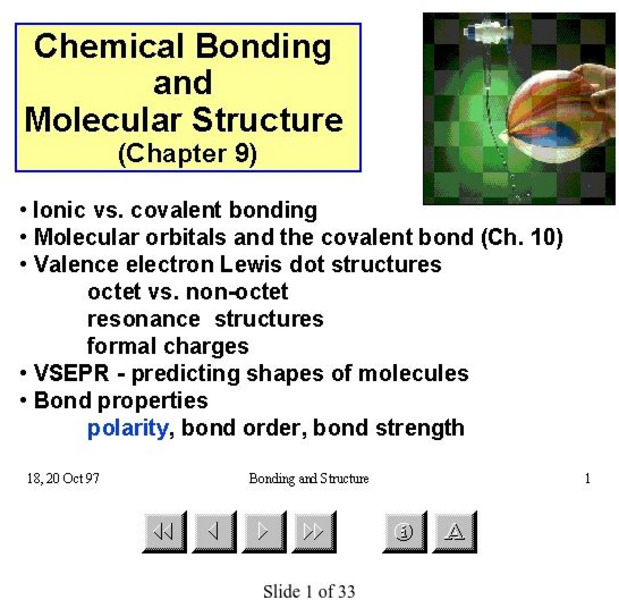
Mc Master University: Molecular Structure
This PowerPoint presentation features 33 slides that explain chemical bonding and molecular shape.
McMaster University
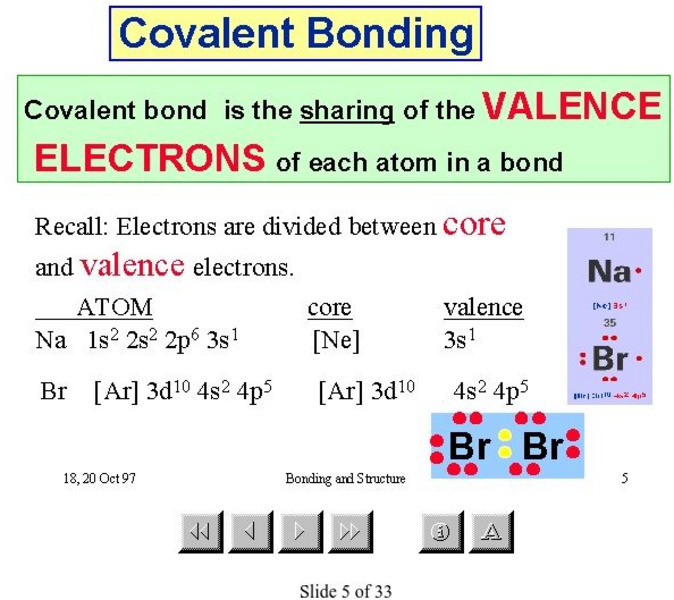
Mc Master University: Covalent Bonding
Slides 5 through 8 in this presentation from the McMaster University explain covalent bonding.
Wisc-Online
Wisc Online: Lewis Dot Structures of Covalent Compounds
Short slide show provides basic information about drawing Lewis dot structures for covalent compounds. Starts with anatomy of the atom, and then shows the relationship between atomic particles and the Periodic Table of Elements. Offers...

American Chemical Society
Middle School Chemistry: Periodic Table and Energy Level Models
Students interpret the information given in the periodic table to describe the arrangement of electrons on the energy levels around an atom.
PBS
Pbs Learning Media: Molecular Shapes
In this interactive activity from ChemThink, students will learn about covalent molecules and how the VSEPR theory predicts the shapes of covalently-bonded molecules.
Michael Blaber, PhD
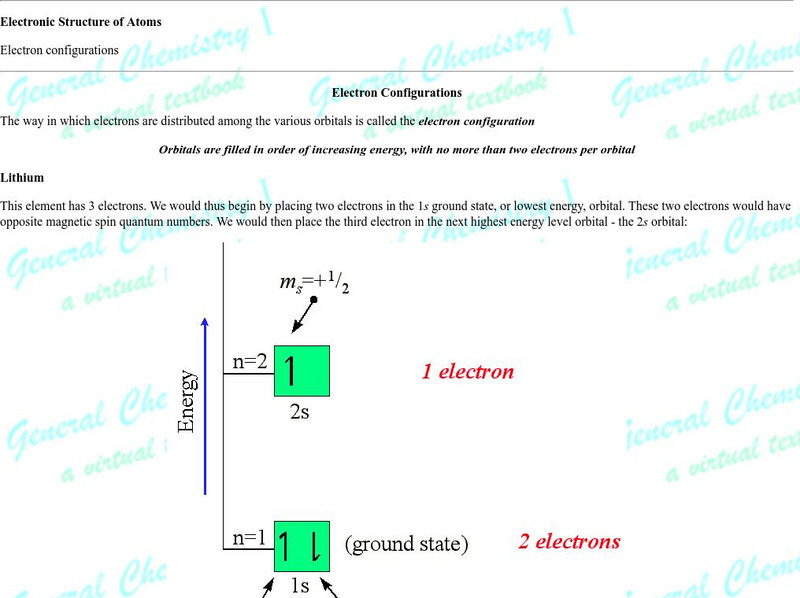
Florida State University: Electronic Structure of Atoms: Electron Configurations
Florida State University provides this article on electronic configurations of atoms and Hund's rule.
Other
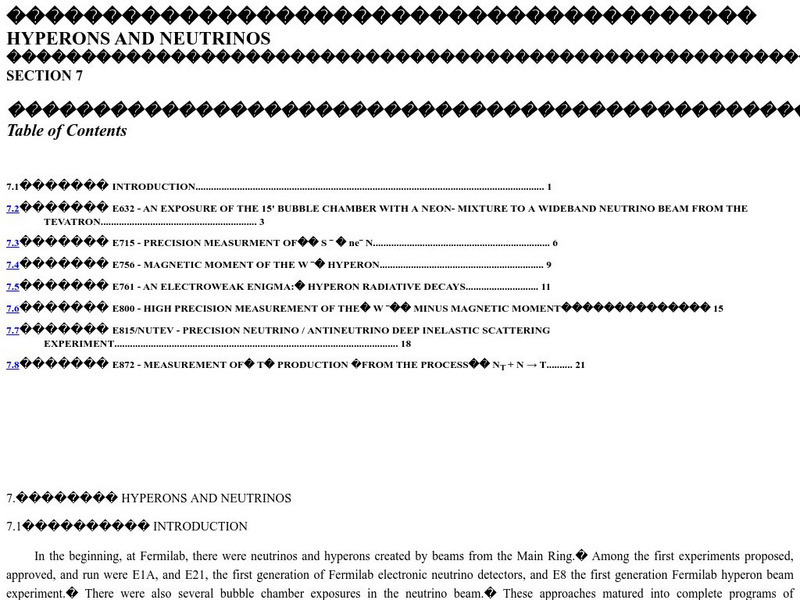
Fermilab: Hyperons & Neutrinos
The third paragraph pinpoints the importance of hyperons in particle research. Hyperons and neutrinos share characteristics of the weak force. Complex stuff, but the real deal. Parts of this report may be very useful. Many photos, slow...
CK-12 Foundation
Ck 12: Molecular Geometry
[Free Registration/Login may be required to access all resource tools.] The following online tutorial explains the basis of VSEPR theory. It helps students predict the shapes of molecules and polyatomic ions using VSEPR theory and it...
CK-12 Foundation
Ck 12: Molecular Geometry
[Free Registration/Login may be required to access all resource tools.] In this interactive learning module, students will learn a technique to predict molecular geometry based on a molecule's Lewis electron dot structure.
Chem4kids
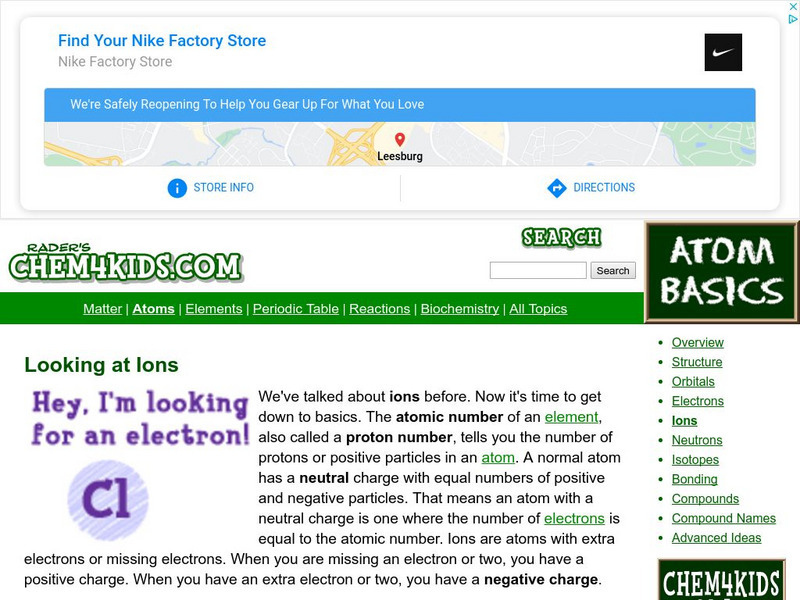
Chem4 Kids: Ions
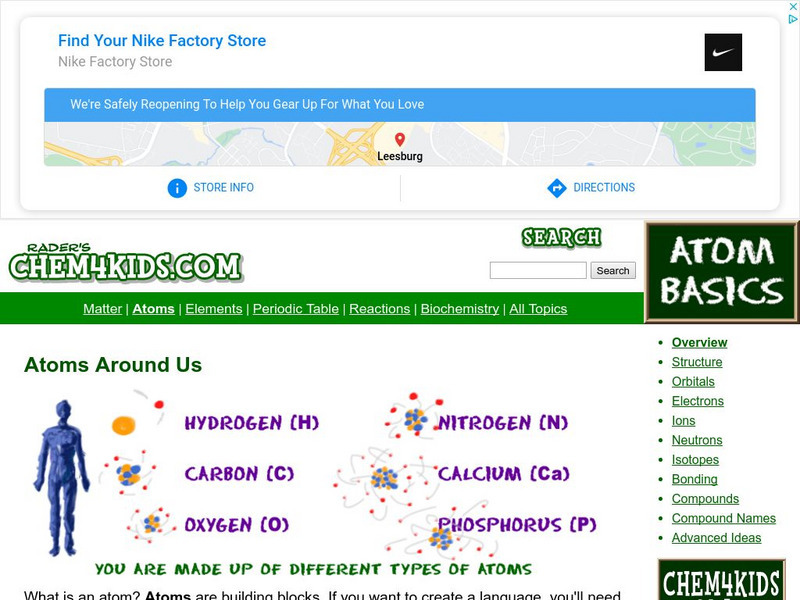
Here at Chem4Kids you can learn all about ions. Content explores what an ion is, its various characteristics, electrovalence, and more.
Chem4kids
Chem4 Kids: Atoms
This site provides a detailed overview of atoms. Content explores an atom's structure, as well as what ions are, how atoms bond, what compounds are (including how to name compounds), and what isotopes are.
American Chemical Society
Middle School Chemistry: Energy Levels, Electrons, and Covalent Bonding
Students discover the concept that two atoms can attract and form a covalent bond.
Chiral Publishing
Chiral Publishing: An Introduction to Chemistry: Molecular Structure: Power Point [Pdf]
This power point covers the molecular structure chapter from "An Introduction to Chemistry". It reviews the main ideas and shows many examples of covalent bonding from valence electrons. Also includes detailed steps to drawing lewis dot...
Chiral Publishing
Chiral Publishing: An Introduction to Chemistry: Molecular Structure: Audio Book
This audio book, narrated by Mark Bishop, describes the formation of covalent bonds. Lewis dot structures help highlight the valence electrons used to determine which bonds form. Also find links to animations and tutorials about other...
Chiral Publishing
Chiral Publishing: An Introduction to Chemistry: Molecular Compounds: Audio Book
Learn all about molecular structures in this easy-to-understand, audio book. See how valence electrons determine how atoms bond together, and look at the bonding inside some of the most common molecules around you.
Vision Learning
Visionlearning: Carbon Chemistry: An Introduction
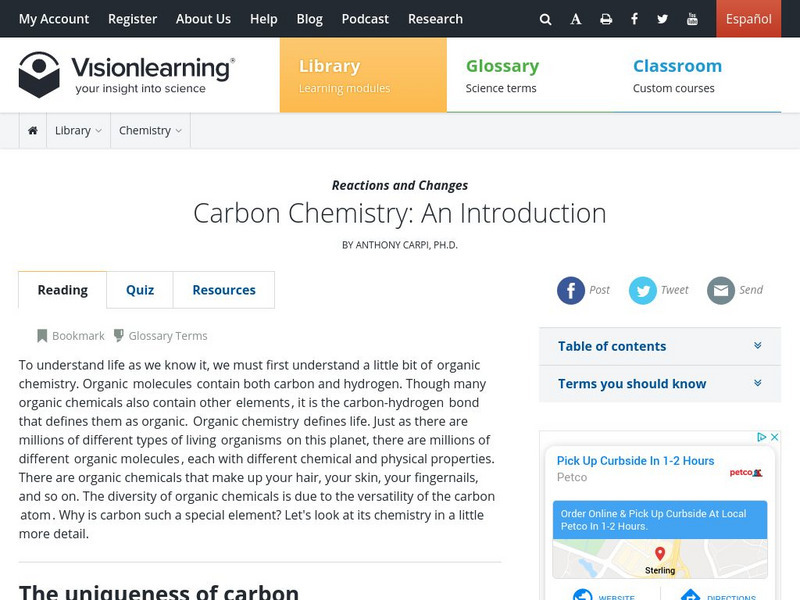
A nice introduction to why carbon is the key to organic chemistry. Explains the role of valence electrons in the bonding of carbon and gives lots of "stick figures" models of simple hydrocarbons.
Other
Organic Chemistry: Lewis/kekule Structures
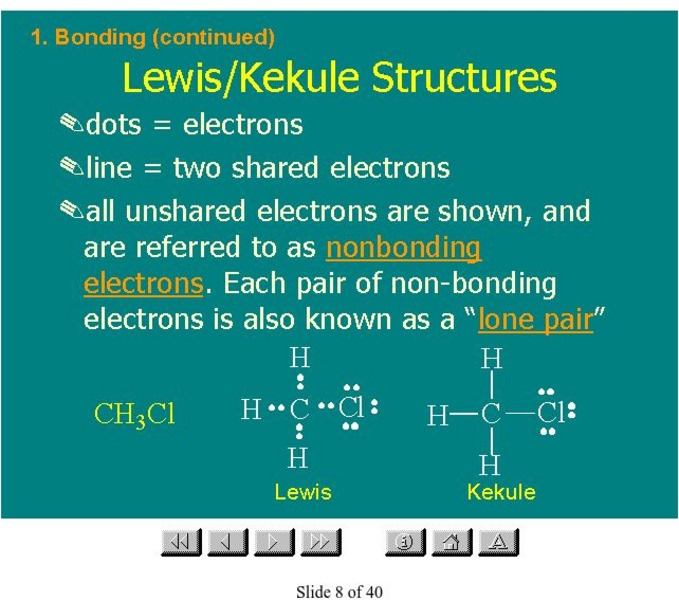
This slide presentation contains a few slides that will be useful for students learning to write Lewis structures. A discussion of multiple bonds is included, and clear examples are shown.
CK-12 Foundation
Ck 12: Periodic Trends
[Free Registration/Login may be required to access all resource tools.] In the following online tutorail students will use the Periodic Table to identify and explain periodic trends, including atomic and ionic radii, electronegativity,...
TeachEngineering
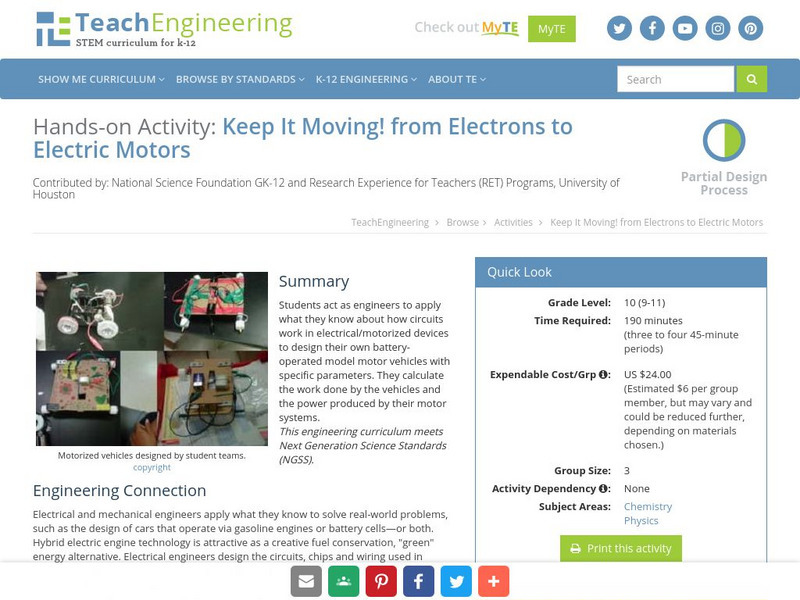
Teach Engineering: Keep It Moving! From Electrons to Electric Motors
Students act as engineers to apply what they know about how circuits work in electrical/motorized devices to design their own battery-operated model motor vehicles with specific paramaters. They calculate the work done by the vehicles...

University of California
Organic Chemistry Page: A Brief Tutorial on Drawing Lewis Dot Structures
An excellent lesson on writing Lewis structures. Examples shown include ammonium ion, carbon dioxide and the carbonate ion.
Other
Chemical Bonds: Formal Charges
A slide presentation with several slides dedicated to the topic of formal charges. Formal charges are explained, and examples are given. A practice example is provided.
CK-12 Foundation
Ck 12: Electron Configuration and the Periodic Table
[Free Registration/Login may be required to access all resource tools.] In this learning module, students will explore how the form of the periodic table is related to electron configurations, which in turn influences chemical reactivity.
University of St. Andrews (UK)
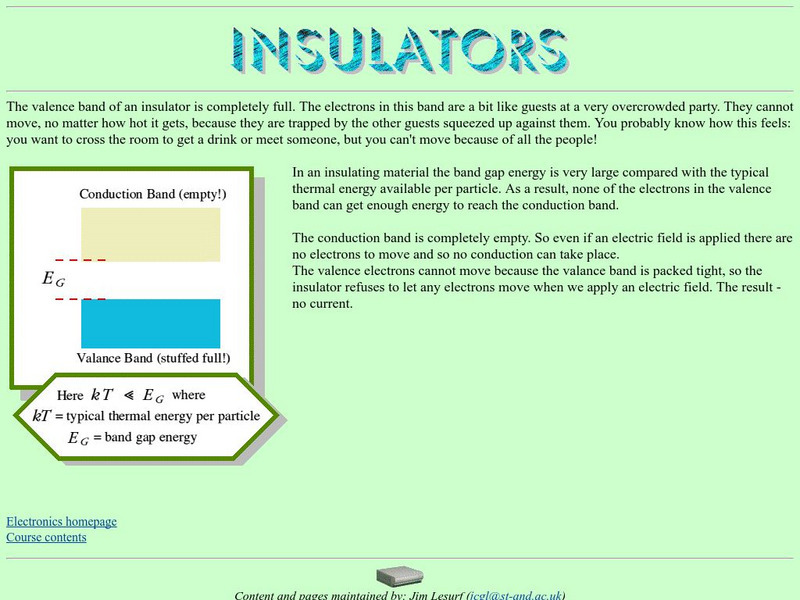
University of St. Andrews: Insulators
The nature of insulators is described at the atomic level. Band gap theory is used to explain what distinguishes insulators from conductors.

Other
Digital First: Eulerizing a Graph
In this applet, students use the tools to eulerize each graph.