Hi, what do you want to do?





Sophia Learning
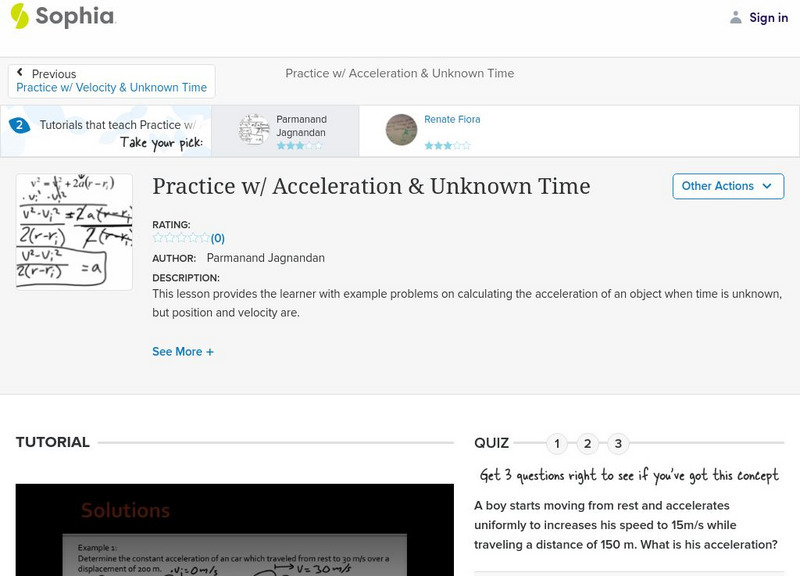
Sophia: Practice W/ Acceleration & Unknown Time: Lesson 1
This lesson provides the learner with example problems on calculating the acceleration of an object when time is unknown, but position and velocity are. It is 1 of 2 in the series titled "Practice w/ Acceleration & Unknown Time."

Physics Classroom
The Physics Classroom: Circular Motion Principles for Satellites
From The Physics Classroom. Uses easy- to-understand language to discuss how circular motion principles apply to the motion of satellites. Describes the tangential velocity and centripetal acceleration of a satellite. Includes many...
Science Education Resource Center at Carleton College
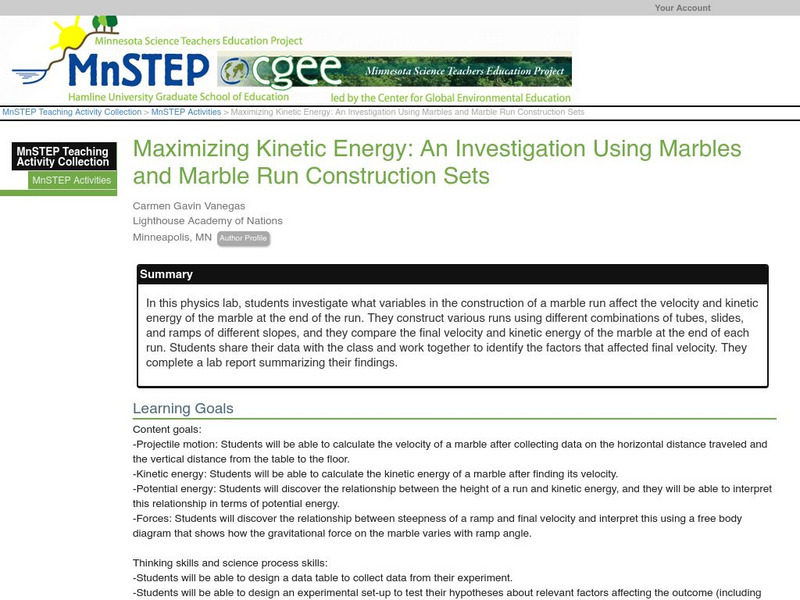
Serc: Maximizing Kinetic Energy: An Investigation Using Marbles
Using marbles to construct a marble run, students will learn about projectile motion, kinetic energy, potential energy, final velocity, and forces.

American Association of Physics Teachers
Com Padre Digital Library: Open Source Physics: Car Race Model
Check out this simulation of kinematics. Test a race car with a constant acceleration versus a race car with constant velocity.
Science Education Resource Center at Carleton College
Serc: Egg Drop
In this physics lab, learners build a container to safely deliver two eggs from the top of the school. Students calculate average velocity, acceleration, momentum, and the amount of force as it hits the ground. If their egg breaks, they...
Texas Education Agency
Texas Gateway: Changes in Motion
In this lesson, you will learn about position vs. time graphs and velocity vs. time graphs and how to use them to solve problems.
Concord Consortium
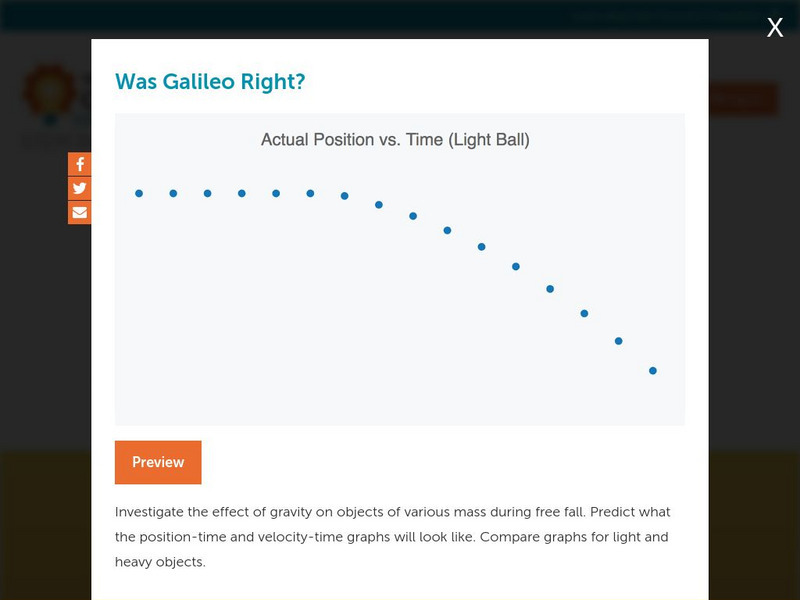
Concord Consortium: Was Galileo Right?
Investigate the effect of gravity on objects of various mass during free fall. Predict what the position-time and velocity-time graphs will look like. Compare graphs for light and heavy objects.
Wikimedia
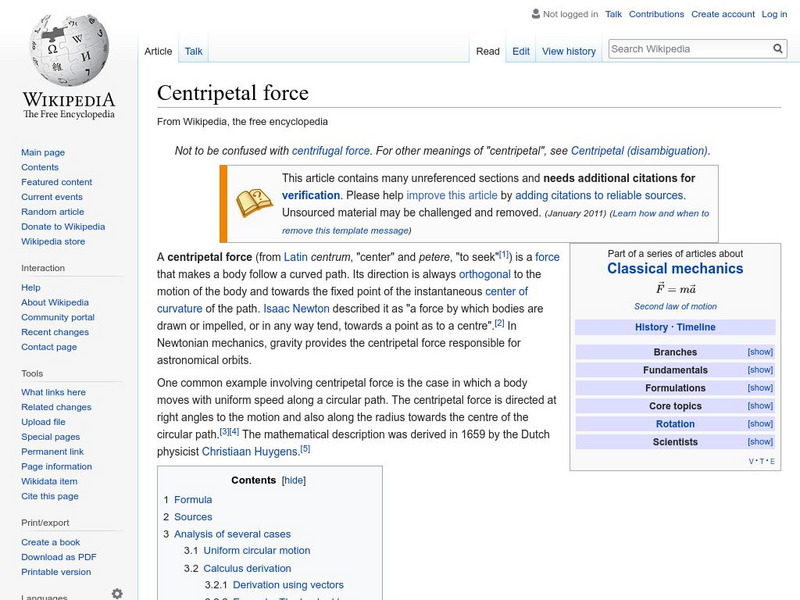
Wikipedia: Centripetal Force
Wikipedia's site on centripetal force provides a section explaining the difference between centripetal force and centrifugal force. Includes formulas and hyperlinked terms.
Physics Aviary
Physics Aviary: Atwood Machine Lab
This lab was designed to have students practice the Atwood lab prior to doing it for real. Students can adjust the masses and the planet and then collect position vs. time data and velocity vs. time data.

Khan Academy
Khan Academy: Start: How Do Computers Simulate the Motion of Virtual Particles?
In this lesson we'll explore how we use fairly simple physics to draw particles which move according to the forces we feel in the real world (such as wind & gravity).
Physics Classroom
The Physics Classroom: Kinetic Energy
Kinetic energy is defined and explained--learning exercises are included to assess your understanding.
Other
Center for Education Partnerships: The Marble Roll
In this Science-athon, students try to make their marble roll the farthest across a flat surface, using their knowledge of forces, motion, and energy to guide them through their apparatus design. Teachers must enroll online.
Other
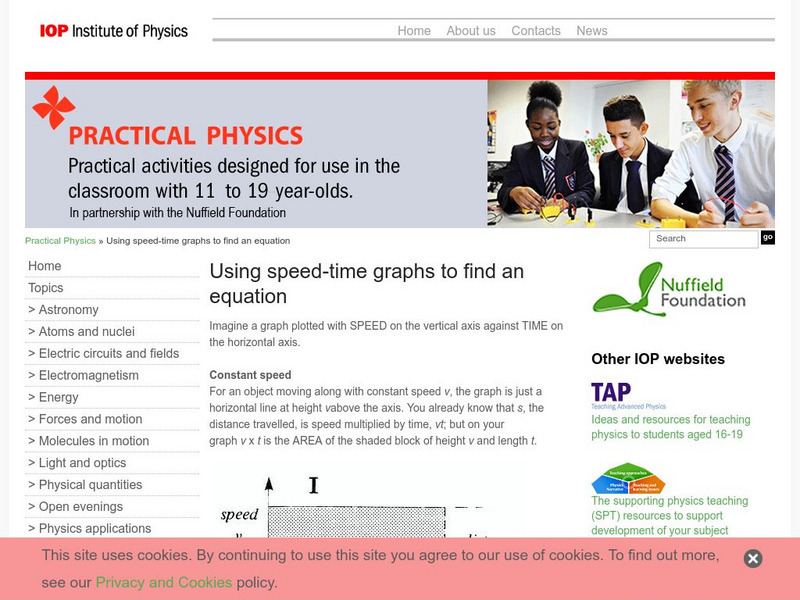
Institute of Physics: Practical Physics: Speed Time Graphs to Find an Equation
An illustrated example of a speed-time graph plotted with speed on the vertical axis against time on the horizontal axis.
Texas Education Agency
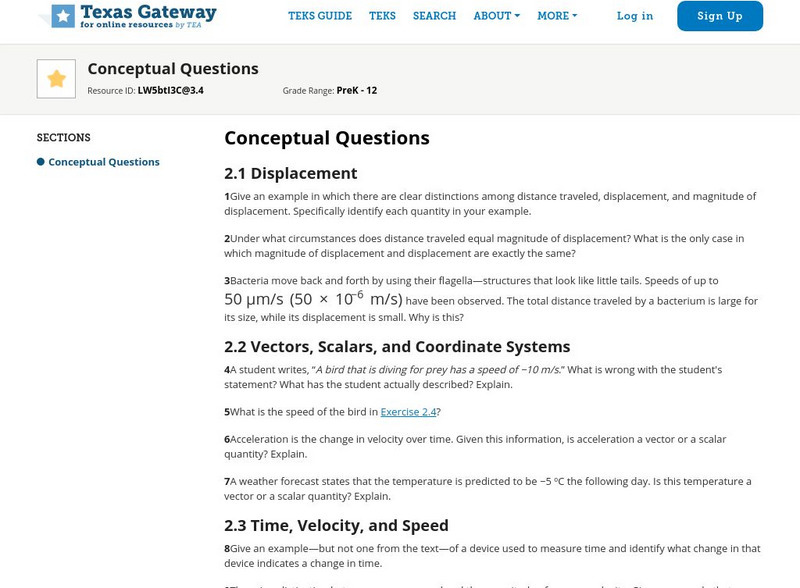
Texas Gateway: Ap Physics: Kinematics Conceptual Questions
This page provides practice questions on each of the conceptual content sections in AP Physics: Chapter 2: Kinematics.

Khan Academy
Khan Academy: What Are Position vs. Time Graphs?
What can you learn from graphs that relate position and time and how are they useful? Article relates what the verticle axis, slope, and curvature represents on a position graph and provides examples.
Georgia Department of Education
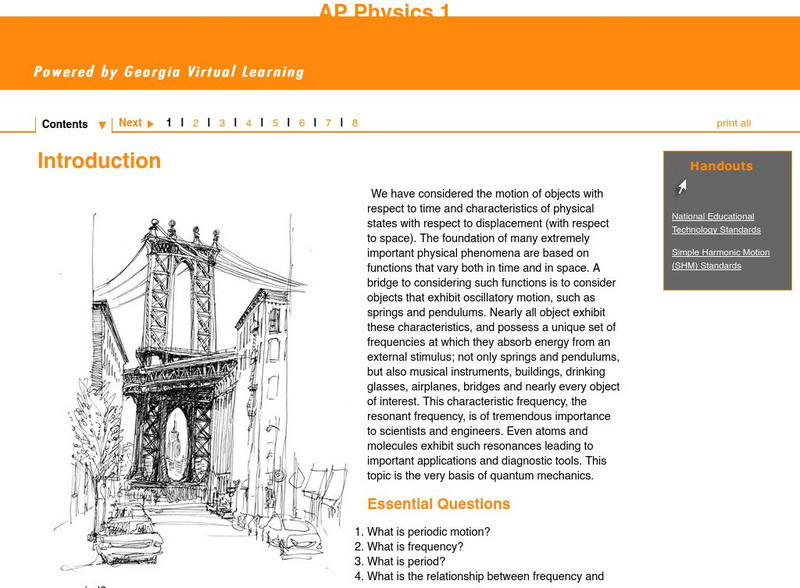
Ga Virtual Learning: Ap Physics 1: Simple Harmonic Motion
In this unit, students will discover the period of time of one oscillation, the frequency of oscillation, the object displacement, its velocity, and its acceleration. They will also discover how to apply the principles of conservation of...
Sophia Learning
Sophia: Practice W/ Position & Unknown Time: Lesson 1
This lesson provides the learner with example problems on calculating the position of an object when time is unknown, but velocity and acceleration are. It is 1 of 2 in the series titled "Practice w/ Position & Unknown Time."
Texas Education Agency
Texas Gateway: Kinematics: Graphical Analysis of One Dimensional Motion
By the end of this section, you will be able to describe a straight-line graph in terms of its slope and y-intercept, determine average velocity or instantaneous velocity from a graph of position vs. time, determine average or...
OpenStax
Open Stax: Introduction to Rocket Propulsion
From a chapter on Linear Momentum and Collisions in a Physics textbook. This section of the chapter discusses Newton's third law of motion in the context of rocket and jet engine propulsion. Students learn how to calculate a rocket's...
Texas Education Agency
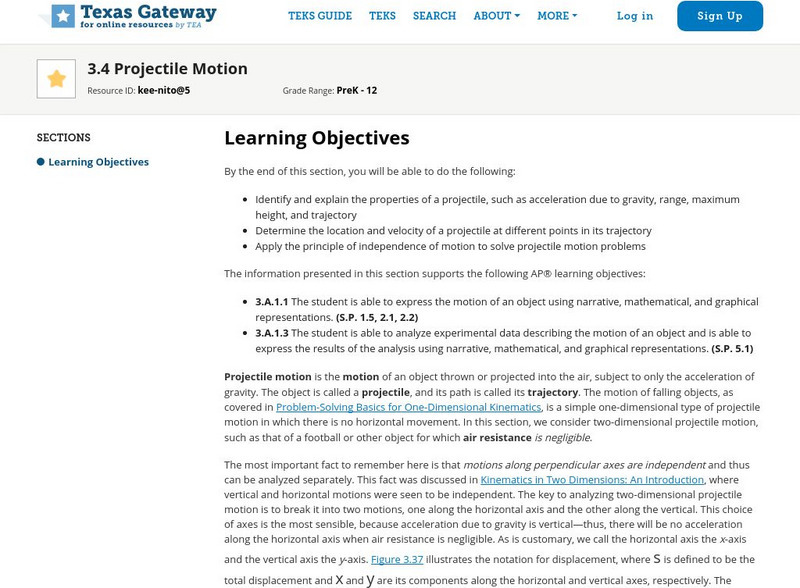
Texas Gateway: Kinematics in Two Dimensions: Projectile Motion
By the end of this section, you will be able to identify and explain the properties of a projectile, such as acceleration due to gravity, range, maximum height, and trajectory; determine the location and velocity of a projectile at...
Physics Classroom
The Physics Classroom: 1 D Kinematics
A six-lesson e-textbook covering topics in one dimension kinematics. Lessons include informational text, interactive activities, and quick, interactive comprehension checks along the way.
Science and Mathematics Initiative for Learning Enhancement (SMILE)
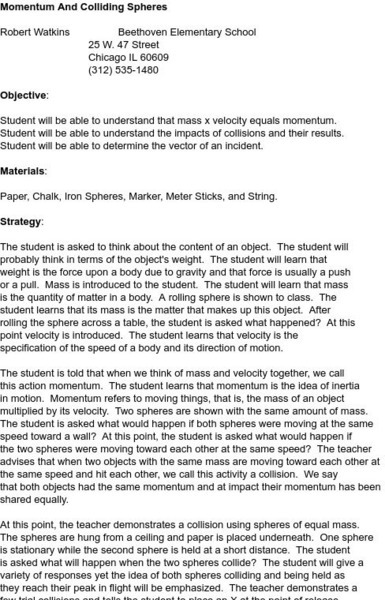
Smile: Colliding Spheres
This lab activity from the Illinois Institute of Technology lets students investigate the impact of collisions upon the velocity and momentum of the colliding objects. Requires understanding of vectors.
OpenStax
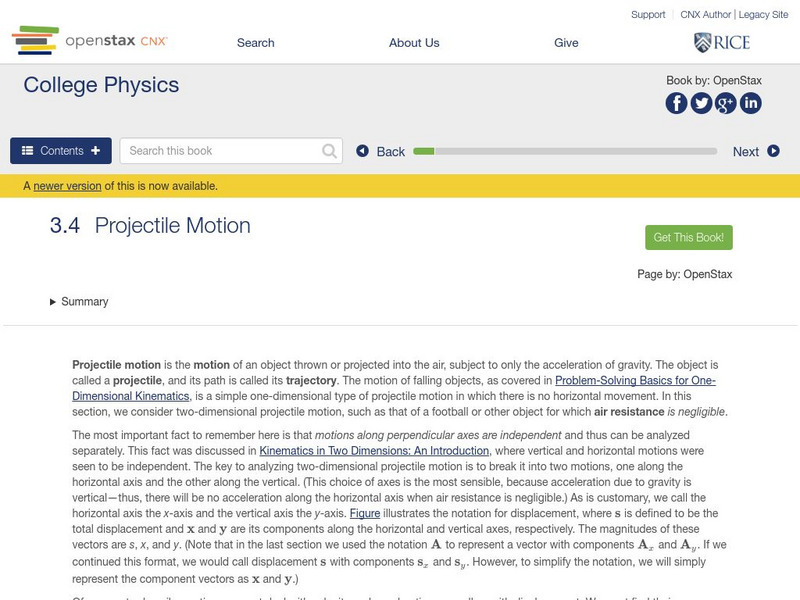
Open Stax: Projectile Motion
The following interactive helps students understan how to identify and xplain the properties of a projectile, such as acceleration due to gravity, range, maximum height, and trajectory. They will determine the location and velocity of a...

Georgia Department of Education
Ga Virtual Learning: Linear Motion
A learning module where students gain an understanding of the relationships between the different kinds of motion. Students will be able to explain free-fall motion and use kinematics equations to calculate problems involving falling...