Hi, what do you want to do?





University of Colorado
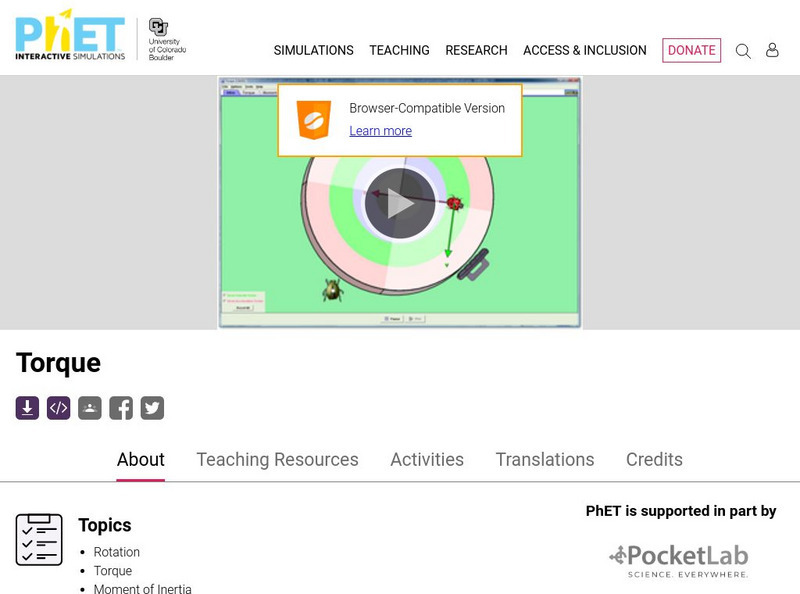
University of Colorado: Ph Et Interactive Simulations: Torque
Experiment how torque causes an object to rotate. This interactive simulation shows how angular acceleration, moment of inertia, angular momentum, and torque relate to one another.
University of Colorado
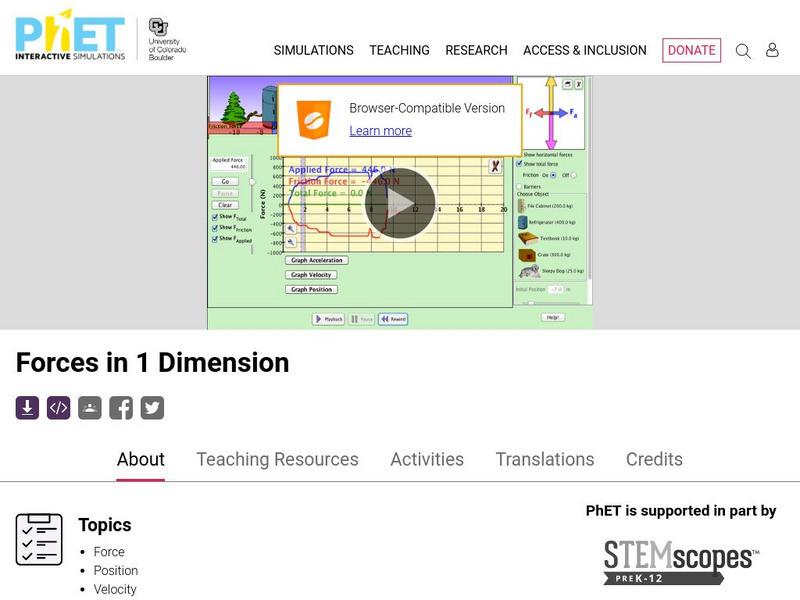
University of Colorado: Ph Et Interactive Simulations: Forces in One Dimension
Use this simulation to see the results of applying a force to move an object. Analyze forces and friction using graphs.
CK-12 Foundation
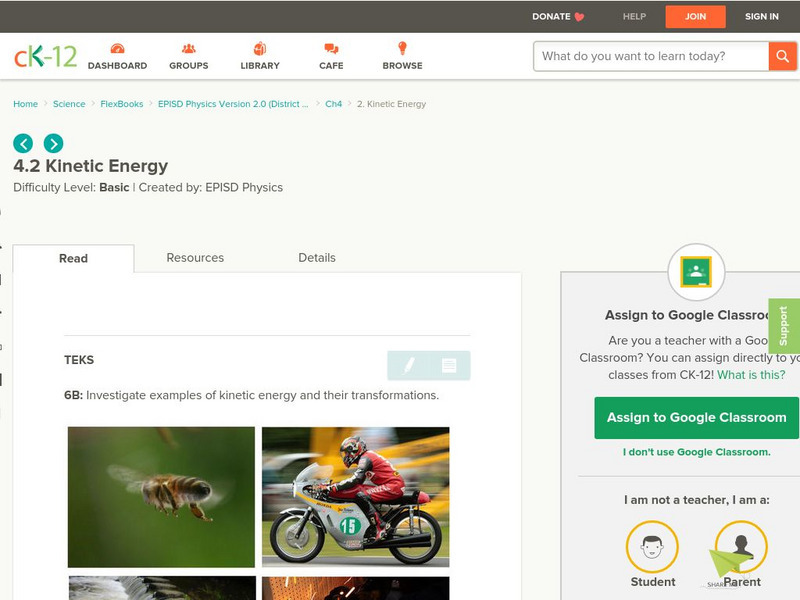
Ck 12: Kinetic Energy
[Free Registration/Login may be required to access all resource tools.] In this online lesson students will begin to investigate examples of kinetic energy and their transformations.
Texas Education Agency
Texas Gateway: Changes in Motion
Given diagrams or scenarios, students will measure and graph changes in motion.
TeachEngineering
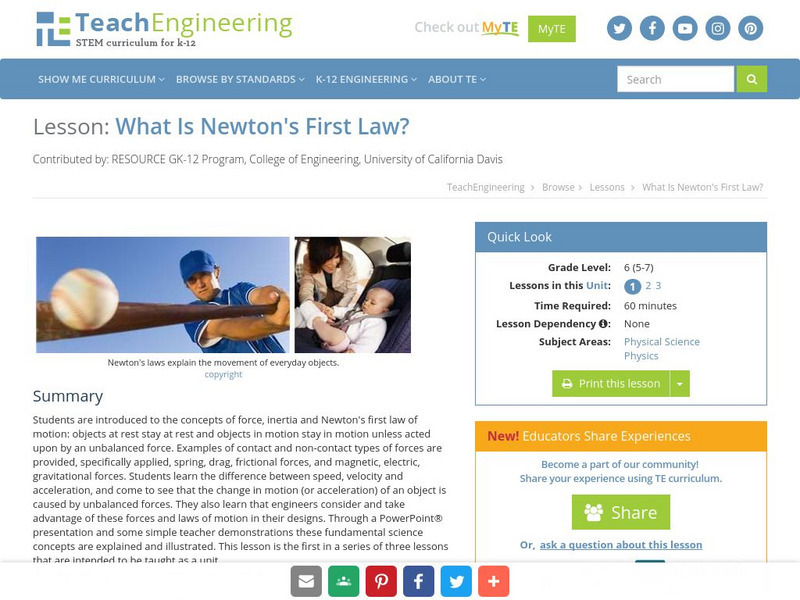
Teach Engineering: What Is Newton's First Law?
Students are introduced to the concepts of force, inertia, and Newton's first law of motion: objects at rest stay at rest and objects in motion stay in motion unless acted upon by an unbalanced force.This instructional activity is the...

Cosmo Learning
Cosmo Learning: Mechanics of Solids
A collection of video lectures from a course introducing students to the mechanics of solids. Webpage includes forty-one lectures from a professor at the National Programme on Technology Enhanced Learning. Lectures vary in length and...
MadSci Network
The Mad Scientist Network: Bouncing Rubber Ball
A question and answer format is used to relate elastic potential energy to the bounce of a rubber ball. Explanation of this simple phenomenon is thorough, complete, and free of trite statements.
Physics Classroom
The Physics Classroom: 1 Dimensional Kinematics
An activity in which average speed is calculated for a ball sliding along an inclined plane. This speed is compared to various instantaneous speeds along the incline.
Stanford University
Stanford University: Conventionality of Simultaneity
This site from Stanford University is on the topic of simultaneity in relativity.
TeachEngineering
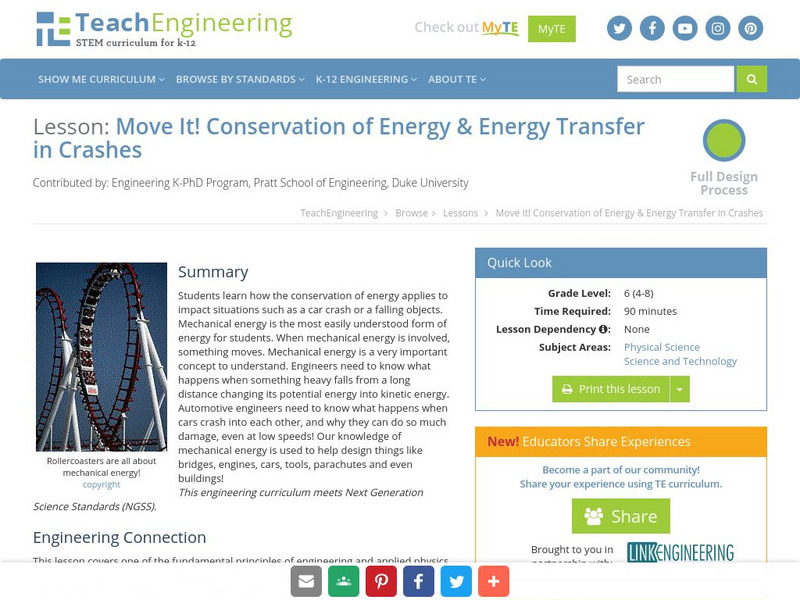
Teach Engineering: Move It!
Mechanical energy is the most easily understood form of energy for students. When there is mechanical energy involved, something moves. Mechanical energy is a very important concept to understand. Engineers need to know what happens when...
Science and Mathematics Initiative for Learning Enhancement (SMILE)
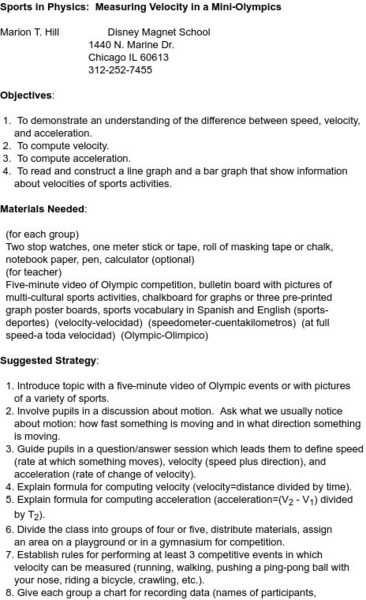
Smile: Sports in Physics: Measuring Velocity in a Mini Olympic
The Illinois Institute of Technology provides this site on Physics. It is a student lab investigation in which students compare the concept and quantity of velocity to that of acceleration. Includes directions, ideas for assessment, a...
Soft Schools
Soft Schools: Physics Quizzes: Newton's Three Laws
Assess your understanding of Newton's three laws of motion and the ability to distinguish between the three with this interactive multiple choice quiz. Receive immediate feedback to your answers.
Wikimedia
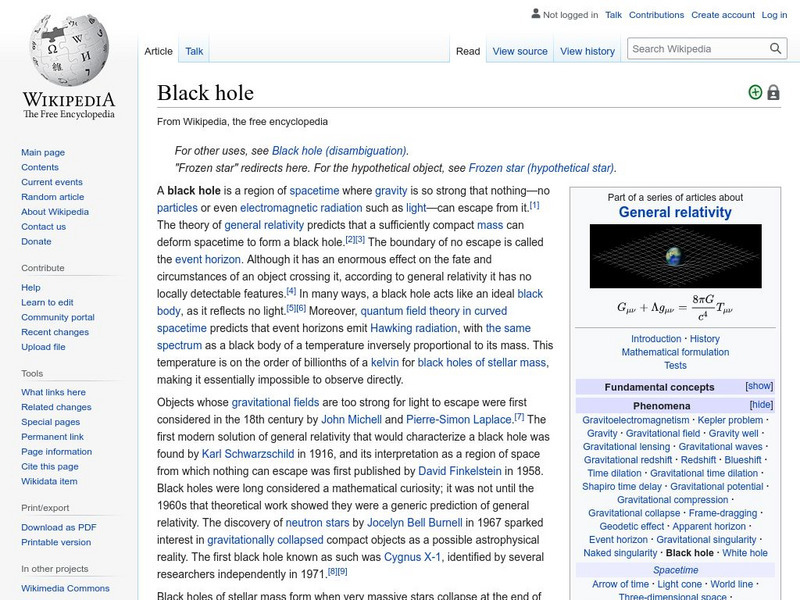
Wikipedia: The Black Hole
This site examines the black hole as an object in astrophysics. Delve into this comprehensive resource that covers this concept from its history, to qualitative physics, the reality of black holes, mathematical physics and more.
Science Education Resource Center at Carleton College
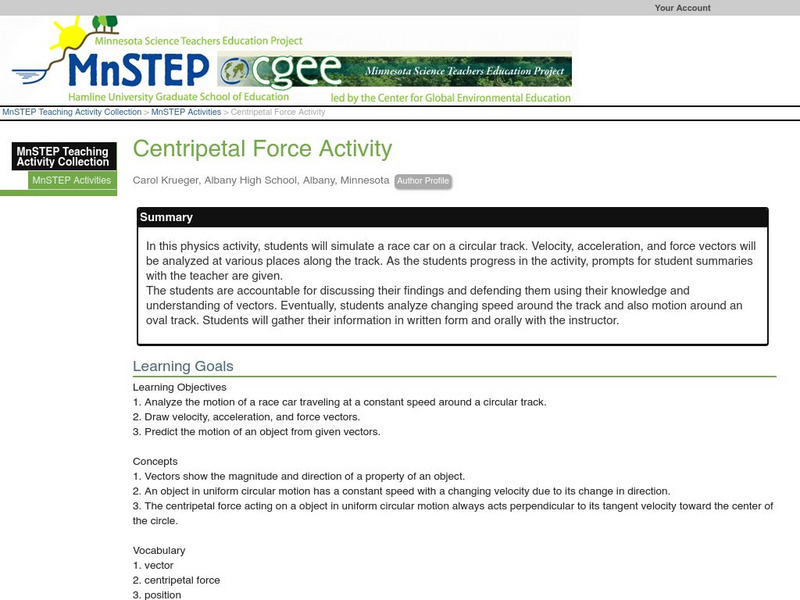
Serc: Centripetal Force Activity
For this physics activity, students will simulate a race car on a circular track. Velocity, acceleration, and force vectors will be analyzed at various places along the track. As the students progress in the activity, prompts for student...
Physics Classroom
The Physics Classroom: Mathematics of Satellite Motion
The mathematics associated with the motion of satellites is described. Equations (for period, velocity, acceleration and force) are stated, symbols described, and sample problems solved. Includes five practice problems with solutions and...
Physics Aviary
Physics Aviary: Newton's Law Lab
This lab was designed to have students investigate the factors that affect the acceleration of an object on a frictionless horizontal surface. The simulation will give the students a position vs. time graph and a velocity vs. time graph....

Alabama Learning Exchange
Alex: Motion in One Dimension
This hands-on exercise allows learners to view and calculate the various factors involved in one-dimensional motion. Students will use remote control vehicles to illustrate the linear motion. Learners will use the information gathered...
Curated OER
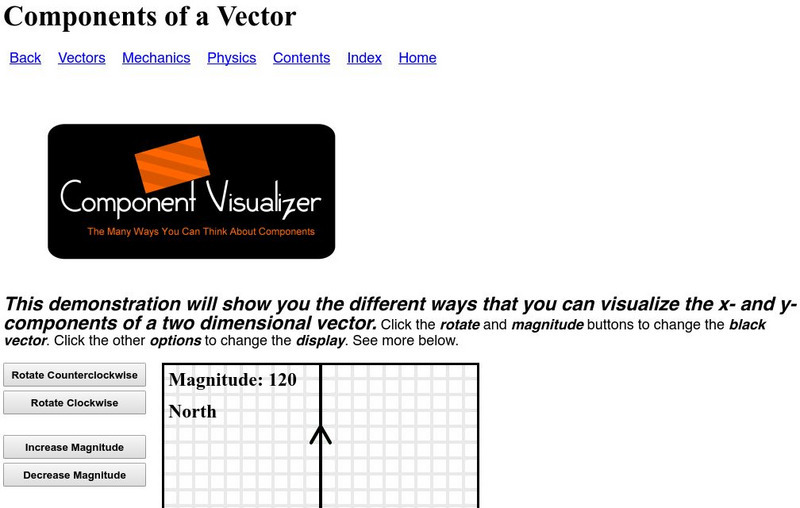
Zona Land: Components of a Vector
An interactive Java applet where users can rotate a vector about its tail and view the components of that vector. Magnitude of the components is updated on screen as the vector is dragged.
Ministry of Education and Universities of the Region of Murcia (Spain)
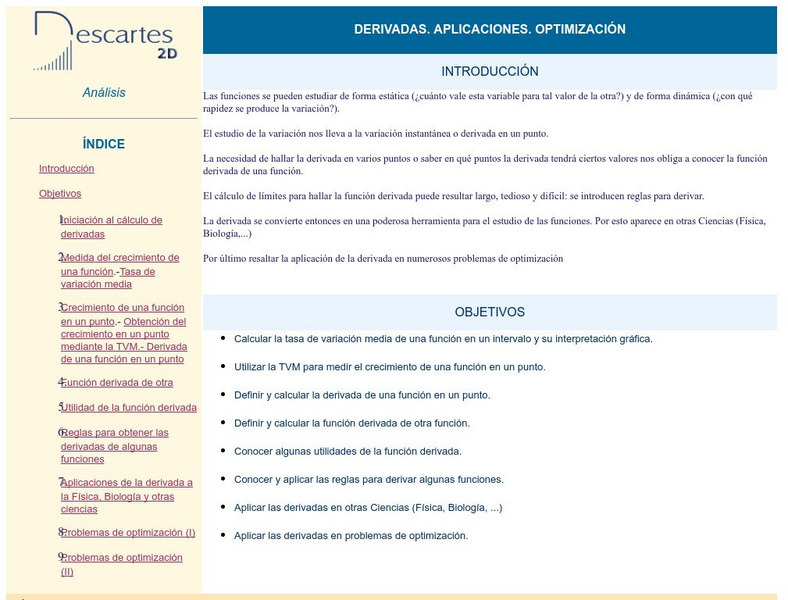
Ministerio De Educacion Y Ciencia: Derivadas. Aplicaciones. Optimizacion.
In Spanish. This interactive unit is intended to show you how to calculate the derivative of a function and the application of the derivative in other sciences.
Educaplus (Jesús Peñas Cano)
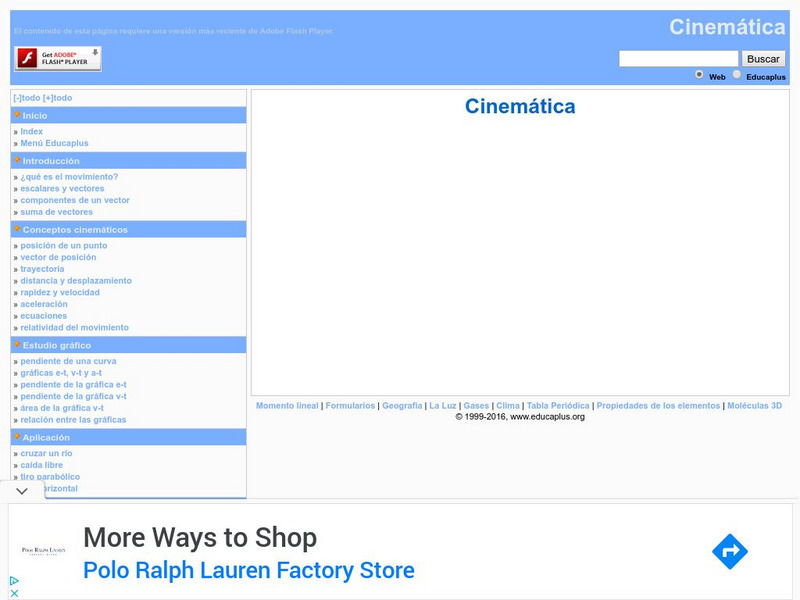
Educaplus: Estudio De Los Movimientos
This site shows a cinematic study of rectilinear movements which requires the use of equations and graphs. Every day life applications are also shown.
Texas Education Agency
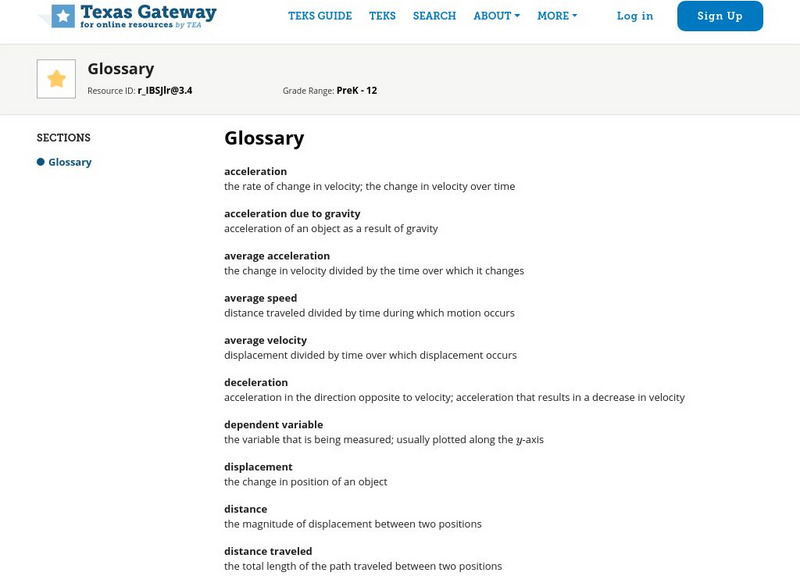
Texas Gateway: Ap Physics: Glossary for Kinematics
This is a glossary of terms and definitions used in AP Physics: Chapter 2: Kinematics.
Ministry of Education and Universities of the Region of Murcia (Spain)
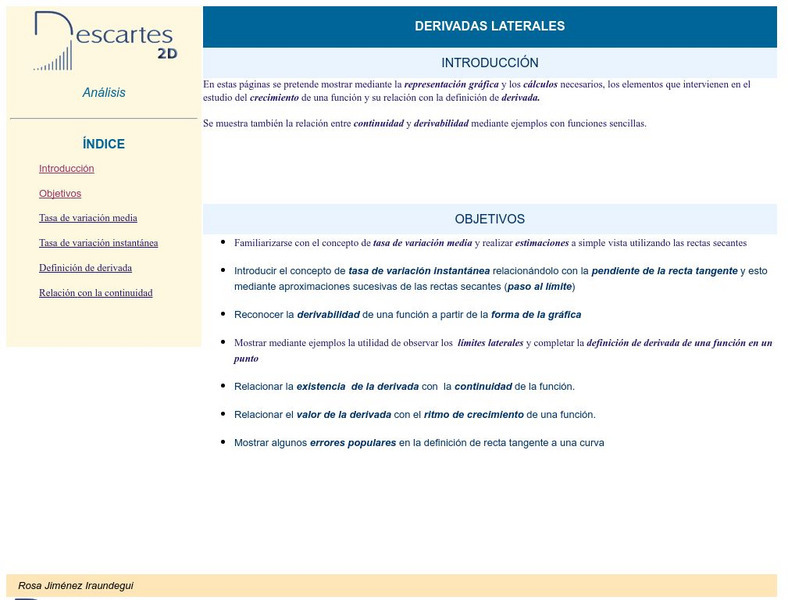
Ministerio De Educacion Y Ciencia: Derivadas Laterales
This interactive unit is intended to show by graphing and calculations, the elements involved in the study of the growth of a functions and its relation to the definition of derivative.
Other
Uc Riverside: Usenet Relativity Faq
A physics usenet listing of frequently asked questions relating to relativity, answered by a number of scientists. Administrivia and Reference, Speed of Light, Special Relativity, General Relativity and Cosmology, Black Holes. Loads of...
Other
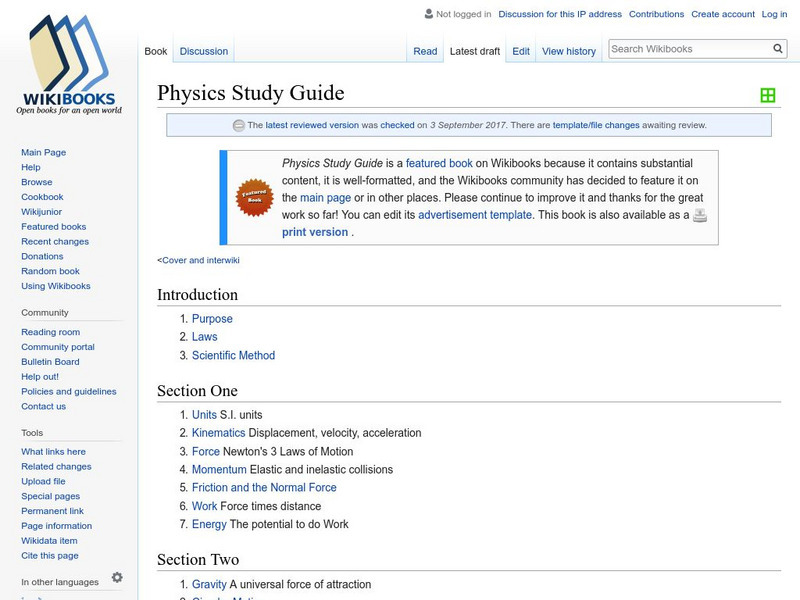
Wikibooks: Physics Study Guide
A handy resource that gives an overview of equations and definitions pertinent to an introductory, college-level physics course, with two of its three sections focusing on motion-related topics and principles.