Hi, what do you want to do?






Curated OER
American Revolution and Constitution Take-Home Assessment
In this early American history activity, students draw diagrams of that feature the responsibilities of each of the 3 branches of the federal government and then create their own original visuals that highlight the formation of American...

Curated OER
Transcription of Lord Dunmore’s Proclamation
In this primary source analysis worksheet, students read Lord Dunmore's Proclamation and discuss its historical significance.

Curated OER
The Mayflower Compact
Eighth graders investigate historical documents of the United States by reading the Mayflower Compact. In this U.S. History instructional activity, 8th graders analyze the wording of the original Mayflower Compact of the first U.S....

Southern Nevada Regional Professional Development Program
Common Core Reading Standards: Understanding Argument
What does your class know about logical fallacies? They can find out quite a bit and practice identifying logical fallacies if you follow the steps and use the resources provided here! After reviewing ethos, pathos, and logos, ask small...

Curated OER
The Origins of American Government
Learners create an advertising campaign to persuade the Founding Fathers to adopt a particular political philosophy. Working in groups, they conduct research about a certain political philosophy. Students create a pitch to be made to...

Curated OER
American Revolution and Constitution Take Home Assessment
In this early American history worksheet, students create posters that feature the branches of government as established by the U.S. Constitution. Students also research founding ideals of the nation and use Venn diagrams to compare and...

Curated OER
Presidents and the Constitution: Washington, Adams, Jefferson, Madison and the Barbary Pirates
Students explore the Barbary Pirates of the Mediterranean. In this American history lesson, students read a narrative regarding the conflict between the Barbary Pirates and the United States under the leadership of Washington, Adams,...

Curated OER
Jefferson vs. Franklin: Renaissance Men
Students list a variety of interests and achievements of Franklin and Jefferson. They take a position that one or the other's interests and achievements were more wide-ranging or that they were equivalent. They write out their findings.

Curated OER
Our Compromise, Our Constitution
Sixth graders explore, analyze and study our constitutional government and become aware of the purpose of our government. They assess the basic rights that are protected by the United States Constitution through graphic organizers and...

Curated OER
Religious Freedom and Persecution throughout the World
Students discuss the role of religion throughout the world. Using documents from the United Nations, they read through Article 18 and describe it in detail. In groups, they identify religions based on how much freedom or persecution is...

Curated OER
Telegram from Senator Joseph McCarthy to President Harry S. Truman
Students research Senator Joseph McCarthy's February 9, 1950 speech, given at Wheeling, West Virginia, in which he claimed more than 200 State Department employees were members of the Communist Party.

Curated OER
What is the (No) Establishment Clause?
High schoolers research and discuss the Establishment Clause.

Curated OER
Thomas Jefferson
In this American history comprehension activity, 6th graders read a selection on Thomas Jefferson and answer 16 short answer comprehension question.
University of Groningen
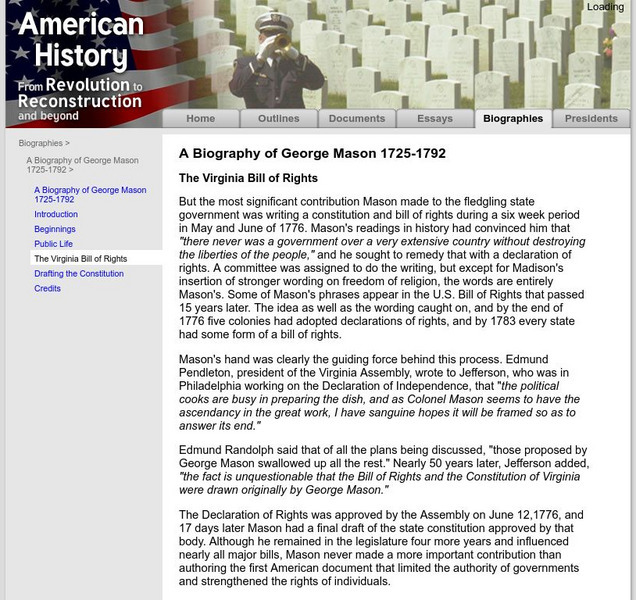
American History: Biographies: George Mason the Virginia Bill of Rights
The Virginia Bill of Rights was the framework for the U.S. Constitution's Bill of Rights. Some of Mason's actual phrasing appear in the first ten amendments passed fifteen years later. He is credited for authoring the first American...

Bill of Rights Institute
The Bill of Rights Institute: The Bill of Rights
The first 10 amendments to the Constitution make up the Bill of Rights. Written by James Madison in response to calls from several states for greater constitutional protection for individual liberties, the Bill of Rights lists specific...
Bill of Rights Institute
Bill of Rights Institute: George Mason
George Mason's ideas helped to shape the Founding documents of the United States, but few Americans remember him today. The words he used when writing the Virginia Declaration of Rights and the Virginia Constitution of 1776 inspired the...
State Library of North Carolina
N Cpedia: Declaration of Rights
The first North Carolina Declaration of Rights, modeled in part on comparable declarations in Virginia, Maryland, and Pennsylvania, was adopted on behalf of the state by the Fifth Provincial Congress on 17 Dec. 1776.
Virginia History Series
Virginia History Series: Virginia Becomes a State [Pdf]
Virginia played a pivotal role in the Revolutionary War and the creation of our new government. This slideshow uses pictures, graphs, and a detailed timeline showing the major events in Virginia from 1760-1800.
Bill of Rights Institute
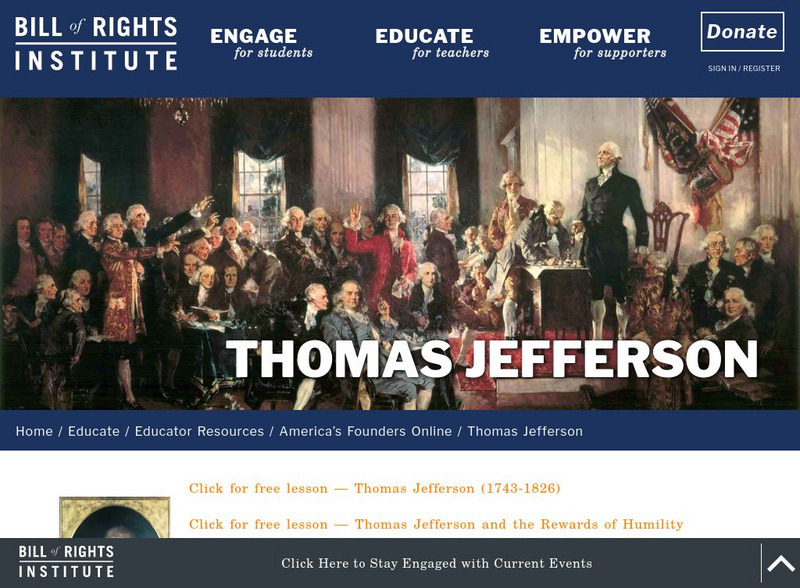
Bill of Rights Institute: Thomas Jefferson
Thomas Jefferson hoped that he would be remembered for three accomplishments: his founding of the University of Virginia, his crafting of the Virginia Statute for Religious Freedom, and his authorship of the Declaration of Independence....
Bill of Rights Institute
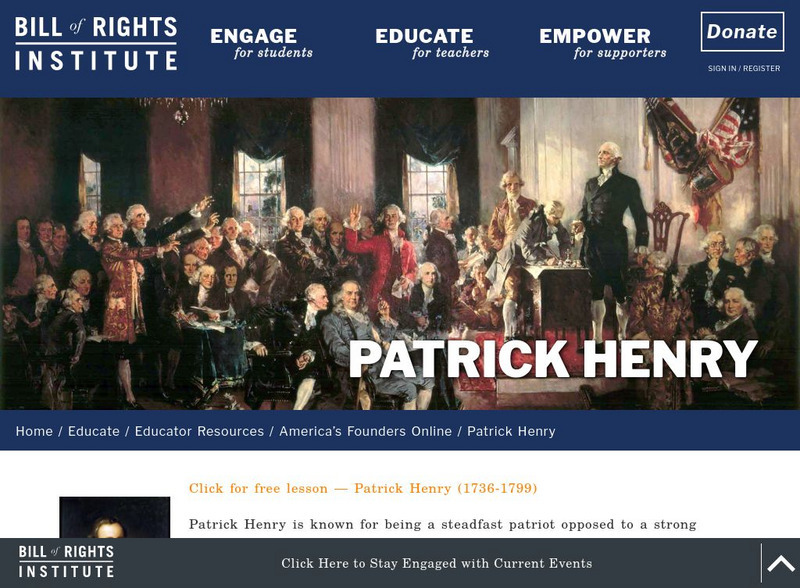
Bill of Rights Institute: Patrick Henry
Patrick Henry is known for being a steadfast patriot opposed to a strong centralized government. In 1765, Henry was elected to the Virginia House of Burgesses. By the 1770s, Henry had emerged as one of the most radical leaders of the...
US National Archives
Nara: Charters of Freedom: Constitution of the United States
Comprehensive overview of the U.S. Constitution. Places the Constitution in context with two other founding charters of American democracy and government, the Declaration of Independence and the Bill of Rights. Includes access to digital...
Bill of Rights Institute
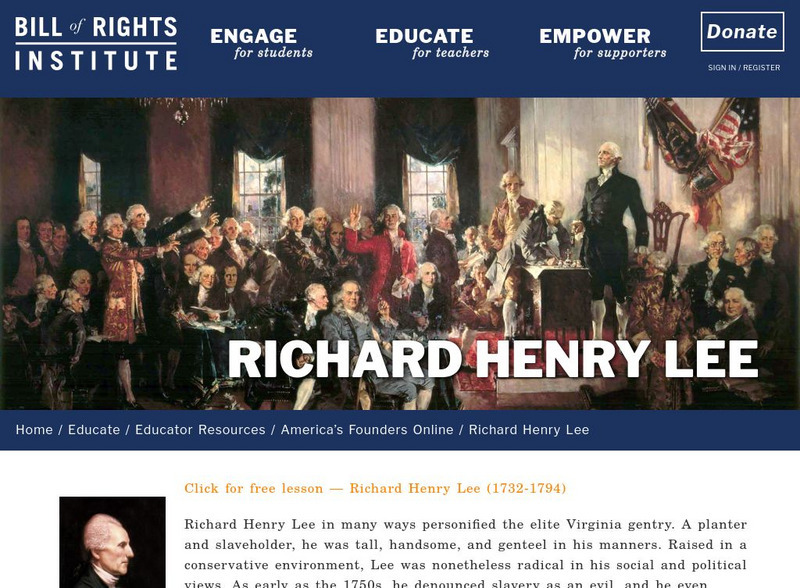
Bill of Rights Institute: Richard Henry Lee
Richard Henry Lee in many ways personified the elite Virginia gentry. A planter and slaveholder, he was tall, handsome, and genteel in his manners. Raised in a conservative environment, Lee was nonetheless radical in his social and...
University of Groningen
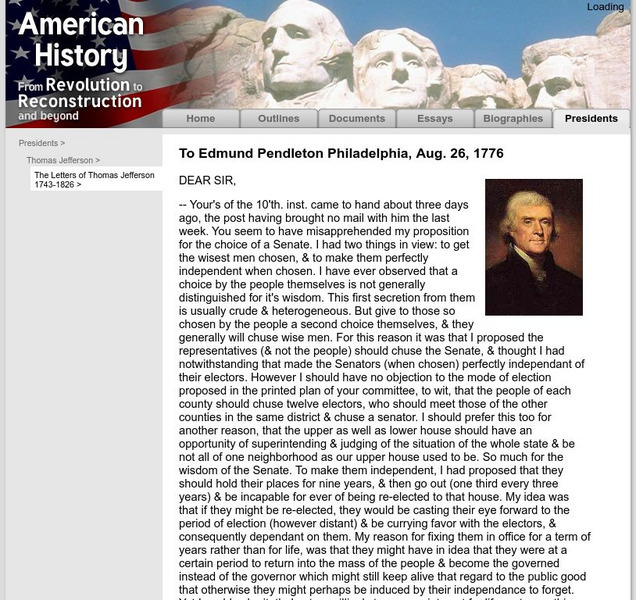
American History: Presidents: Letters of Thomas Jefferson to Edmund Pendleton
In this letter, which he wrote shortly after the Declaration of Independence, Jefferson describes to Edmund Pendleton how to set up the Virginia Legislature.
Colonial Williamsburg Foundation
Colonial Williamsburg: Politics in Colonial Virginia
This site explores the politics involved in Colonial Williamsburg, leading up to the American Revolution. Content focuses on famous speeches, documents, and influential people.