Hi, what do you want to do?





Math Planet
Math Planet: Surface Area and Volume of Pyramids, Prisms, Cylinders, and Cones
Explanation of surface area and the volume of pyramids, prisms, cylinders, and cones through examples and a video lesson. [1:44]

National Council of Teachers of Mathematics
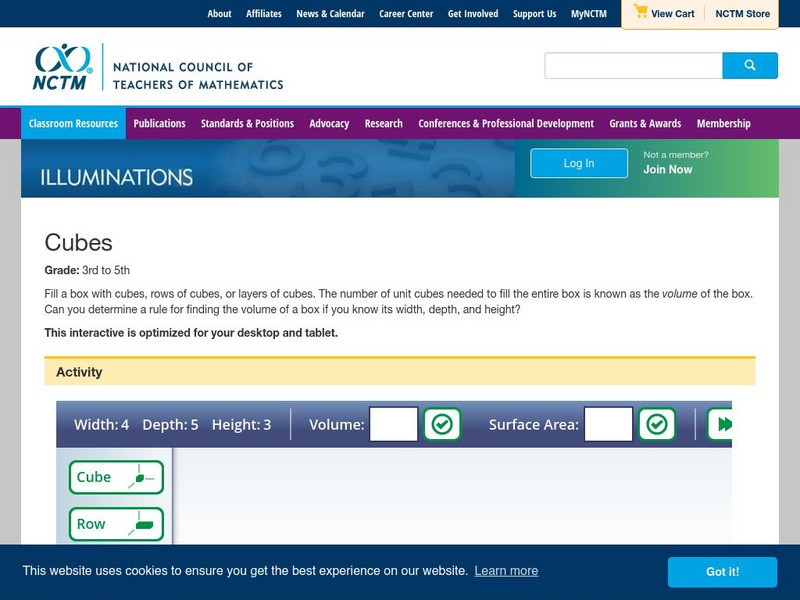
Nctm: Illuminations: Volume of a Cube
"The volume of a cube can be developed by considering unit cubes, a single row (longs) of unit cubes or a single layer (flats) of cubes using this applet." This easy software makes it possible to easily construct a cube and take it...
Government of Alberta
Learn Alberta: Math Interactives: Exploring Surface Area, Volume, and Nets
Investigate the concepts of area, volume, 3D shapes, and nets using this interactive Learn Alberta math. The solid shapes focused on this exploration include rectangular and triangular prisms, rectangular and triangular pyramids,...
Calculator Soup
Calculator Soup: Volume Calculator
Use this online calculator to calculate the volume of geometric solids including a capsule, cone, frustum, cube, cylinder, hemisphere, pyramid, rectangular prism, sphere, and spherical cap.
National Council of Teachers of Mathematics
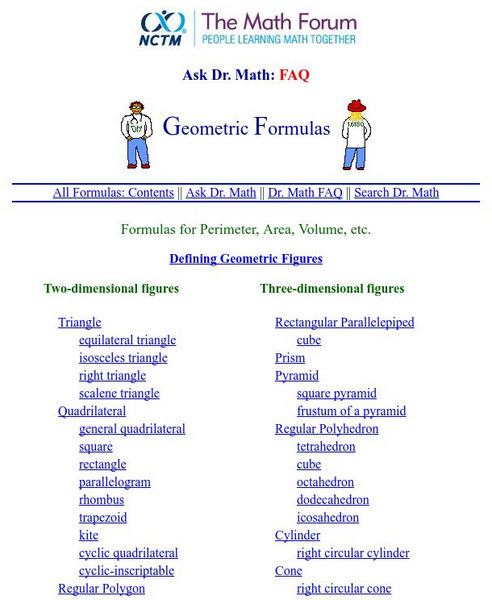
The Math Forum: Ask Dr. Math: Faq, Geometric Figures
This page brings you to a table of contents of three-dimensional figures. Selecting a figure will bring you to a page defining and illustrating the figure with applicable formulas listed.
Texas Instruments
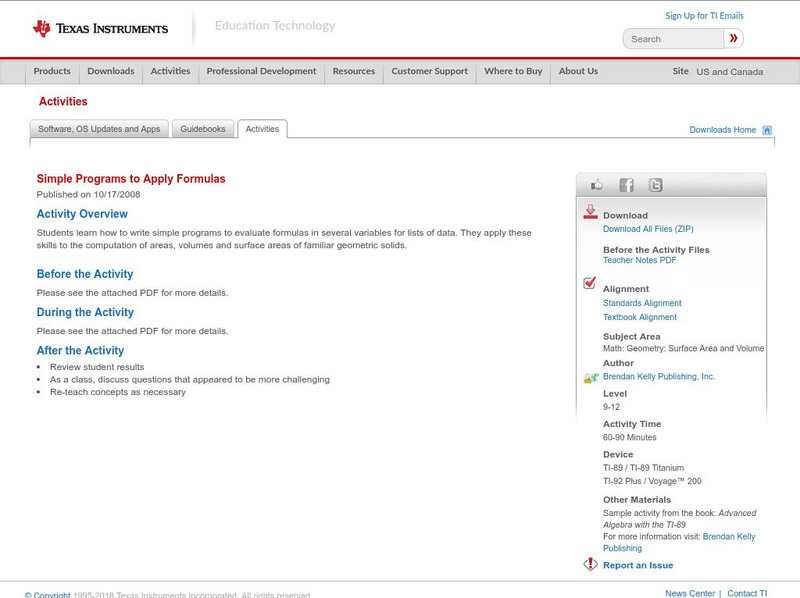
Texas Instruments: Simple Programs to Apply Formulas
Students learn how to write simple programs to evaluate formulas in several variables for lists of data. They apply these skills to the computation of areas, volumes and surface areas of familiar geometric solids.
Illustrative Mathematics
Illustrative Mathematics: G Gmd, G Mg Tennis Balls in a Can
In this task, students investigate the volume of tennis balls and their cylindrical container, the empty space around the balls, different ways of slicing them, and what their visualizations will look like. Aligns with G-GMD.B.4 and...

National Council of Teachers of Mathematics
The Math Forum: The Cylinder Problem: High School Lesson
Using an engaging approach, this lesson plan requires young scholars to record the volume of cylinders as a function of the radius. Students will construct and measure the volume of several cylinders and then begin comparing these shapes.

National Council of Teachers of Mathematics
The Math Forum: Building a Pyramid
This Math Forum instructional activity gives instructions on how to build a paper pyramid. Bonuses included finding the surface area and volume of the pyramid.

Texas A&M University
Wtamu Virtual Math Lab: Beginning Algebra: Formulas
This tutorial will show you how using formulas can help you solve problems. Include formulas for various geometric shapes and steps showing how to use them.
Sophia Learning
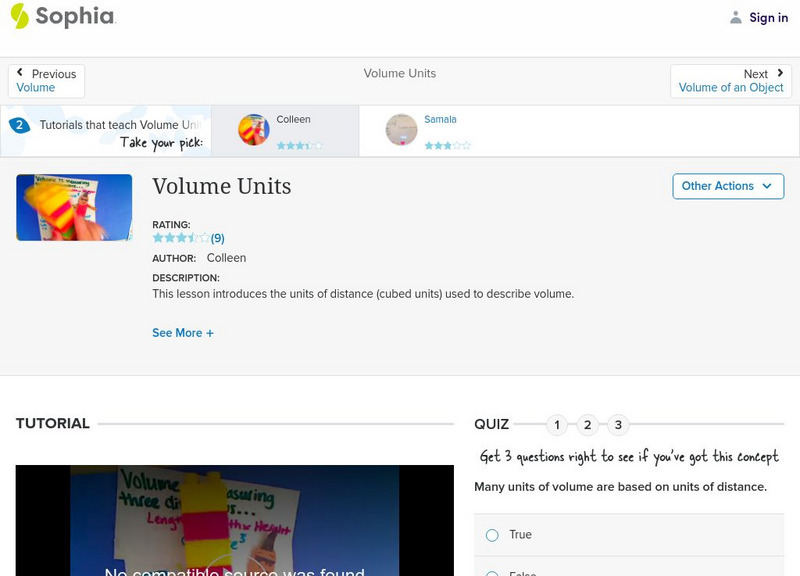
Sophia: Volume Units
This lesson introduces the units of distance (cubed units) used to describe volume. Students watch a video tutorial and then can take an online quiz.
PBS
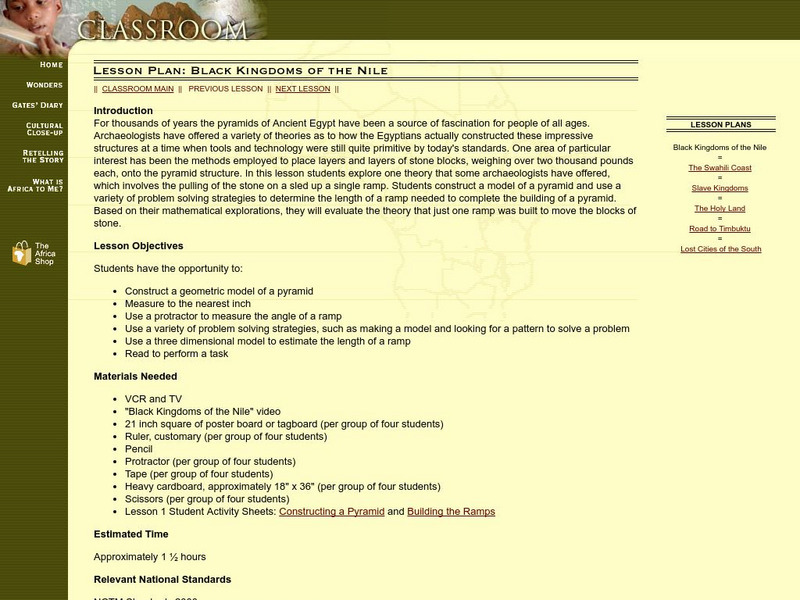
Pbs: Black Kingdoms of the Nile
A geometry instructional activity that examines the history and structure of ancient pyramids and engages students in constructing pyramid models. A comprehensive instructional activity that considers students with diverse learning...
National Council of Teachers of Mathematics
The Math Forum: The Cylinder Problem: Middle School Lesson
This lesson offers an interesting, hands-on experience for middle school students studying cylinders. Students will create cylinders, and measure and compare their volumes.
University of Cambridge
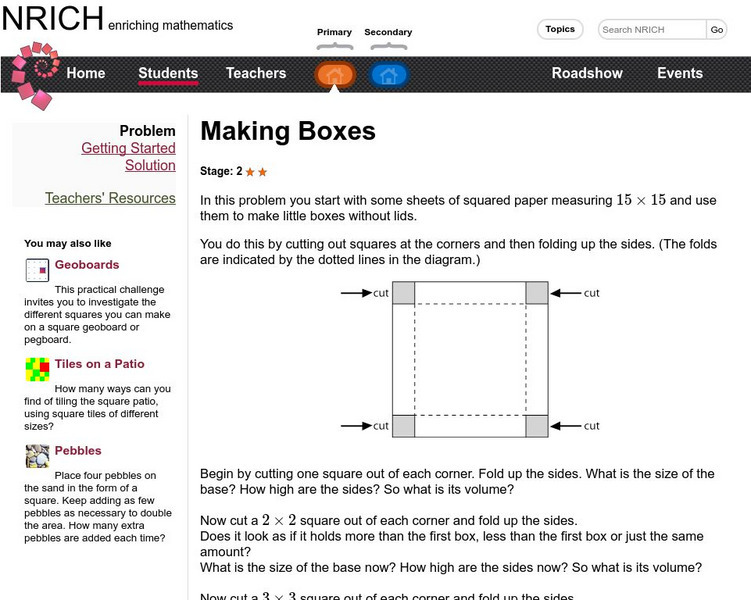
University of Cambridge: Nrich: Making Boxes
Have fun and learn by making a box and then find out its maximum volume as well as other problem-solving activities, including making a table of your results and drawing a graph.
Other
University of Edinburgh: Glossary of Introductory Computer Graphics Terms
This website, from the University of Edinburgh, provides a lengthy glossary of computer graphics terms written by Olin Lathrop, author of "The Way Computer Graphics Work". This site provides simple definitions of basic terms; no graphics...

ClassFlow
Class Flow: Solids
[Free Registration/Login Required] In this flip chart, students apply geometric sense by using the properties of two-dimensional and three-dimensional shapes to solve mathematical problems involving area and volume.