Hi, what do you want to do?






Curated OER
Are You a Trend Setter?
Students are introduced to the periodic table of elements. They devise and perform and experiment in which they determine the density of specific elements. They use their results to predict the density of other elements in the same group.

Curated OER
Viscosity and Density
In this viscosity and density pre-lab instructional activity, students define these two terms and determine how to find relative viscosity and the volume of an irregular shaped solid. This instructional activity has 13 short answer...

Curated OER
Unit Perimeters and Areas
Students use Geometers SketchPad to find the area and perimeter of several shapes. For this geometry lesson, students determine area of rectangles and progress through irregular polygons. None of the referenced worksheets are included...

Curated OER
Perimeter
Young scholars use their hands, feet, computer, and rulers to measure the perimeter of objects. For this measurement lesson plan, students measure objects around the room and computer generated shapes.

Curated OER
Density and Buoyancy Lesson Plan
Learners investigate why some objects float or sink in water. For this physics lesson, students calculate the density of clay ball using a mathematical equation. They write a complete lab report about the experiment.

Curated OER
The Estimation Station
Students challenge "common knowledge" against newly learned estimation strategies and put those strategies into use. They consider variables in estimating different groups of objects and practice skills of representing numbers.

Curated OER
Introduction to Estimation and Making Arrays
Students explore the concept of estimating and organizing a group of objects into an array to count the exact number of items. They create their own arrays and practice elements of estimation.

Curated OER
Using Density to Identify Wood Types
Students identify different woods based on their density. In this density lesson, students use a triple beam balance to find the mass and a metric ruler for the volume. They look through various wood blocks and identify what type of wood...

Curated OER
Floaters and Sinkers
Fifth graders define density as the amount of mass per volume a material contains, compare the densities of several types of materials, especially those that sink in water compared to those that float. They use two different methods to...

Curated OER
CO2 Blow Out!
Fifth graders determine that carbon dioxide is a gas given off during respiration and that oxygent is the gas that is absorbed during respiration. They determine the air capacity of the lungs.

Curated OER
Geometry Scavenger Hunt
Students use the digital camera, identify geometric shapes (in nature as well as man-made), and gain a better understanding of geometric vocabulary. They search for and recognize geometric shapes in unusual settings

Curated OER
Area Lesson Plan
Students manipulate a variety of materials and computer applets in order to explore area and the units used to measure it.

Curated OER
Estimation
Students complete computer activities about estimating if items are more or less than a given amount. In this estimation lesson plan, students also estimate measurements around the classroom.
Science Education Resource Center at Carleton College
Serc: Irregular Shaped Object Lab Test
Students will determine what an unknown substance is by finding mass, volume, displacement, and density of an object. Students will also create a report which will require them to read a graph, interpret data, calculate averages, and...

PBS
Pbs: Calculating Volume: Tunnel Construction
Investigate some of the mathematical challenges Boston engineers had to deal with during the Central Artery Tunnel Project (the "Big Dig"). This video focuses on the irregular shape of the casting basin and the volume calculations...
TeachEngineering
Teach Engineering: Determining Densities
Students will use two different methods to determine the densities of a variety of materials and objects. The first method involves direct measurement of the volumes of objects that have simple geometric shapes, while the second uses the...
TeachEngineering
Teach Engineering: Floaters and Sinkers
Through this curricular unit, students are introduced to the important concept of density. The focus is on the more easily understood densities of solids, but students may also explore the densities of liquids and gases. Students devise...
TeachEngineering
Teach Engineering: Floaters and Sinkers
This instructional activity introduces students to the important concept of density. The focus is on the more easily understood densities of solids, but students can also explore the densities of liquids and gases. Students devise...
Illustrative Mathematics
Illustrative Mathematics: G Mg How Many Leaves on a Tree? (Version 2)
In this task, students must estimate the number of leaves on a large tree, taking into account various complex factors such as the area shaded by the tree, the area of irregularly shaped leaves, the uneven distribution of leaves, the...
Cuemath
Cuemath: Prism
Explore the world of prisms in this mini-lesson by learning what are prisms, definitions with shapes and examples, the difference between regular, irregular, right, and oblique prisms, the surface area of a prism, and the volume of a...
TeachEngineering
Teach Engineering: Density Column Lab Part 1
In this first part of a two-part lab activity, students use triple balance beams and graduated cylinders to take measurements and calculate the densities of several common, irregularly shaped objects with the purpose to resolve confusion...
PBS
Pbs Learning Media: Formulas: Targeted Math Instruction
At the end of this lesson plan about formulas, students will be able to identify and apply the correct formula for a given situation, solve for any unknown component of the formulas for perimeter, circumference, and area of regular and...
Other
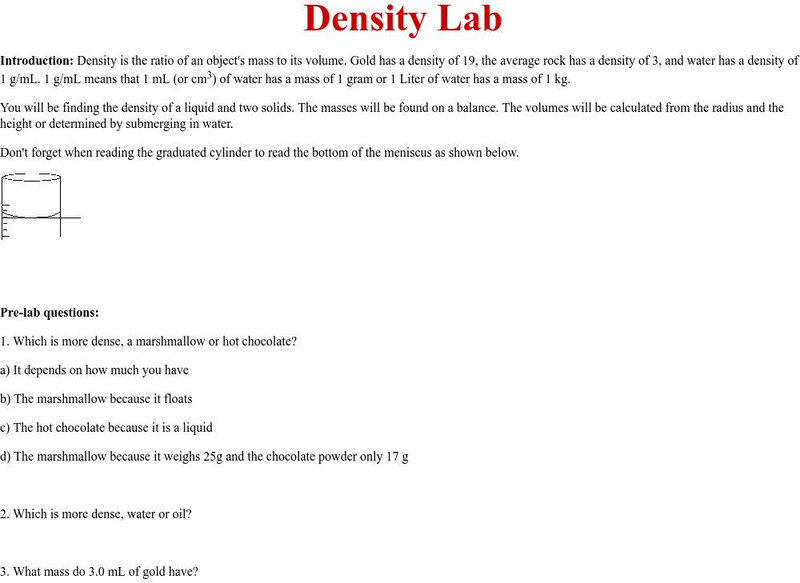
Lapeer County Schools Science Resources: Density Lab
A simple lab experiment for students to find the density of two solids and a liquid (does not use water displacement). Note that number 1d should not state "weighs" since mass is being found.