Hi, what do you want to do?






Professor Dave Explains
Practice Problem: VSEPR Theory and Molecular Geometry
What's with all these shapes? Let's practice assigning hybridization, electron-domain geometry, and molecular geometry. Octahedral! Tetrahedral! Linear! Pyramids and see-saws and what not! Chemistry is fun, isn't it?
Curated Video
VSEPR Theory: Predicting Molecular Shapes with Ease
VSEPR postulates state that the geometry of a molecule depends on the number and arrangement of bonding and lone electron pairs around the central atom
Curated Video
VSEPR Theory: Learn Molecular Geometry Fast - Chemistry Study Guide
Struggling with VSEPR theory and molecular geometry? This video simplifies the concepts you need to master these essential chemistry topics. Learn how to draw Lewis structures with the correct geometry, understand bond angles, and...
Professor Dave Explains
VSEPR Theory and Molecular Geometry
Did you know that geometry was invented by molecules? It's true! Until the first stars went supernova and littered all the elements across the cosmos, everything was simply spheres, from protons to stars. But then, under cooler planetary...
Curated Video
VSEPR Theory Postulates: The Rules Behind Molecular Geometry
The Valence Shell Electron Pair Repulsion (VSEPR) theory predicts molecular shapes by focusing on the repulsion between electron pairs surrounding a central atom. The main postulates include: Electron Pair Repulsion: Electron pairs...
Curated Video
Shaping Molecules: Geometry of AB₄, AB₅, and AB₆ Explained
The geometry of molecules with the general formulas AB₄, AB₅, and AB₆ is determined by the Valence Shell Electron Pair Repulsion (VSEPR) theory, which helps predict molecular shapes based on the repulsion between electron pairs around...
Curated Video
VSEPR Theory - lone electron pair influence
Bond Angle Distortion: Lone pairs reduce bond angles between bonding pairs. For example, in a molecule like NH₃ (ammonia), the ideal tetrahedral angle of 109.5° is compressed to around 107° due to the presence of a lone pair on nitrogen....
Professor Dave Explains
Visualizing Molecular Geometry With 3D Software
We've already learned about VSEPR theory, and how to use it to predict the shapes of various molecules. But we didn't cover all of the molecular geometries for certain hybridizations, and we didn't talk about bond angles, so let's do...
Curated Video
Valency Revealed Group IV Elements' Complex Chemistry
Tetrahedron formation is a crucial aspect of the chemical bonding and molecular geometry of Group 4 elements like carbon, silicon, germanium, tin, and lead. The tetrahedral shape is formed by the arrangement of four substituents around...

JFR Science
VSEPR Theory: Determining the 3D Shape of Molecules
Ready to take molecules out of the two dimensional world and into 3-D? Chemistry scholars explore molecular geometry through a well-written video from the JFR Science series. Topics include the effects of bonding and non-bonding...

Berkeley University of California
Molecular Structure and Geometry
While physics is known for the math connections, chemistry is know for geometric connections. The 11th video in the series discusses how to determine the molecular structure of bonded atoms in a 3-D plane using steric numbers.
Tyler DeWitt, PhD
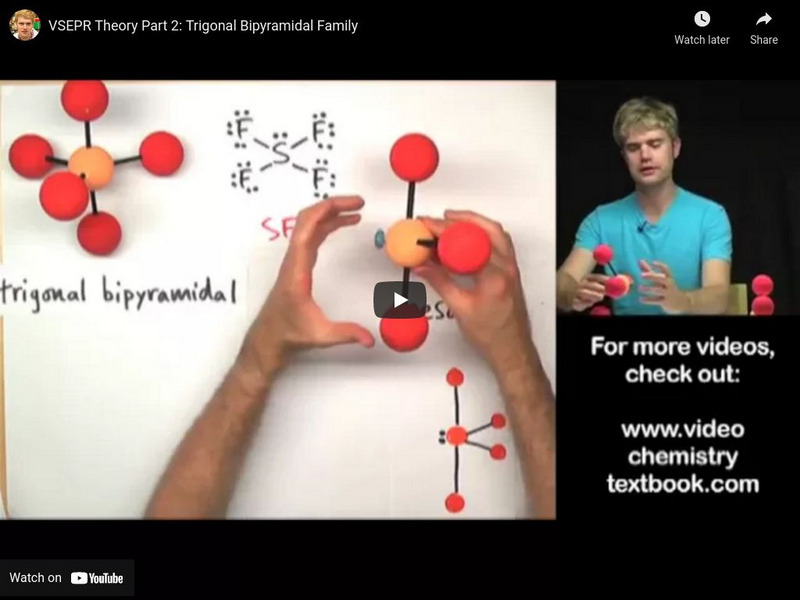
Science With Tyler De Witt: Vsepr Theory Part 2: Trigonal Bipyramidal Family
In this tutorial, take a look at diagrams of the VSEPR shapes, and examine bond angles for each structure. [15:06]
Tyler DeWitt, PhD
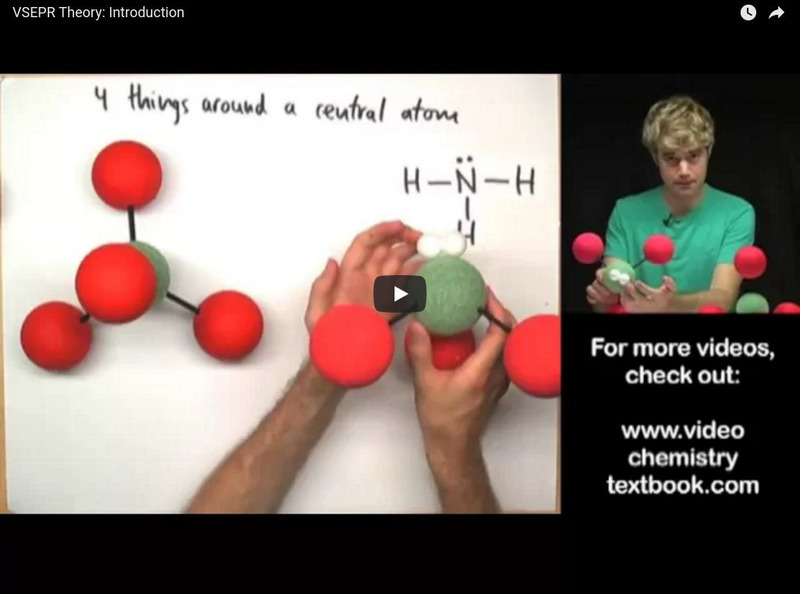
Science With Tyler De Witt: Vsepr Theory: Introduction
This is an introduction to the basics of VSEPR Theory. In this video, learn about the following shapes: linear, trigonal planar, bent, tetrahedral, and trigonal bipyramidal.

Other
Youtube: Vsepr Theory Practice Problems
Learn how to take a Lewis structure and determine what the 3D shape the molecule will be using the VSEPR theory. [14:24]

Sophia Learning
Sophia: Vsepr: Exceptions to the Octet: Lesson 2
This lesson will explain there are molecules that are exceptions to the octet rule and illustrate some common examples with complex shapes. It is 2 of 2 in the series titled "VSEPR: Exceptions to the Octet."

Sophia Learning
Sophia: Vsepr: Exceptions to the Octet: Lesson 1
This lesson will explain there are molecules that are exceptions to the octet rule and illustrate some common examples with complex shapes. It is 1 of 2 in the series titled "VSEPR: Exceptions to the Octet."