Hi, what do you want to do?






Curated OER
Prairies
Students identify the basic characteristics of the prairie ecosystem, and several commonly known prairie species. They create a classroom mural of a prairie ecosystem; and create reports about what they have found out.

Curated OER
Our Changing Environment-- A Demonstration
Students observe and describe changes in an environment when some of the components are changed. They recognize the process of succession by
preparing a miniaturized environment in which a variety of plants and seeds are grown.

Curated OER
Classification of Animals
Third graders practice classiyfying items and identify three major characteristics scientists use to classify animals. They describe the differences between ectothermic and endothermic animals.

Curated OER
Hide & Seek Butterflies
Students examine a variety of butterflies and discuss how they believe they get their color variations. In groups, they brainstorm the advantages and disadvantages of their color schemes. To end the lesson, they watch butterflies in...

Curated OER
Making a Taxonomic Key
Students work as a team of abalone taxonomists who examine and classify abalones based on their shell characteristics of the four most common species. They also study the visible details of each species shell, make notes and eventually...

Curated OER
Grounded for Life
Second graders become familiar with the lives of penguins including their life cycles, habitats and basic needs. Students will experience the lives of penguins through stories and video.

Curated OER
Birds of Wisconsin
First graders explore the job done by ornithologists. They role play identifying the characteristics that make a bird a bird. They discuss what makes each bird species unique. Students are introduced to Wisconsin's most common and rare...

Curated OER
Great River Bend Adventure
Students use their imagination. They discuss the 4 C's of teamwork: Concentration, Communications, Coomperation, and Consideration. Students discuss the safety guidelines of the project. They complete a rope maze. The group walks...

Curated OER
Our Schoolsyard is Full of Biology
Students study the habitats found in their schoolyard. They apply firsthand, what they have learned in the classroom to something familiar to them. Students look at biotic, abiotic habitats. Small groups will present their findings to...

Curated OER
What Trout Need
Students investigate the important components for a healthy trout habitat. In this fish habitat lesson, students discuss how the aquarium will simulate a trout's environment in nature. Students complete a trout information sheet to set...

Curated OER
"Habitats"
Students complete a unit of lessons on animals and animal conservation. They observe a square meter of ground outside the school, set up a model environment, analyze an owl pellet, grow bread mold, and explore various websites.

Curated OER
Eco-Logical: A Coastal Logic Problem
Fourth graders study the characteristics of five coastal communities. They use logic cards and matching activities to identify the proper community for plant and animal species.

Curated OER
Past Time: Vocabulary Practice
In this past time worksheet, learners select the word or phrase from 3 choices that means the same as the word in bold in 12 sentences. All pertain to events in the past.

Curated OER
Vocabulary Practice With Past Time
For this word meanings worksheet, students practice their vocabulary skills while using the past tense. Students complete twelve multiple choice questions where they choose the correct meaning of the bold word in each sentence.

Curated OER
Most Troublesome Exotic Invasive Plant Species Web Quest
Students participate in a Web Quest activity in which they identify common exotic invasive plant species of the Southern Appalachian Region. After identifying the top 10 exotic invasive species, they choose one to research in depth.

Curated OER
Animal Tracks
Students study animals. In this science lesson, students make plaster casts of animals that live in the area. Students identify the tracks.

Nature Canada
Nature Canada: Canada's Boreal Forest
A look at Canada's Boreal Forest ecosystem. One of the largest ecosystems in the world, it provides abundant fresh water for North America and is home to many species of wildlife, for example, wolves and caribou. There is also discussion...
Friends of Algonquin Park
The Science Behind Algonquin's Animals: Spruce Bogs
A Spruce bog is a northern type of habitat and is formed between small bodies of water and forests. Learn about a Spruce bog in Algonquin part and view a panorama movie of the bog.
PBS
Nova: Earth in Peril
A series of nine maps with accompanying explanations. They show how population growth has affected the environment around the world in terms of water availability, climate change, land and forest use, and more. There are both interactive...

Alabama Learning Exchange
Alex: Wildlife Math
This integrated lesson is the result of collaboration between Chip Blanton, a wildlife management teacher, and Greg Pendergrass, a math teacher (Ft. Payne High School). Learning to manage wildlife requires an understanding of planting...
Smithsonian Institution
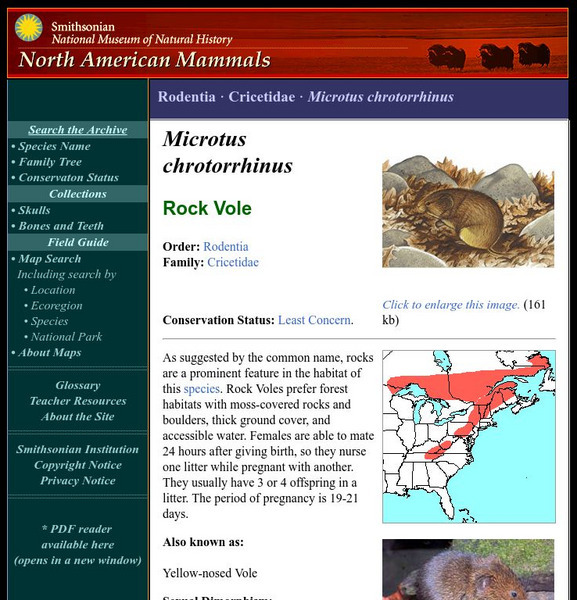
National Museum of Natural History: American Mammals: Rock Vole
As suggested by the common name, rocks are a prominent feature in the habitat of this species. Rock Voles prefer forest habitats with moss-covered rocks and boulders, thick ground cover, and accessible water. Learn more about the...